
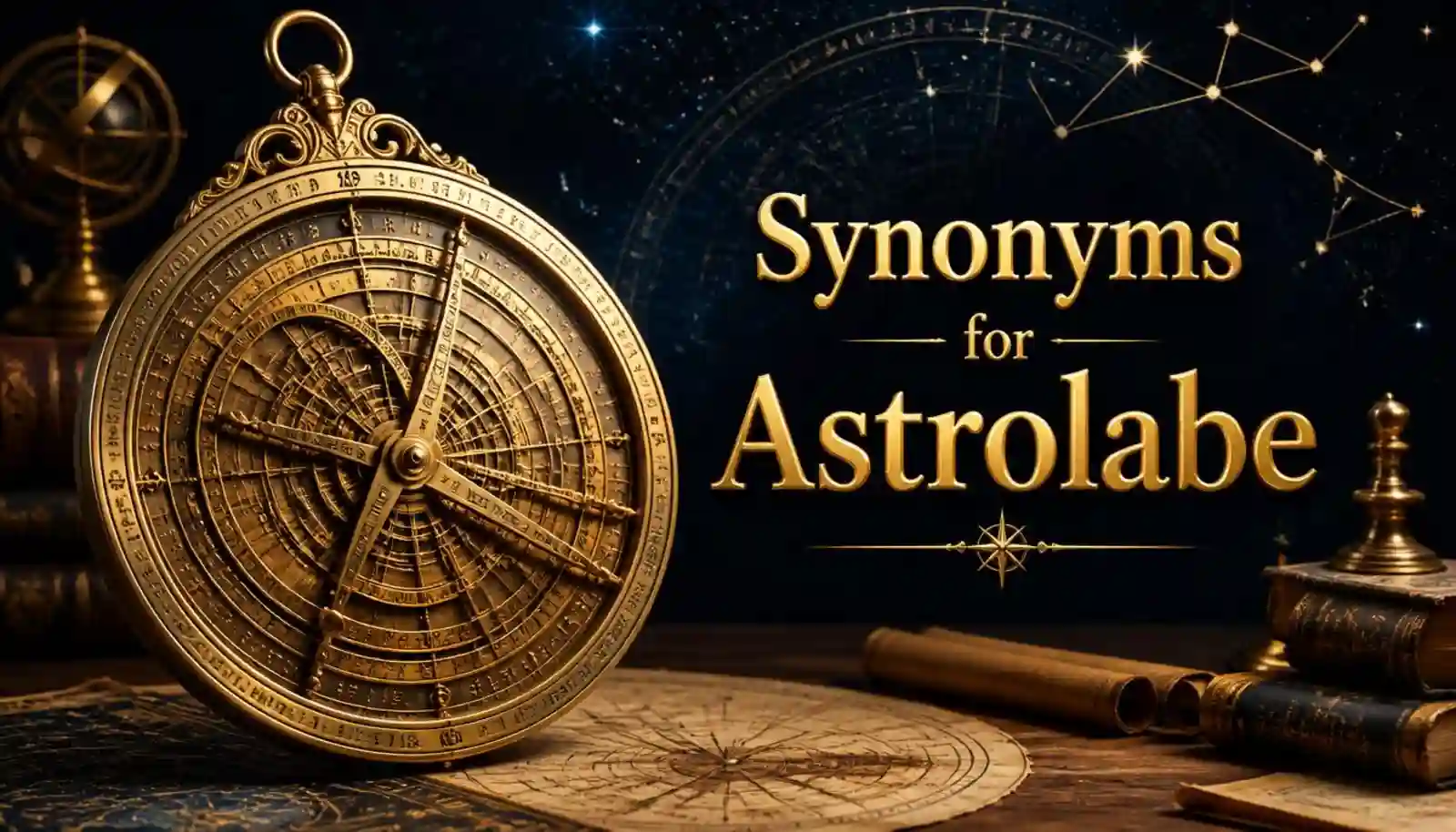
Have you ever seen an old instrument used to study the stars? An astrolabe is a historical tool used to study the sky, measure positions, tell time, and perform astronomical calculations. Because it refers to a specific device, finding true synonyms for astrolabe can be challenging.
Astrolabium is the closest historical alternative, while star finder and astronomical calculator describe functions associated with an astrolabe rather than naming the instrument itself. This guide covers these terms, along with astrolabe types, related instruments, and components.
Quick Answer
The closest historical alternative to astrolabe is astrolabium, a historical form of the same term.
Other expressions, including star finder and astronomical calculator, describe particular functions or uses associated with an astrolabe. They are not exact modern synonyms.
This guide divides the terms into clear groups:
- Historical alternative: astrolabium
- Functional descriptions: star finder, astronomical calculator
- Types of astrolabe: planispheric astrolabe, universal astrolabe, mariner’s astrolabe
- Related instruments: quadrant, sextant, armillary sphere, nocturnal, and others
- Astrolabe components: rete, alidade, mater, tympan
A sextant, quadrant, or armillary sphere may relate to an astrolabe, but none of these words means astrolabe.
Closest Historical Alternative
Astrolabium
Meaning: Astrolabium is a historical form or variant of the word astrolabe.
Examples:
- The manuscript describes an astrolabium used for astronomical calculations.
- The museum collection includes an illustration of an astrolabium.
Astrolabium is the closest historical alternative in this list, but modern writers rarely use it as a replacement for astrolabe. Use it mainly when discussing historical texts, terminology, or forms of the word.
Functional and Descriptive Expressions
Star Finder
Meaning: A star finder is a tool that helps users identify or locate stars.
Examples:
- The sailor used a star finder to identify a bright star.
- The guide showed the students how to use the star finder.
Star finder is a broad functional expression and can describe devices other than astrolabes, so do not treat it as an exact synonym.
Astronomical Calculator
Meaning: An astronomical calculator is a tool or device that performs calculations involving astronomical objects or events.
Examples:
- The astrolabe could function as an early astronomical calculator.
- The historian described the device as an astronomical calculator.
This term describes one function of an astrolabe rather than serving as its standard alternative name.
Types of Astrolabe
Planispheric Astrolabe
Meaning: A planispheric astrolabe is a type of astrolabe that represents the celestial sphere on a flat surface.
Examples:
- The museum displayed a finely engraved planispheric astrolabe.
- A planispheric astrolabe can represent the sky for a particular latitude.
This term identifies a specific type of astrolabe rather than serving as a synonym for every astrolabe.
Universal Astrolabe
Meaning: A universal astrolabe is a type designed to work across different geographic latitudes.
Examples:
- The scholar examined a historical universal astrolabe.
- A universal astrolabe works across different geographic locations.
The term refers to a particular form of astrolabe, so do not use it as a general replacement for astrolabe.
Mariner’s Astrolabe
Meaning: A mariner’s astrolabe is a specialized astrolabe associated with astronomical observations and practical use at sea.
Examples:
- The museum displayed a historic mariner’s astrolabe.
- Sailors could use a mariner’s astrolabe to take astronomical measurements.
This term identifies a specialized form of astrolabe rather than a general synonym.
Read More: Synonyms for Doom: 30 Words with Meaning and Example
Related Historical and Astronomical Instruments
Armillary Sphere
Meaning: An armillary sphere is a historical astronomical model that uses rings to represent celestial circles.
Examples:
- The teacher used an armillary sphere to explain celestial coordinates.
- The museum displayed an elaborate armillary sphere.
An armillary sphere is a related astronomical instrument, not another name for an astrolabe.
Quadrant
Meaning: A quadrant is a measuring instrument based on a quarter-circle that measures angles.
Examples:
- The navigator used a quadrant to measure an angle.
- The museum collection includes an old quadrant.
A quadrant is a different historical instrument that shares some astronomical and measuring applications with an astrolabe.
Sextant
Meaning: A sextant is a navigation instrument that measures the angular distance between celestial objects and the horizon.
Examples:
- The sailor used a sextant to measure the Sun’s altitude.
- The sextant became an important tool for marine navigation.
A sextant is a different navigation instrument that shares some astronomical and navigational purposes with an astrolabe.
Cross-Staff
Meaning: A cross-staff is a historical instrument that measures angles and the altitude of distant objects.
Examples:
- The navigator carried a wooden cross-staff.
- The cross-staff measured the altitude of a star.
The cross-staff belongs to the history of astronomical navigation but is not another name for an astrolabe.
Backstaff
Meaning: A backstaff is a historical navigation instrument that measures the altitude of the Sun without requiring the user to look directly at it.
Examples:
- The sailor used a backstaff during the voyage.
- The backstaff allowed the navigator to measure the Sun’s altitude indirectly.
The backstaff is a related historical navigation instrument, not a synonym for astrolabe.
Nocturnal
Meaning: A nocturnal is a historical instrument that helps users estimate time at night by observing stars.
Examples:
- The historian examined a wooden nocturnal.
- A nocturnal helped sailors estimate the time during the night.
A nocturnal relates to an astrolabe because both could support astronomical timekeeping, but they are different instruments.
Read More: Synonyms for Prohibit: 30 Alternatives, Meanings, and Examples
Torquetum
Meaning: A torquetum is a historical astronomical instrument designed to measure and convert celestial coordinates.
Examples:
- The museum collection includes a historic torquetum.
- The torquetum helped astronomers make detailed measurements.
A torquetum is a related astronomical instrument rather than a synonym for astrolabe.
Dioptra
Meaning: A dioptra is an ancient instrument used to measure angles and make observations.
Examples:
- Ancient engineers used a dioptra for surveying.
- The dioptra helped users make precise angular measurements.
The dioptra is a different ancient measuring instrument that belongs to the broader history of scientific instruments.
Parts of an Astrolabe
Rete
Meaning: The rete is the open, rotating part of a traditional astrolabe that represents important stars and the zodiac.
Examples:
- The rete rotated across the face of the astrolabe.
- The craftsman decorated the rete with detailed pointers.
The rete is a component of an astrolabe, not an alternative name for the complete instrument.
Alidade
Meaning: An alidade is a rotating sighting rule that users employ to take measurements with an instrument.
Examples:
- He moved the alidade toward the star.
- The alidade helped the user take an astronomical observation.
An alidade can serve as a component of an astrolabe and also appears on other measuring instruments.
Mater
Meaning: The mater is the main body or case of a traditional astrolabe that holds its plates.
Examples:
- The engraved mater formed the body of the instrument.
- The plates fitted inside the astrolabe’s mater.
The mater is a major structural component of an astrolabe rather than a synonym for the instrument.
Tympan
Meaning: A tympan is a removable plate in an astrolabe that carries information for a particular latitude.
Examples:
- The user selected the correct tympan for the location.
- The astrolabe had a tympan marked for a specific latitude.
A tympan is a component of an astrolabe and cannot replace the word astrolabe when referring to the complete device.
Read More: Synonyms for Freak: 30 Words Meaning and Example
How Accurate Are These Synonyms for Astrolabe?
The most important point is that astrolabe has very few direct modern synonyms.
Astrolabium is the closest historical alternative because it is a historical form of the same term. Star finders and astronomical calculators are better understood as functional or descriptive expressions.
Planispheric astrolabe, universal astrolabe, and mariner’s astrolabe identify particular forms or uses of astrolabes. Do not treat them as interchangeable with every use of astrolabe.
Terms such as quadrant, sextant, cross-staff, backstaff, nocturnal, torquetum, and dioptra refer to different historical instruments. They provide useful related vocabulary when discussing astronomy, navigation, surveying, and the history of scientific instruments.
Finally, rete, alidade, mater, and tympan name components of an astrolabe. They cannot replace the word astrolabe when you mean the complete device.
For accurate writing, use astrolabium when a historical alternative fits the context. Use the other terms only when you specifically mean a function, type, related instrument, or component.
Frequently Asked Questions
What is the closest alternative to astrolabe?
Astrolabium is the closest historical alternative because it is a historical form of the same term. Star finder is a broader functional expression and may refer to other astronomical devices.
Is planisphere a synonym for astrolabe?
No. A planisphere is a different astronomical device that represents the night sky. A planispheric astrolabe is a specific type of astrolabe.
Is an armillary sphere the same as an astrolabe?
No. Both are historical astronomical tools, but an armillary sphere uses rings to model celestial circles, while an astrolabe has a different structure and set of functions.
Is a sextant a synonym for astrolabe?
No. A sextant is a different navigation instrument. It shares some astronomical and navigational purposes with an astrolabe but is not the same device.
What is an astrolabe used for?
An astrolabe can support astronomical calculations, help determine star positions, measure altitude, tell time, assist with surveying, and support celestial navigation.
What part of an astrolabe shows the stars?
The rete is the open rotating component that represents important stars and the zodiac.
Conclusion
Finding synonyms for astrolabe requires more precision than simply creating a long list of similar-looking words. Because astrolabe is a specialized historical instrument, astrolabium is the closest historical alternative, while other terms describe its functions, types, related instruments, or components.
Understanding these distinctions makes your writing more accurate and natural. Whether you are writing an essay, researching the history of astronomy, or creating educational content, choosing the correct term helps readers understand exactly what you mean.

Rafaqat Ali is the founder of RankVorexa, a vocabulary-focused website dedicated to synonyms, word meanings, and better English word choices. He creates simple, useful, and easy-to-understand content to help students, writers, bloggers, and English learners improve their vocabulary and writing skills.