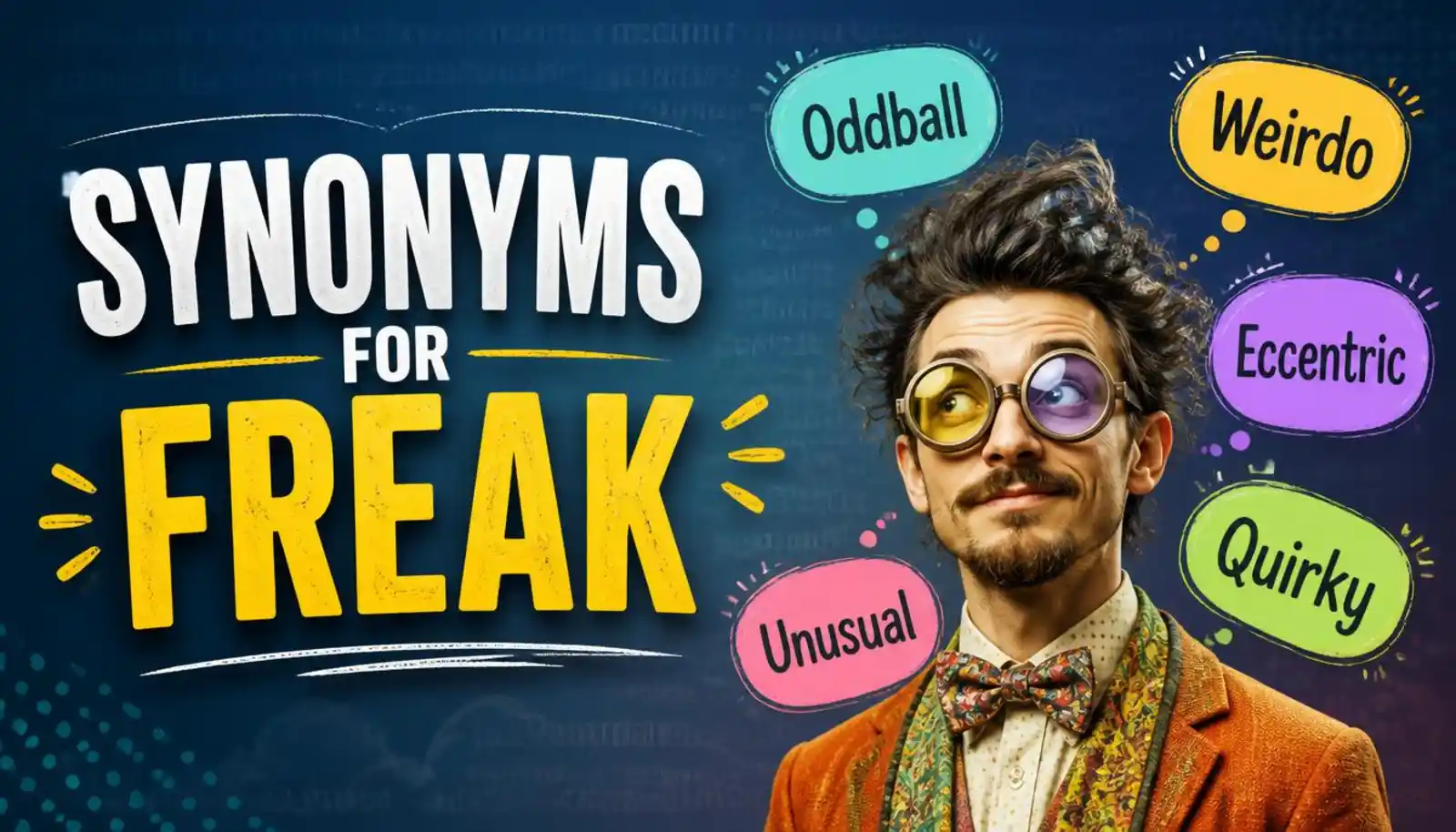
Looking for synonyms for freak? The best choice depends on the context. For a strange person, try oddball, weirdo, eccentric, or misfit. Softer options include quirky, unconventional, and offbeat. For phrases like fitness freak, words such as enthusiast, buff, or fanatic may fit better.
Quick Answer
The closest natural alternatives to freak when referring to a strange person include oddball, weirdo, and eccentric. Depending on the context, misfit, nonconformist, quirky, unconventional, weird, peculiar, odd, and strange can also work.
For the “person who is extremely interested in something” sense, useful alternatives include enthusiast, buff, fanatic, devotee, and aficionado.
Not every term below can replace freak in every sentence. Some are direct or close alternatives, while others describe a related idea or work only in a particular context.
Synonyms for Freak
| Word or Term | Category |
| Oddball | Close synonym |
| Weirdo | Informal synonym |
| Eccentric | Close synonym |
| Misfit | Contextual alternative |
| Nonconformist | Contextual alternative |
| Oddity | Related term |
| Quirky | Softer descriptive alternative |
| Unconventional | Softer descriptive alternative |
| Peculiar | Descriptive alternative |
| Odd | Descriptive alternative |
| Strange | Descriptive alternative |
| Unusual | Descriptive alternative |
| Weird | Informal descriptive alternative |
| Bizarre | Strong descriptive alternative |
| Unorthodox | Contextual alternative |
| Atypical | Formal descriptive alternative |
| Offbeat | Softer descriptive alternative |
| Uncommon | Contextual descriptive alternative |
| Outsider | Related alternative |
| Individualist | Related alternative |
| Maverick | Related alternative |
| Free spirit | Related expression |
| Bohemian | Lifestyle-related term |
| Rebel | Related alternative |
| Nontraditional | Descriptive alternative |
| Enthusiast | Alternative for interest sense |
| Buff | Informal alternative for interest sense |
| Fanatic | Strong alternative for interest sense |
| Devotee | Alternative for interest sense |
| Aficionado | Alternative for interest sense |
Oddball
Oddball is a natural informal word for a person whose behavior or personality seems unusual or eccentric.
- My new neighbor is a friendly oddball with some unusual hobbies.
- Everyone knew him as the lovable oddball of the group.
Usage: This is one of the closest informal alternatives to freak when talking about an unusual person. It can sound playful rather than insulting.
Weirdo
Weirdo is an informal noun for someone who behaves in a very strange or unusual way.
- Some people thought he was a weirdo because of his unusual habits.
- She laughed when her brother called himself a harmless weirdo.
Usage: Weirdo is common in casual speech but can be insulting, so use it carefully.
Eccentric
Eccentric describes a person whose behavior, appearance, or ideas are noticeably unconventional.
- The eccentric artist wore colorful clothes every day.
- Her eccentric uncle collects unusual objects from around the world.
Usage: Eccentric is often less harsh than freak and can even suggest individuality or creativity.
Misfit
Misfit describes someone who feels or seems out of place within a particular group or society.
- He felt like a misfit at his new school.
- The novel follows a group of misfits who become close friends.
Usage: A misfit is not necessarily strange; the key idea is that the person does not fit comfortably into a group or environment.
Nonconformist
Nonconformist describes someone who does not follow conventional social habits, opinions, or expectations.
- She was a nonconformist who preferred her own style.
- His nonconformist attitude made him stand out from his classmates.
Usage: This word often has a more neutral or positive tone than freak.
Oddity
Oddity refers to a person or thing that is unusual, strange, or different from what is expected.
- The museum displayed an oddity that attracted many visitors.
- His unusual invention became a local oddity.
Usage: Oddity is related to freak but is not a direct replacement in every sentence. It often emphasizes unusualness rather than personality.
Read More: Synonyms for Tundra: 30 Words with Meaning and Example
Quirky
Quirky describes someone or something with unusual characteristics that are often amusing or appealing.
- Her quirky personality makes conversations more interesting.
- He has a quirky habit of collecting vintage postcards.
Usage: Quirky is a softer and often more positive choice than freak.
Unconventional
Unconventional describes someone or something that does not follow traditional or commonly accepted patterns.
- She has an unconventional approach to teaching.
- His unconventional style quickly attracted attention.
Usage: This is a neutral alternative when the main idea is being different from the norm.
Peculiar
Peculiar describes someone or something that seems noticeably strange or unusual.
- There was something peculiar about his behavior.
- She had a peculiar way of solving simple problems.
Usage: Peculiar can sound mildly negative, but it is generally less offensive than calling someone a freak.
Odd
Odd describes someone or something that seems unusual, unexpected, or different from what is normal.
- He seemed a little odd at first.
- That was an odd thing to say during the meeting.
Usage: Odd is short, common, and flexible, but it does not always carry the strong meaning associated with freak.
Strange
Strange describes someone or something that seems unfamiliar, unusual, or difficult to explain.
- He has a strange sense of humor.
- The strange man stood quietly near the entrance.
Usage: Strange is one of the broadest alternatives and works in many contexts, although it is less specific than freak.
Unusual
Unusual means different from what is common, expected, or typical.
- She has an unusual personality.
- His unusual hobby became a popular conversation topic.
Usage: This is a neutral choice and usually sounds much less judgmental than freak.
Read More: Synonyms for Executive: 30 Words with Meaning and Example
Weird
Weird is an informal adjective meaning very strange, unusual, or difficult to understand.
- He has a weird sense of humor.
- That was a weird thing to do.
Usage: Weird is extremely common in modern informal English. Depending on tone, it can be playful, neutral, or negative.
Bizarre
Bizarre describes something extremely strange, unusual, or unexpected.
- The story took a bizarre turn.
- He wore a bizarre costume to the party.
Usage: Bizarre is stronger than strange or unusual and is usually used for behavior, events, situations, or appearances rather than as a direct noun for a person.
Unorthodox
Unorthodox describes something that does not follow traditional or commonly accepted methods or beliefs.
- She used an unorthodox method to solve the problem.
- His unorthodox ideas surprised the committee.
Usage: This works better for methods, ideas, approaches, or practices than as a direct substitute for freak referring to a person.
Atypical
Atypical means not typical or not representative of what is normally expected.
- His reaction was atypical for someone in that situation.
- The case showed an atypical pattern.
Usage: Atypical is more formal and analytical than freak. It is useful when the focus is simply on being outside the usual pattern.
Offbeat
Offbeat describes someone or something unusual, unconventional, or outside the mainstream.
- She has an offbeat sense of humor.
- The café has an offbeat atmosphere.
Usage: Offbeat is often lighter and more positive than freak, especially when describing creative people or ideas.
Uncommon
Uncommon means not frequently seen, found, or experienced.
- His approach to the problem was uncommon.
- She has an uncommon talent for remembering details.
Usage: Uncommon focuses on rarity rather than strangeness, so it is only a contextual alternative.
Read More: Synonyms for Prior: Words for Earlier or Previous
Outsider
Outsider describes someone who is not part of a particular group or who feels separate from it.
- He was treated as an outsider by the other students.
- The story follows an outsider searching for acceptance.
Usage: The main idea is social separation, not necessarily unusual behavior.
Individualist
Individualist describes someone who values independence and prefers to think or act according to personal principles.
- She is an individualist who prefers making her own decisions.
- His individualist style sets him apart from his colleagues.
Usage: This term is generally more positive and deliberate than freak. It emphasizes independence rather than strangeness.
Maverick
Maverick refers to a person who does not follow conventional practices and prefers an independent approach.
- The maverick designer rejected traditional methods.
- He became known as a maverick in his industry.
Usage: Maverick often carries a positive sense of independence and originality, so it is not a direct synonym for freak.
Free Spirit
Free spirit describes someone who values freedom and tends to live according to personal preferences rather than social expectations.
- Her friends admire her as a free spirit.
- He has always been a free spirit who dislikes strict routines.
Usage: This expression is usually positive and should not be treated as a direct replacement for the potentially negative freak.
Bohemian
Bohemian describes a person associated with an unconventional, artistic, or nontraditional lifestyle.
- The writer lived a bohemian lifestyle in the city.
- Her bohemian style reflected her love of art and travel.
Usage: Bohemian is more specific than freak because it suggests a particular lifestyle or artistic culture.
Rebel
Rebel refers to someone who resists authority, rules, or established conventions.
- He was a rebel who questioned every school rule.
- Her rebellious attitude made her stand out.
Usage: A rebel may be unconventional, but the defining idea is resistance rather than unusualness.
Read More: Synonyms for Morning: 30 Words, Meaning and Example
Nontraditional
Nontraditional describes someone or something that differs from customary or established practices.
- They chose a nontraditional career path.
- Her nontraditional approach worked surprisingly well.
Usage: This is a neutral descriptive alternative and works best when the focus is on departure from tradition.
Enthusiast
Enthusiast describes someone who has strong interest and excitement about a particular subject or activity.
- She is a photography enthusiast.
- He is an enthusiastic reader of science fiction.
Usage: This applies to the “freak” sense in expressions such as fitness freak or movie freak. It does not mean a strange person.
Buff
Buff is an informal noun for someone who is very interested in a particular subject or activity.
- He is a history buff who visits museums whenever he travels.
- My brother is a movie buff with an impressive film collection.
Usage: Buff is especially natural with subjects such as sports, history, movies, music, or fitness.
Fanatic
Fanatic describes someone with extremely strong enthusiasm or devotion to a particular interest or activity.
- He is a football fanatic who watches every game.
- She is a fitness fanatic who rarely misses a workout.
Usage: Fanatic is stronger than enthusiast and can suggest excessive or extreme enthusiasm.
Devotee
Devotee describes someone who is strongly dedicated to or enthusiastic about a particular person, activity, subject, or belief.
- She is a devoted yoga enthusiast and longtime devotee of the practice.
- He became a devotee of classical music during college.
Usage: Devotee emphasizes dedication and commitment rather than simply unusual behavior.
Aficionado
Aficionado refers to someone who is very knowledgeable and enthusiastic about a particular subject or activity.
- He is a coffee aficionado who knows a great deal about different beans.
- She is a film aficionado with an extensive collection.
Usage: This is a useful alternative to freak in phrases such as coffee freak or film freak. It usually sounds more refined and positive.
Read More: Synonyms for Disruptive: 30 Better Words for Different Contexts
What Does Freak Mean?
The word freak has several meanings, so its best synonym depends on the context.
As a noun, freak can refer to a person considered extremely unusual or strange. In this sense, alternatives include oddball, weirdo, eccentric, and, depending on context, misfit.
It can also refer to someone who is extremely interested in something:
- fitness freak
- computer freak
- movie freak
In this sense, words such as enthusiast, buff, fanatic, devotee, and aficionado may be more appropriate.
As an adjective, freak appears in expressions such as freak accident and freak weather, where it means unusually unexpected or extreme.
The phrasal verb freak out means to become extremely upset, frightened, excited, or overwhelmed. Freak someone out means to cause someone to feel that way.
Is Freak a Negative Word?
When freak is used as a noun for a person, it can sound insulting or demeaning, especially when it is used to mock someone’s appearance, behavior, or differences.
For neutral writing, words such as unusual, unconventional, eccentric, quirky, or nonconformist may be better choices, depending on the intended meaning.
However, freak is not always negative. In expressions such as fitness freak or movie freak, it can simply describe someone with an unusually strong interest in something.
What Is a Softer Synonym for Freak?
Some softer alternatives include quirky, unconventional, eccentric, unusual, offbeat, and individualistic.
The best choice depends on what you want to communicate. Quirky often sounds playful, unconventional is neutral, and eccentric suggests unusual personality or behavior.
What Is a Synonym for Freak Person?
For the “strange person” sense, common alternatives include oddball, weirdo, and eccentric. Misfit, outsider, nonconformist, and individualist can work when the context involves social differences or independence.
Avoid treating every descriptive adjective as a direct noun replacement. For example, weird describes a person, while weirdo is the noun for a person.
What Is a Synonym for Fitness Freak?
Depending on tone, useful alternatives include fitness enthusiast, fitness buff, fitness fanatic, or fitness aficionado.
Enthusiast sounds neutral, buff is informal, fanatic is stronger, and aficionado suggests knowledgeable enthusiasm.
Conclusion
The best synonyms for freak depend on the meaning and tone you need. For a strange or unconventional person, oddball, weirdo, eccentric, quirky, unusual, and nonconformist are useful choices in different contexts.
For the sense of someone who is extremely interested in something, enthusiast, buff, fanatic, devotee, and aficionado are more precise. Because freak can sound insulting when used for a person, a more specific alternative often makes your writing clearer, more natural, and more respectful.

Rafaqat Ali is the founder of RankVorexa, a vocabulary-focused website dedicated to synonyms, word meanings, and better English word choices. He creates simple, useful, and easy-to-understand content to help students, writers, bloggers, and English learners improve their vocabulary and writing skills.