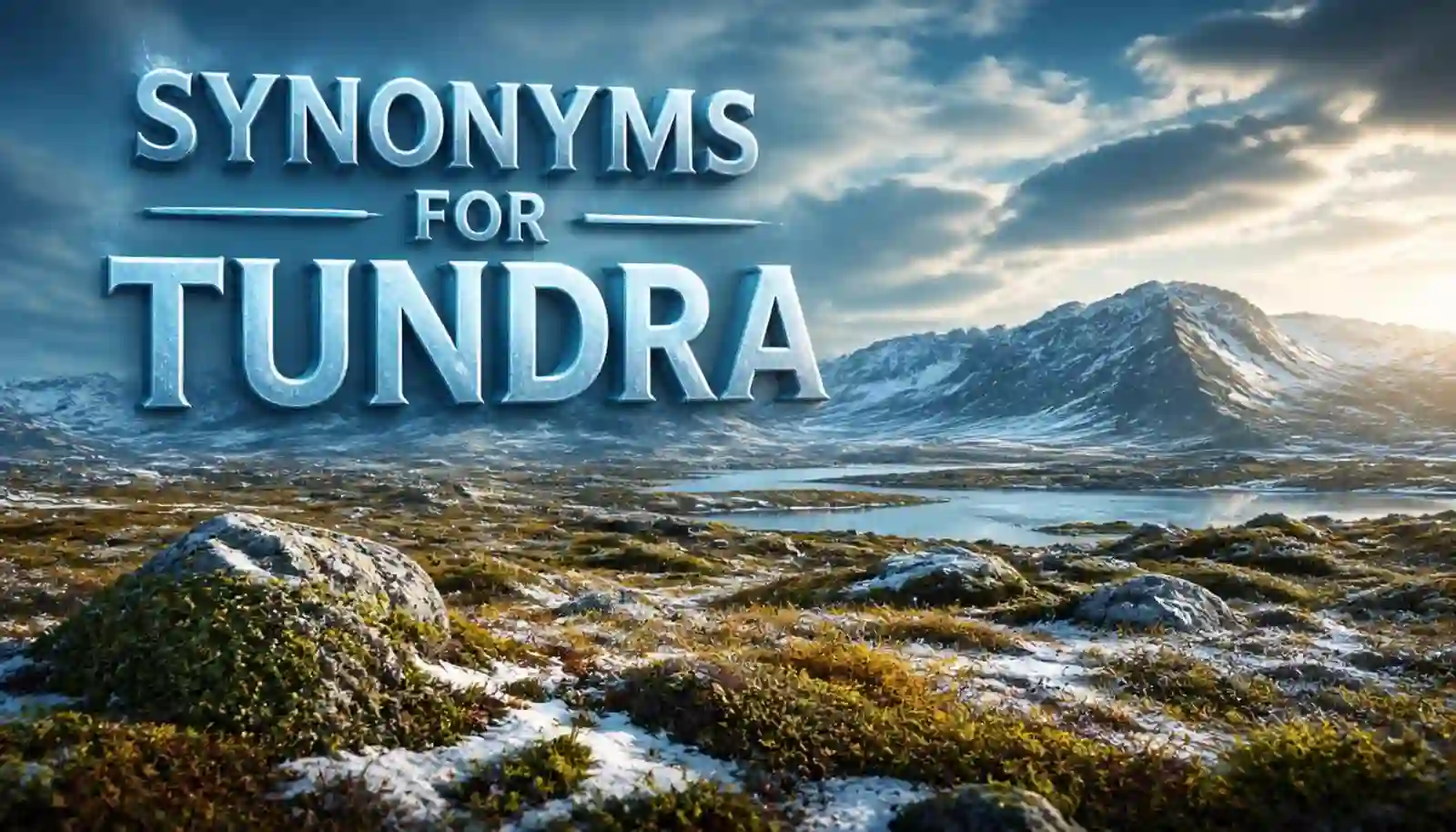
Looking for synonyms for tundra? Tundra describes a cold, mostly treeless biome with low-growing vegetation.
Because it has a specific ecological meaning, it has very few exact synonyms. This guide covers related expressions, descriptive alternatives, tundra types, and similar landscapes.
Quick Answer
There are very few exact synonyms for tundra. Useful related expressions include tundra landscape, tundra region, treeless landscape, treeless terrain, and Arctic landscape. However, terms such as alpine tundra, permafrost landscape, polar desert, and steppe describe a type, feature, or related environment rather than meaning exactly the same thing as tundra.
30 Synonyms and Related Terms for Tundra
| Word or Term | Category |
|---|---|
| Tundra biome | Direct expression |
| Tundra ecosystem | Direct expression |
| Tundra region | Direct expression |
| Tundra landscape | Direct expression |
| Tundra zone | Direct expression |
| Tundra belt | Direct expression |
| Treeless landscape | Descriptive expression |
| Treeless terrain | Descriptive expression |
| Treeless plain | Descriptive expression |
| Frozen landscape | Descriptive expression |
| Frozen plain | Descriptive expression |
| Barren landscape | Descriptive expression |
| Sparse-vegetation landscape | Descriptive expression |
| Cold treeless landscape | Descriptive expression |
| Arctic landscape | Geographic term |
| Polar landscape | Geographic term |
| Arctic terrain | Geographic term |
| Polar terrain | Geographic term |
| Arctic region | Broader geographic term |
| Polar region | Broader geographic term |
| Arctic tundra | Type of tundra |
| Alpine tundra | Type of tundra |
| Montane tundra | Type of tundra |
| Subarctic tundra | Descriptive tundra term |
| Antarctic tundra | Tundra-related expression |
| Permafrost landscape | Related environmental term |
| Arctic desert | Related environment |
| Polar desert | Related environment |
| Steppe | Different landscape |
| Moorland | Different landscape |
Accuracy note: These 30 terms are not 30 exact synonyms. Tundra is a specific biome, so the list combines direct expressions, descriptive alternatives, geographic terms, tundra types, related environments, and different landscapes that may share some features with tundra.
Definition and Meaning of Tundra
Tundra is a cold, mostly treeless biome with a short growing season and low-growing vegetation.
Tundra occurs mainly in high northern latitudes and also develops at high elevations where cold conditions limit tree growth. Common vegetation includes mosses, lichens, grasses, sedges, and small shrubs.
Many Arctic tundra areas contain permafrost, which is ground that remains at or below 0°C for at least two consecutive years. However, permafrost and tundra are different concepts and should not be used as synonyms.
The word tundra therefore refers to a specific biome, not simply any cold, frozen, or treeless landscape.
Tundra occurs in different geographic settings, most notably Arctic tundra and alpine tundra.
Tundra Biome
Meaning: A tundra biome is the tundra considered as a distinct ecological biome.
Examples:
- The tundra biome supports plants adapted to extreme cold.
- Researchers monitor changes in the tundra biome.
Tundra Ecosystem
Meaning: A tundra ecosystem includes the organisms and environmental conditions interacting within the tundra.
Examples:
- Climate changes can affect the tundra ecosystem.
- Scientists study food webs within the tundra ecosystem.
Tundra Region
Meaning: A tundra region is an area where tundra occurs.
Examples:
- Caribou migrate through the tundra region.
- Scientists collected samples from the tundra region.
Tundra Landscape
Meaning: A tundra landscape is a landscape characterized by tundra vegetation and environmental conditions.
Examples:
- Snow covered much of the tundra landscape.
- The photographer captured the vast tundra landscape.
Tundra Zone
Meaning: A tundra zone is a geographic or ecological area where tundra occurs.
Examples:
- The forest gradually changes into a tundra zone at higher elevations.
- Researchers mapped the boundary of the tundra zone.
Tundra Belt
Meaning: A tundra belt is a broad geographic area where tundra occurs.
Examples:
- The tundra belt extends across parts of the far north.
- Climate changes are affecting vegetation within the tundra belt.
Read More: Synonyms for Campus: 30 words and Meaning and Example
Treeless Landscape
Meaning: A treeless landscape is an area where trees are absent or uncommon.
Examples:
- The hikers crossed a vast treeless landscape.
- The treeless landscape provided an open view of the mountains.
Treeless Terrain
Meaning: Treeless terrain is land without significant tree growth.
Examples:
- The team traveled across difficult treeless terrain.
- Strong winds swept over the exposed treeless terrain.
Treeless Plain
Meaning: A treeless plain is a broad, relatively flat area without trees.
Examples:
- Herds moved across the treeless plain.
- The treeless plain stretched toward the distant hills.
Frozen Landscape
Meaning: A frozen landscape is an area strongly affected by freezing temperatures, ice, or snow.
Examples:
- The expedition entered a vast frozen landscape.
- Winter transformed the valley into a frozen landscape.
Frozen Plain
Meaning: A frozen plain is a broad, relatively flat area affected by freezing conditions.
Examples:
- The explorers crossed the frozen plain.
- Snow covered much of the frozen plain.
Barren Landscape
Meaning: A barren landscape is an open area with little vegetation.
Examples:
- Only a few hardy plants grew in the barren landscape.
- The travelers saw a barren landscape stretching to the horizon.
Read More: Synonyms for Smart: 30 Words with Meaning and Example
Sparse-Vegetation Landscape
Meaning: A sparse-vegetation landscape is an area where plant growth is relatively limited.
Examples:
- The researchers recorded plant life in the sparse-vegetation landscape.
- Few species survive in such a sparse-vegetation landscape.
Cold Treeless Landscape
Meaning: A cold treeless landscape is a cold environment where trees are absent or scarce.
Examples:
- The aircraft flew over a cold treeless landscape.
- Small shrubs survived in the cold treeless landscape.
Arctic Landscape
Meaning: An Arctic landscape is a natural environment located in the Arctic.
Examples:
- The Arctic landscape changes during the short summer.
- Small shrubs grow across parts of the Arctic landscape.
Polar Landscape
Meaning: A polar landscape is a natural environment located in a polar region.
Examples:
- The documentary showed a remote polar landscape.
- Researchers observed changes in the polar landscape.
Arctic Terrain
Meaning: Arctic terrain is the land surface found in the Arctic.
Examples:
- The team traveled carefully across difficult Arctic terrain.
- Rocky Arctic terrain made the journey challenging.
Polar Terrain
Meaning: Polar terrain is land found in a polar environment.
Examples:
- The explorers prepared for harsh polar terrain.
- Deep snow made the polar terrain difficult to cross.
Read More: Synonyms for Funds: 30 Useful Words and Financial Alternatives
Arctic Region
Meaning: The Arctic region is the area surrounding the North Pole.
Examples:
- The Arctic region experiences long, cold winters.
- Many species have adapted to the Arctic region.
Polar Region
Meaning: A polar region is an area surrounding either the North or South Pole.
Examples:
- Scientists monitor environmental changes in polar regions.
- Polar regions experience extreme seasonal conditions.
Arctic Tundra
Meaning: Arctic tundra is tundra found across the high northern latitudes.
Examples:
- Mosses and small shrubs grow across the Arctic tundra.
- Caribou migrate across the Arctic tundra.
Alpine Tundra
Meaning: Alpine tundra is tundra found above the tree line in mountainous areas.
Examples:
- Small wildflowers grow in the alpine tundra.
- The hikers reached the alpine tundra above the forest.
Montane Tundra
Meaning: Montane tundra is tundra occurring at high elevations in mountainous regions.
Examples:
- The hikers entered the montane tundra above the tree line.
- Hardy plants survive in the cold montane tundra.
Subarctic Tundra
Meaning: Subarctic tundra describes tundra occurring in cold areas near the Arctic.
Examples:
- The forest gradually gives way to subarctic tundra farther north.
- Plants in subarctic tundra must survive a short growing season.
Read More: Synonyms for Rookie: 30 Alternatives, Meanings & Examples
Antarctic Tundra
Meaning: Antarctic tundra is a term used for tundra-like terrestrial environments in parts of Antarctica.
Examples:
- Researchers study the limited vegetation found in Antarctic tundra-like environments.
- Cold conditions restrict plant growth in these Antarctic environments.
Permafrost Landscape
Meaning: A permafrost landscape is an environment where permanently frozen ground is an important feature.
Examples:
- Building roads can be difficult in a permafrost landscape.
- Rising temperatures are changing some permafrost landscapes.
Arctic Desert
Meaning: An Arctic desert is an extremely cold and dry environment in the Arctic.
Examples:
- Some Arctic deserts receive very little precipitation.
- Only specialized plants survive in parts of the Arctic desert.
Polar Desert
Meaning: A polar desert is a desert environment found in a polar region.
Examples:
- Very little precipitation falls in many polar desert environments.
- Some polar desert areas support only limited vegetation.
Steppe
Meaning: A steppe is a broad, mostly treeless grassland usually associated with a relatively dry climate.
Examples:
- Horses moved across the open steppe.
- Strong winds swept across the Central Asian steppe.
Moorland
Meaning: Moorland is open land typically dominated by grasses, heather, and low shrubs.
Examples:
- Mist covered the moorland in the early morning.
- Sheep grazed across the open moorland.
Read More: Synonyms for Shall: 30 Alternatives With Meanings and Examples
Short Answer and FAQs
What are the closest synonyms for tundra?
There are very few exact synonyms for tundra. Expressions such as tundra landscape and tundra region refer directly to tundra, while treeless landscape and treeless terrain describe some of its characteristics.
Is Arctic landscape a synonym for tundra?
No. The Arctic landscape is a broader geographic expression. The Arctic contains tundra as well as ice, glaciers, mountains, water, and other environments.
Is treeless landscape another word for tundra?
No. A treeless landscape describes an area without significant tree growth. It can refer to tundra, but it can also describe grasslands, deserts, and other environments.
Is frozen landscape a synonym for tundra?
No. A frozen landscape describes an environment affected by freezing conditions. It does not specifically identify the tundra biome.
Is steppe the same as tundra?
No. A steppe is a mostly treeless grassland generally associated with a relatively dry climate. Tundra is a much colder biome with a short growing season and low-growing vegetation.
Is moorland another word for tundra?
No. Moorland is a different open landscape. It can share features such as low vegetation and limited tree growth, but it is not the same biome.
What is the difference between tundra and permafrost?
Tundra is a biome, while permafrost refers to ground that remains frozen for at least two consecutive years. They are related but not interchangeable.
What are the main types of tundra?
The two major settings commonly discussed are Arctic tundra and alpine tundra. Tundra-like terrestrial environments also occur in limited parts of Antarctica.
What is another word for Arctic tundra?
There is no perfect one-word synonym. Depending on the sentence, tundra landscape, tundra region, Arctic terrain, or Arctic landscape can describe related aspects of Arctic tundra, but they are not fully interchangeable.
Conclusion
Tundra has very few exact synonyms because it names a specific biome. Terms such as tundra landscape, treeless terrain, Arctic landscape, and alpine tundra can describe related aspects, but they are not always interchangeable.

Rafaqat Ali is the founder of RankVorexa, a vocabulary-focused website dedicated to synonyms, word meanings, and better English word choices. He creates simple, useful, and easy-to-understand content to help students, writers, bloggers, and English learners improve their vocabulary and writing skills.