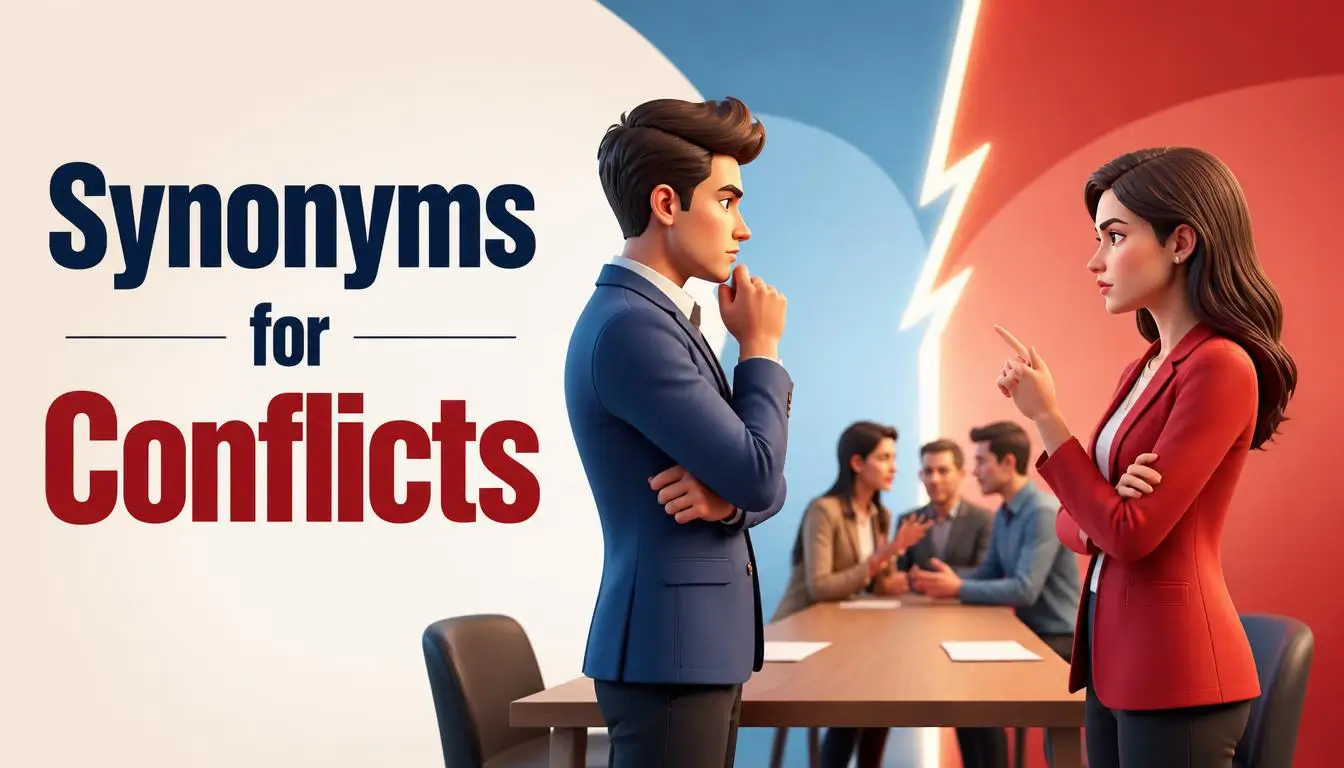
The word conflicts describes disagreements or clashes between people or groups. Synonyms such as disagreements, disputes, and clashes fit different situations.
Learning these alternatives helps you express ideas clearly in everyday conversations and writing.
Quick Answer
The best synonyms for conflicts depend on the situation:
- Disagreements: Differences in opinions or beliefs.
- Disputes: Disagreements over a specific issue, claim, or decision.
- Clashes: Strong disagreements or direct opposition.
- Arguments: Disagreements expressed through words.
- Quarrels: Often angry disagreements, usually between people.
- Confrontations: Direct encounters between opposing sides.
- Feuds: Long-lasting, bitter disagreements.
- Discord: A lack of agreement or harmony.
- Strife: Serious or prolonged conflict.
Use disagreements for differences of opinion, disputes for contested issues, and clashes for strong opposition. For long-lasting hostility, feuds or strife may be more suitable.
Definition and Meaning of Conflicts
Conflicts is the plural form of the noun conflict. It refers to situations in which people, groups, ideas, needs, or interests oppose one another.
Conflicts can occur in several contexts:
- Personal conflicts: Disagreements or opposing needs between people.
- Political conflicts: Opposition or struggles between political groups or nations.
- Internal conflicts: Competing feelings, beliefs, or choices within a person.
- Scheduling conflicts: Situations in which two or more events overlap in time.
- Conflicts of interest: Situations in which competing interests may affect someone’s judgment.
The context matters because no single synonym works for every meaning. For example, disagreement may fit a personal conflict, while overlapping appointments or a schedule clash may better describe a scheduling conflict.
Grammar matters, too. Conflict is plural, while discord and strife are generally uncountable nouns. A replacement may require a change to the whole sentence rather than a simple word swap.
Table of Synonyms for Conflicts
| Word | Category | Simple Meaning |
| Disagreements | Close synonym | Differences of opinion or belief |
| Disputes | Close synonym | Disagreements over a particular issue |
| Clashes | Close synonym | Strong disagreements or direct opposition |
| Arguments | Context-dependent alternative | Disagreements expressed through words |
| Quarrels | Close synonym | Often angry personal disagreements |
| Confrontations | Context-dependent alternative | Direct encounters between opposing sides |
| Feuds | Context-dependent alternative | Long-lasting, bitter disagreements |
| Discord | Close synonym | A lack of agreement or harmony |
| Strife | Close synonym | Serious or prolonged conflict |
| Altercations | Context-dependent alternative | Heated verbal or physical confrontations |
| Contention | Close synonym | Disagreement or a matter being argued over |
| Friction | Context-dependent alternative | Strain between people or groups |
| Antagonism | Context-dependent alternative | Strong opposition or hostility |
| Opposition | Context-dependent alternative | Resistance to a person, idea, or action |
| Hostilities | Context-dependent alternative | Hostile or aggressive actions |
| Struggles | Context-dependent alternative | Difficult efforts involving problems or opposition |
| Battles | Context-dependent alternative | Intense fights or difficult struggles |
| Showdowns | Informal alternative | Direct confrontations over an important issue |
Main Synonyms for Conflicts
1. Disagreements
Meaning: Disagreements are situations in which people have different opinions, beliefs, or views. This is one of the most useful alternatives when a conflict centers on differing opinions.
Category: Close synonym.
Examples:
- We had a few disagreements about the project.
- Their disagreements did not affect their friendship.
2. Disputes
Meaning: Disputes are disagreements over a specific issue, claim, right, or decision. The word is common in legal, business, and formal settings.
Category: Close synonym.
Examples:
- The neighbors settled their property dispute.
- The two companies are involved in a payment dispute.
3. Clashes
Meaning: Clashes are strong disagreements or direct opposition between people, groups, or ideas. The word often emphasizes a sharp difference or a heated encounter.
Category: Close synonym.
Examples:
- The two leaders clashed over the new policy.
- Cultural clashes created tension within the team.
4. Arguments
Meaning: Arguments are disagreements in which people express opposing views, sometimes angrily. Unlike conflict, the word often suggests a spoken or written exchange.
Category: Context-dependent alternative.
Examples:
- The siblings had an argument about sharing a room.
- Their arguments became less frequent over time.
5. Quarrels
Meaning: Quarrels are often angry disagreements about personal or everyday matters. They usually involve people who argue with one another.
Category: Close synonym.
Examples:
- The children had a quarrel over the game.
- Their small quarrels usually ended with an apology.
Read More: Synonyms for Reach: Words, Meanings, and Examples
6. Confrontations
Meaning: Confrontations are direct encounters in which opposing people or sides face each other. They may be tense, but not every conflict leads to a confrontation.
Category: Context-dependent alternative.
Examples:
- The manager avoided a confrontation with the angry customer.
- Their confrontation brought the problem into the open.
7. Feuds
Meaning: Feuds are long-lasting, bitter disagreements between people, families, or groups. The word suggests ongoing hostility rather than a brief difference of opinion.
Category: Context-dependent alternative.
Examples:
- The two families ended their decades-long feud.
- An old feud divided the business partners.
8. Discord
Meaning: Discord is a lack of agreement, peace, or harmony between people or groups. It describes a state of disagreement rather than one specific argument.
Category: Close synonym.
Examples:
- The decision created discord among the members.
- Open communication helped reduce discord in the office.
9. Strife
Meaning: Strife is serious or prolonged conflict, especially within a family, community, or country. It often appears in formal or news-related writing.
Category: Close synonym.
Examples:
- Political strife weakened the government.
- The family hoped to put years of strife behind them.
10. Altercations
Meaning: Altercations are heated confrontations that may involve angry words or physical aggression. The term is more specific than conflicts and often describes a particular incident.
Category: Context-dependent alternative.
Examples:
- The argument led to an altercation outside the store.
- Security staff stepped in to stop the altercation.
Read More: Synonyms for President: Meanings and Examples
11. Contention
Meaning: Contention refers to disagreement or a point that people argue about. It is often used in formal discussions, debates, and writing.
Category: Close synonym.
Examples:
- The budget became a source of contention.
- There was considerable contention over the final decision.
12. Friction
Meaning: Friction is strain or irritation between people who do not get along or agree. It may signal a conflict without describing an open argument.
Category: Context-dependent alternative.
Examples:
- Different work styles caused friction between the coworkers.
- Clear expectations reduced friction within the team.
13. Antagonism
Meaning: Antagonism is strong opposition or hostility toward a person, group, or idea. It emphasizes negative feelings or resistance more than a simple disagreement.
Category: Context-dependent alternative.
Examples:
- His comments created antagonism among the workers.
- Mutual antagonism made cooperation difficult.
14. Opposition
Meaning: Opposition is resistance to a person, idea, decision, or action. It can be part of a conflict, but opposition does not always involve a dispute or personal hostility.
Category: Context-dependent alternative.
Examples:
- The proposal faced strong opposition from residents.
- Opposition grew after the rules changed.
15. Hostilities
Meaning: Hostilities are hostile or aggressive actions between opposing sides, especially in political or military situations. This word usually suggests a more serious situation than an ordinary disagreement.
Category: Context-dependent alternative.
Examples:
- Both countries agreed to end hostilities.
- Hostilities increased after the failed negotiations.
Read More: Synonyms for Vary: Words, Meanings, and Examples
16. Struggles
Meaning: Struggles are difficult efforts to overcome problems, opposition, or competing demands. The word emphasizes the challenge involved, so it is not a direct replacement for every use of conflicts.
Category: Context-dependent alternative.
Examples:
- The team faced struggles over how to divide its responsibilities.
- Their struggles to agree on a plan delayed the project.
17. Battles
Meaning: Battles are intense fights or difficult struggles against an opponent, problem, or challenge. The word can be literal or figurative and often makes the situation sound more intense.
Category: Context-dependent alternative.
Examples:
- The two groups fought a bitter battle over control of the organization.
- She faced an inner battle between fear and hope.
18. Showdowns
Meaning: Showdowns are direct confrontations in which opposing sides face each other over an important issue. This informal word often suggests a decisive or dramatic encounter.
Category: Informal alternative.
Examples:
- The debate turned into a showdown between the candidates.
- The two managers prepared for a showdown over the budget.
Read More: Synonyms for Tranquility: Words, Meanings, and Examples
Related Terms That Are Not Always Synonyms
Some words describe conditions that may cause, accompany, or result from conflicts. They can make writing more precise, but they do not always replace conflicts directly.
| Related term | Meaning | Example |
| Tensions | Feelings of strain or unease that may lead to conflict | Tensions rose after the announcement. |
| Rivalries | Ongoing competition between people or groups | The schools have a friendly sports rivalry. |
| Incompatibility | A lack of fit between people, ideas, or systems | Incompatibility between their goals threatened the partnership. |
| Contradictions | Statements or ideas that oppose one another | The report contained contradictions about the project’s cost. |
| Competing interests | Different needs or goals that may be difficult to balance | The committee had to balance competing interests. |
| Power struggles | Conflicts over control, influence, or authority | A power struggle developed between the executives. |
| Discordance | A lack of agreement or consistency between elements | Discordance between the findings raised questions. |
| Overlap | A shared period or area, sometimes causing a scheduling problem | The meeting overlap created a scheduling conflict. |
Usage note: Tensions may exist without an open disagreement, and a rivalry can be friendly. Contradictions usually describe opposing statements or ideas. For scheduling conflicts, overlapping appointments or schedule clashes may fit better than disputes or quarrels.
Context and Usage Comparison
Not every alternative for conflicts works in every sentence. These comparisons show how the meaning changes with the word you choose.
Conflicts vs. Disagreements
A conflict can involve competing goals, interests, or serious opposition. A disagreement usually focuses on differences in opinion.
- Conflict: The employees had a conflict over their responsibilities.
- Disagreement: The employees had a disagreement about the best schedule.
Use disagreement when people mainly hold different views. Use conflict when the situation involves broader opposition or competing needs.
Conflicts vs. Disputes
A dispute usually concerns a specific issue that people contest. A conflict can involve a wider struggle between people or groups.
- Dispute: The company disputed the invoice.
- Conflict: The two companies had a conflict over their business relationship.
Use dispute for contested claims, payments, rights, or decisions.
Conflicts vs. Clashes
A clash often suggests strong or direct opposition. A conflict can continue over time without a single dramatic confrontation.
- Clash: The lawmakers clashed over the proposed law.
- Conflict: The lawmakers remained in conflict over policy priorities.
Use clash to emphasize a strong disagreement or sharp difference.
Conflicts vs. Arguments
An argument often involves spoken disagreement. A conflict can exist even when people do not argue openly.
- Argument: They had an argument about money.
- Conflict: They had a conflict of interest in the business deal.
Use argument for a verbal disagreement and conflict for the broader situation.
Conflicts vs. Struggles
A struggle emphasizes difficulty or effort. A conflict emphasizes opposition between people, interests, ideas, or goals.
- Struggle: He faced a struggle to balance work and family life.
- Conflict: His work schedule conflicted with his family responsibilities.
Use struggle to highlight a challenge and conflict to highlight opposing demands. Notice that the second example uses conflicted as a verb, not conflicts as a noun.
Which Synonym Works Best in Different Situations?
| Situation | Suitable word choices |
| Different opinions | Disagreements |
| Contested claims or decisions | Disputes |
| Heated personal exchanges | Arguments, quarrels |
| Strong opposing views | Clashes |
| Direct encounters between opposing sides | Confrontations |
| Long-lasting hostility | Feuds, strife |
| Workplace strain | Friction |
| Political or military aggression | Hostilities |
| Difficulty overcoming opposing demands | Struggles |
| Informal description of a decisive confrontation | Showdowns |
| Events scheduled at the same time | Overlapping appointments, schedule clashes |
Common mistake to avoid: Do not replace conflicts with tensions in every sentence. Tensions describe strain that may exist before, during, or after a conflict; they do not necessarily mean that an actual disagreement has occurred.
Short Answer
The closest alternatives for conflicts include disagreements, disputes, clashes, and discord. Use arguments for verbal disagreements, feuds for long-lasting hostility, and strife for serious or prolonged conflict. For scheduling issues or competing interests, choose a phrase that matches the specific situation rather than forcing a general synonym into the sentence.
Frequently Asked Questions
1. What is the closest synonym for conflicts?
Disagreements and disputes are among the closest alternatives. Disagreements usually involve differences of opinion, while disputes often concern a specific contested issue.
2. What word can replace conflicts in a sentence?
You can use disagreements, disputes, clashes, or arguments, depending on the context. For example, “The coworkers had a conflict” could become “The coworkers had a disagreement” if the issue involved different opinions.
3. What is the difference between conflicts and clashes?
A conflict can be an ongoing struggle between people, interests, or ideas. A clash often emphasizes a strong disagreement or direct opposition.
4. What is a formal synonym for conflicts?
Disputes, contention, and strife can work in formal writing, depending on the meaning. In legal or business contexts, disputes is often suitable for disagreements about rights, claims, or decisions.
5. Are conflicts and disagreements interchangeable?
Not always. A disagreement usually involves different opinions, while a conflict may also involve competing goals, responsibilities, interests, or prolonged hostility.
Conclusion
Choosing the right synonym for conflicts helps you describe disagreements, struggles, and opposing interests accurately. Words such as disputes, clashes, and arguments express different kinds of disagreement, while feuds and strife suggest deeper or longer-lasting problems. By considering meaning, context, and grammar, you can choose alternatives that make your essays, emails, and everyday writing clearer and more natural.

Rafaqat Ali is the founder of RankVorexa, a vocabulary-focused website dedicated to synonyms, word meanings, and better English word choices. He creates simple, useful, and easy-to-understand content to help students, writers, bloggers, and English learners improve their vocabulary and writing skills.