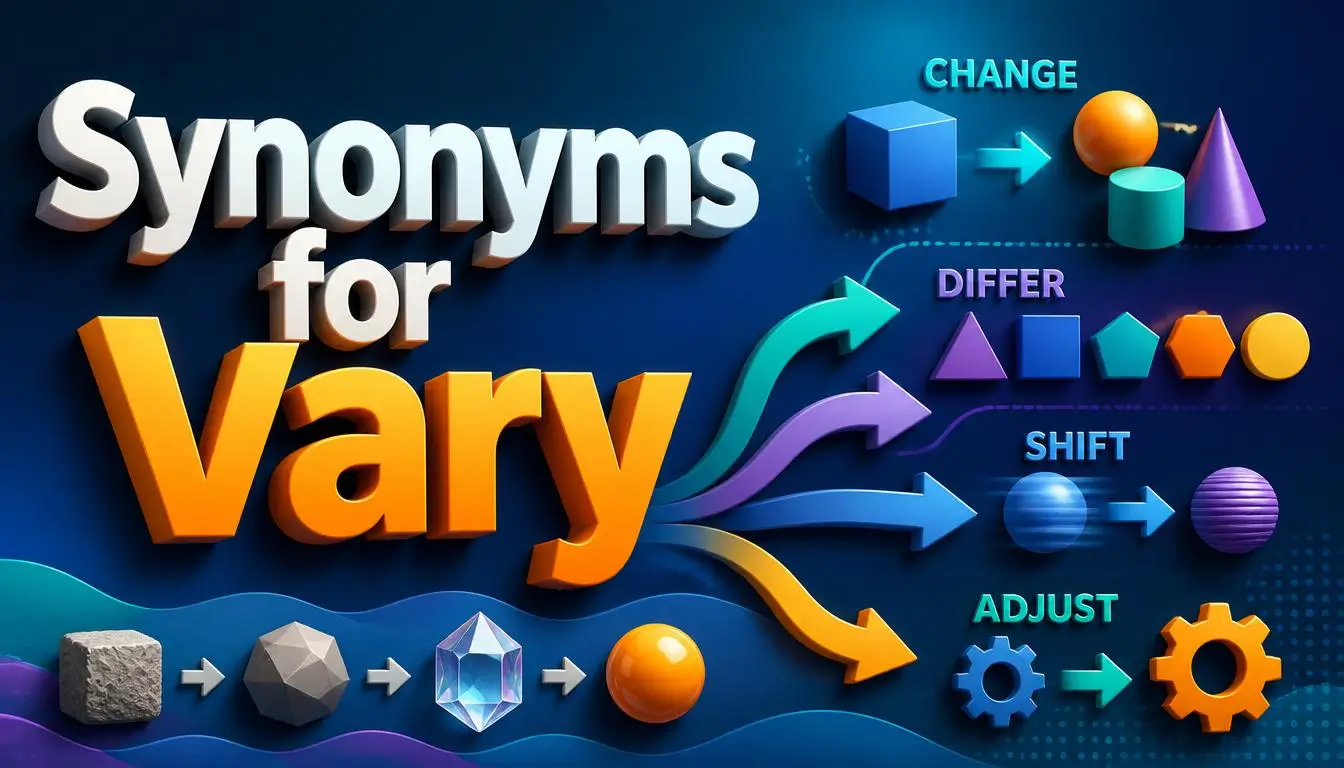
The word vary means to change or differ. Synonyms for vary include change, differ, fluctuate, and alter, each describing a different type of change.
Understanding these alternatives helps you choose the right word for everyday conversations and writing.
Quick Answer: What Are the Best Synonyms for Vary?
The best general synonym for vary is change. Other useful alternatives include differ, fluctuate, alter, shift, and modify. Choices differ when comparing things, fluctuate when values rise and fall, and alter when something is deliberately changed.
What Does Vary Mean?
Vary is a verb that means to differ from one thing to another or to change. It can also mean to make something different, as when you vary a recipe or an approach. Its exact meaning depends on the sentence.
- To change: The weather can vary throughout the day.
- To differ: Prices vary from store to store.
- To make something different: You can vary the recipe by adding different spices.
Because these meanings are not identical, the best synonym depends on the context.
Synonyms for Vary: Words and Meanings
The table below lists useful alternatives and explains when each one fits.
| Word | Category | Simple Meaning |
| Change | Close synonym | To become or make something different |
| Differ | Context-dependent synonym | To be unlike something else |
| Fluctuate | Context-dependent synonym | To rise and fall or move between different levels |
| Alter | Close synonym | To make something different |
| Shift | Context-dependent synonym | To move or change direction, focus, or position |
| Modify | Close synonym | To make specific or partial changes |
| Adjust | Context-dependent synonym | To change something to make it more suitable |
| Deviate | Context-dependent synonym | To move away from a standard or expected course |
| Diverge | Context-dependent synonym | To become different or move apart |
| Alternate | Context-dependent alternative | To switch between options or states |
| Range | Context-dependent alternative | To extend across a set of values or possibilities |
| Transform | Strong-change alternative | To change something greatly |
| Diversify | Specialized alternative | To introduce variety or expand into different areas |
| Change up | Informal expression | To do something differently |
| Evolve | Related term | To develop or change gradually over time |
Main Synonyms for Vary
1. Change
Meaning: To become different or make something different.
Category: Close synonym
Change is the most versatile alternative to vary. It works in many everyday situations, but it does not always express differences between several things.
Examples:
- Our plans may change because of the weather.
- You can change the design to make it easier to use.
2. Differ
Meaning: To be unlike another person or thing.
Category: Context-dependent synonym
Use differ when pointing out how people, opinions, results, or objects are not the same. It is especially useful when comparing two or more things.
Examples:
- The two reports differ in several important ways.
- Students may differ in their learning styles.
3. Fluctuate
Meaning: To rise and fall or move repeatedly between different levels.
Category: Context-dependent synonym
Fluctuate is especially useful for prices, temperatures, demand, and other values that move up and down. It is not a general synonym for every kind of change.
Examples:
- Gas prices fluctuate throughout the year.
- Her energy levels fluctuate during the day.
4. Alter
Meaning: To make something different, usually by changing part of it.
Category: Close synonym
Alter often describes an intentional change to a plan, design, document, or situation.
Examples:
- We had to alter the schedule after the meeting moved.
- The tailor altered the jacket to improve its fit.
5. Shift
Meaning: To move or change position, direction, focus, or emphasis.
Category: Context-dependent synonym
Use shift when something moves from one state, position, or focus to another.
Examples:
- Public opinion can shift over time.
- The team shifted its focus to customer service.
Read More: Synonyms for Tranquility: Words, Meanings, and Examples
6. Modify
Meaning: To make specific changes to something without completely replacing it.
Category: Close synonym
Modify is useful when describing changes to a plan, product, rule, or method.
Examples:
- The teacher modified the assignment for younger students.
- We modified the design to reduce costs.
7. Adjust
Meaning: To change something to make it more suitable or effective.
Category: Context-dependent synonym
Adjust emphasizes making a change to improve fit, comfort, accuracy, or performance. The change may be small or substantial, depending on the situation.
Examples:
- You may need to adjust the settings.
- The coach adjusted the training plan to suit the players.
8. Deviate
Meaning: To move away from a usual, accepted, or expected course.
Category: Context-dependent synonym
Deviate often appears in formal or technical writing. It describes a departure from an expected pattern, rule, or route rather than just any change.
Examples:
- The results deviate from the original prediction.
- Drivers should not deviate from the marked route.
9. Diverge
Meaning: To become different or move in separate directions.
Category: Context-dependent synonym
Use diverge when paths, opinions, trends, or ideas begin to separate.
Examples:
- Their opinions diverge on several key issues.
- The two roads diverge beyond the bridge.
10. Alternate
Meaning: To switch between two or more options or states.
Category: Context-dependent alternative
Alternate fits situations involving turns or repeated changes between options. It is not a general replacement for vary.
Examples:
- The class alternates between indoor and outdoor activities.
- You can alternate walking and jogging during your workout.
Read More: Synonyms for Dismissive: Meanings and Examples
11. Range
Meaning: To extend between different amounts, levels, or possibilities.
Category: Context-dependent alternative
Range is useful when describing the spread of values or options. It does not usually mean to change something.
Examples:
- Temperatures range from 40°F to 75°F during the season.
- The available prices range from $20 to $100.
12. Transform
Meaning: To change something greatly in form, appearance, or character.
Category: Strong-change alternative
Use transform when the change is substantial rather than small or gradual.
Examples:
- The renovation transformed the old house.
- New technology can transform the way people work.
13. Diversify
Meaning: To add variety or expand into different types or areas.
Category: Specialized alternative
Diversify works well in business, investing, agriculture, and other contexts where variety is deliberately increased.
Examples:
- The company plans to diversify its product range.
- Farmers diversify their crops to reduce risk.
14. Change up
Meaning: To do something differently, often to avoid repetition.
Category: Informal expression
Change up is common in casual speech. It usually suggests trying a different approach rather than simply describing differences.
Examples:
- Let’s change up our usual dinner routine.
- She changed up her workout to keep it interesting.
15. Evolve
Meaning: To develop or change gradually over time.
Category: Related term
Evolve emphasizes gradual development. It may fit some contexts involving change, but it does not usually describe simple differences or short-term fluctuations.
Examples:
- The project evolved as the team received feedback.
- Fashion trends evolve over time.
Read More: Synonyms for Recovery: Words, Meanings, and Examples
Vary vs. Similar Words: What Is the Difference?
| Word | Best Used When | Example |
| Vary | Something changes or differs across situations | Delivery times vary by location. |
| Change | Something becomes different | The delivery time changed. |
| Differ | Two or more things are not the same | Delivery times differ between locations. |
| Fluctuate | A value rises and falls | Delivery costs fluctuate during busy periods. |
| Alter | Someone makes a change | The company altered its delivery policy. |
| Modify | Someone makes a specific or limited change | The company modified its delivery options. |
Common Mistakes When Using Synonyms for Vary
- Using fluctuate for every kind of change: It usually describes values or conditions that rise and fall.
- Using differ without a clear comparison: Differ generally describes how two or more things are unlike each other.
- Treating range as a direct synonym: Range describes a span of values or possibilities, not usually an act of changing.
- Using transform for a small adjustment: Transform suggests a major change.
- Using alternate to mean any change: Alternate generally involves switching between options or states.
FAQs About Synonyms for Vary
1. What is the closest synonym for vary?
Change is usually the closest general synonym. However, differences may be more accurate when comparing people, objects, or results.
2. What is another word for vary in academic writing?
Words such as differ, fluctuate, alter, and deviate can work in academic writing. Choose one based on whether you mean differences, changing values, deliberate changes, or departures from an expected pattern.
3. What is a synonym for vary in amount?
Fluctuation works when an amount rises and falls. Range is useful when describing the minimum and maximum values across a set.
4. Is it the same as change?
Not always. Change often means becoming or making something different, while vary can also describe differences across people, places, times, or situations.
5. What is the opposite of vary?
Possible antonyms include remain constant, stay the same, and be consistent. The best choice depends on whether vary refers to change over time or differences between things.
Conclusion
The best synonyms for vary depend on the meaning you want to express. Change works in many everyday situations, while difference highlights comparisons and fluctuation describes values that rise and fall. Words such as alter, modify, and adjust focus on making changes, while transform suggests a major change. By understanding these differences, you can choose more precise words and make your writing clearer and more natural.

Rafaqat Ali is the founder of RankVorexa, a vocabulary-focused website dedicated to synonyms, word meanings, and better English word choices. He creates simple, useful, and easy-to-understand content to help students, writers, bloggers, and English learners improve their vocabulary and writing skills.