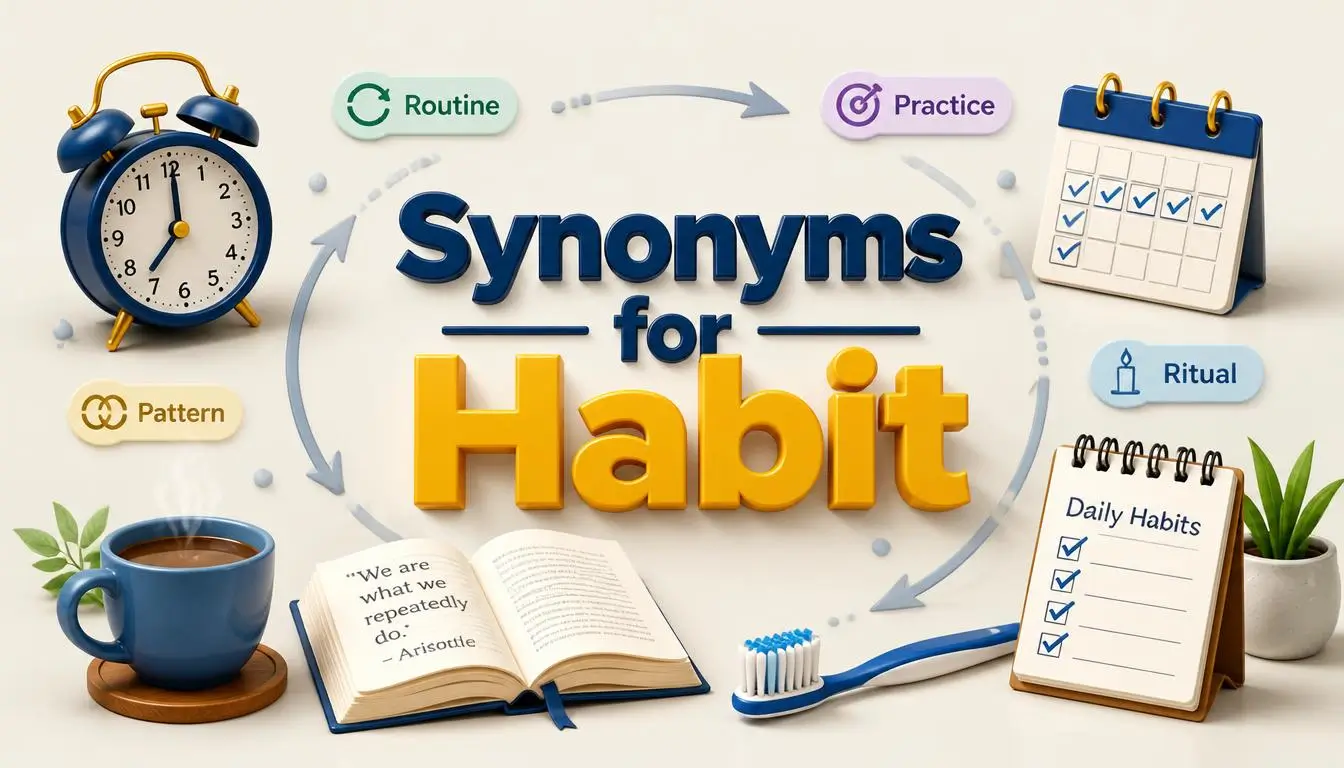
A habit is something you do regularly, often without thinking. Synonyms for habit include routine, practice, and pattern, while tendency, custom, and ritual fit specific situations.
Understanding these differences helps you choose the right words for everyday speech and writing.
Quick Answer
The best synonym for habit depends on the context.
- Routine: Regular activities, often done in a set order.
- Practice: A usual or accepted way of doing something.
- Pattern: A repeated way of behaving or responding.
- Tendency: A likelihood of behaving in a certain way.
- Custom: A traditional way of behaving in a group or community.
- Ritual: A repeated action with personal or special meaning.
- Mannerism: A distinctive way someone speaks, moves, or acts.
Use routine for regular activities, pattern for recurring behavior, and custom for shared traditions.
Definition and Meaning of Habit
The word habit is a noun. It means something a person does regularly, often because repetition has made the action familiar or automatic.
Habits can be helpful, such as exercising every morning, or harmful, such as biting your nails. Some happen almost automatically, while others involve a conscious choice.
Examples:
- Reading before bed is a good habit.
- She has a habit of arriving early.
- He is trying to break his habit of checking his phone too often.
This article focuses on habit as a repeated action or pattern of personal behavior.
Table of Synonyms for Habit
| Word | Category | Simple Meaning |
| Routine | Close synonym | Regular activities, often done in a set order |
| Practice | Close synonym | A usual or accepted way of doing something |
| Pattern | Close synonym | A repeated way of behaving or responding |
| Tendency | Context-dependent alternative | A likelihood of behaving in a certain way |
| Custom | Context-dependent alternative | A traditional practice shared by a group |
| Ritual | Close synonym | A repeated action with personal or special meaning |
| Mannerism | Context-dependent alternative | A distinctive way someone speaks or moves |
| Idiosyncrasy | Context-dependent alternative | A distinctive personal habit or trait |
Useful Synonyms for Habit With Examples
Routine
Meaning: A regular way of doing things, often in a set order.
Category: Close synonym.
Examples:
- My morning routine starts with a cup of coffee.
- She follows the same bedtime routine every night.
Practice
Meaning: A usual or accepted way of doing something. It can also mean repeated activity used to develop a skill.
Category: Close synonym.
Examples:
- Checking your work before submitting it is a good practice.
- The company practices regular safety checks.
Pattern
Meaning: A repeated way of behaving or responding in a situation.
Category: Close synonym.
Examples:
- I noticed a pattern in his spending.
- She has a pattern of staying up too late before exams.
Tendency
Meaning: A likelihood of behaving or responding in a particular way.
Category: Context-dependent alternative.
Examples:
- He has a tendency to interrupt people.
- I have a tendency to worry about small things.
Read More: Synonyms for Recovery: Words, Meanings, and Examples
Custom
Meaning: A usual or traditional way of behaving in a group or community.
Category: Context-dependent alternative.
Examples:
- It is a local custom to greet visitors warmly.
- Sharing food with guests is a custom in their village.
Ritual
Meaning: An action repeated regularly, often because it has personal, emotional, or special meaning.
Category: Close synonym.
Examples:
- Reading a few pages is my nightly ritual.
- They have a ritual of sharing good news at dinner.
Mannerism
Meaning: A distinctive way someone speaks, moves, or behaves.
Category: Context-dependent alternative.
Examples:
- Tapping his pen is a nervous mannerism.
- She has a familiar mannerism of tilting her head when she listens.
Idiosyncrasy
Meaning: A distinctive personal habit or trait that makes someone different from others.
Category: Context-dependent alternative.
Examples:
- His habit of naming every houseplant is a funny idiosyncrasy.
- One of her idiosyncrasies is arranging books by color.
Read More: Synonyms for Prosperous: 20 Words and Their Meanings
How to Choose the Right Alternative for Habit
Choose a word based on what you want to describe: a repeated action, a daily schedule, a recurring behavior, or a shared tradition.
| Word | Best Used For | Example |
| Habit | A repeated personal action | Biting my nails is a bad habit. |
| Routine | Regular activities, often in order | My morning routine includes a walk. |
| Practice | An established method or usual action | Checking your work is a good practice. |
| Pattern | Repeated behavior or events | He has a pattern of arriving late. |
| Tendency | A likelihood of behaving a certain way | She has a tendency to overthink. |
| Custom | A shared or traditional practice | It is a local custom to greet guests. |
| Ritual | A repeated action with special meaning | Tea before bed is my nightly ritual. |
| Mannerism | A distinctive personal behavior | Tapping his fingers is a nervous mannerism. |
Important Differences Between Habit and Similar Words
Habit vs. routine: A habit can be one repeated action, while a routine often includes several activities. Brushing your teeth is a habit; brushing your teeth, washing your face, and getting dressed can form a morning routine.
Habit vs. practice: A habit is something you do regularly, sometimes without thinking. A practice is often an established method or a usual way of doing something.
Habit vs. pattern: A habit usually refers to a repeated personal action. A pattern is broader and can describe recurring behavior or events, whether intentional or not.
Habit vs. custom: A habit usually describes individual behavior. A custom is a practice shared by a group or community.
Habit vs. tendency: A habit is a repeated action. A tendency describes how someone is likely to behave, even if they do not always act that way.
Habit vs. ritual: A ritual often has personal, emotional, or symbolic meaning. A habit does not need to carry any special meaning.
Habit vs. mannerism: A habit is a repeated action, while a mannerism is a distinctive way someone speaks, moves, or behaves.
Common Mistakes to Avoid
- Do not use custom for every personal habit. A custom usually involves a group or tradition.
- Do not use tendency when you mean a fixed daily routine. A tendency describes a likelihood, not a schedule.
- Do not treat pattern and habit as identical. A pattern can describe recurring events that no person deliberately performs.
- Do not use mannerism for every repeated action. It usually refers to a distinctive personal behavior or gesture.
- Do not use ritual for every habit. A ritual often carries personal or special meaning.
Frequently Asked Questions
What is the closest synonym for habit?
Routine is one of the closest alternatives when describing regular activities. However, practice or pattern may fit better when referring to an established action or recurring behavior.
What word can replace habit in a sentence?
The best replacement depends on the context. For example, “Reading before bed is part of my nightly routine” describes a regular bedtime activity.
What is the difference between a habit and a routine?
A habit is usually a repeated action, while a routine is a regular sequence of activities. Drinking water after waking up can be a habit, while your entire morning schedule is a routine.
Is practice another word for habit?
Sometimes. Both can describe repeated actions, but practice often suggests an established method or usual way of doing something. Reviewing your work can be a good practice, while biting your nails is a habit.
What is the opposite of a bad habit?
There is no single opposite in every context. Good habit, healthy habit, and positive habit are common expressions for behaviors that are helpful or beneficial.
Conclusion
Choosing the right alternative for habit makes your writing clearer and more natural. Words such as routine, practice, pattern, and tendency describe different kinds of repeated actions and behavior. Other words, such as custom and ritual, fit more specific situations. Understanding these differences can improve your essays, blog posts, and everyday conversations while helping you build a stronger vocabulary.

Rafaqat Ali is the founder of RankVorexa, a vocabulary-focused website dedicated to synonyms, word meanings, and better English word choices. He creates simple, useful, and easy-to-understand content to help students, writers, bloggers, and English learners improve their vocabulary and writing skills.