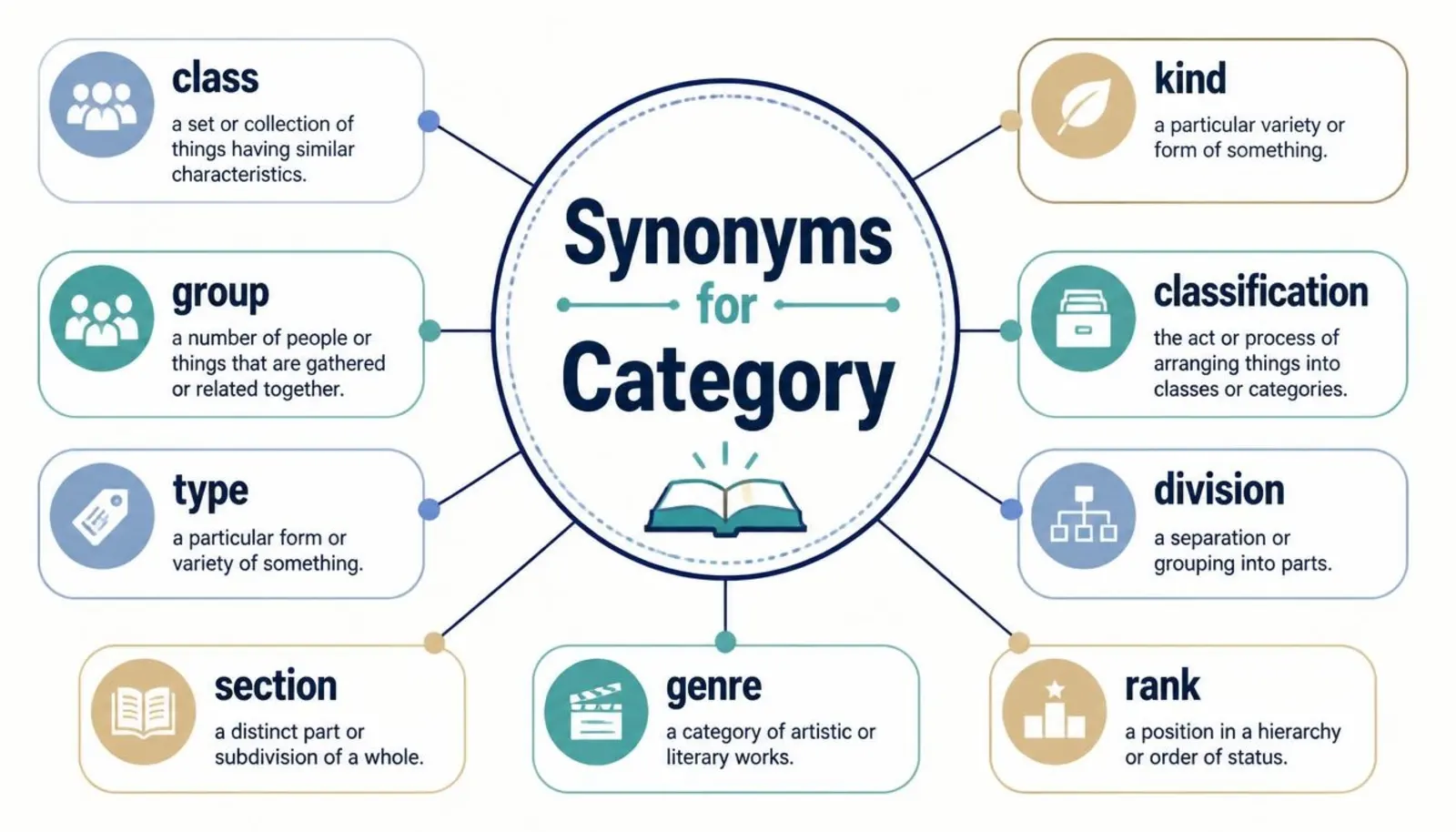
The word category describes a group of people, things, or ideas with shared features. Learning synonyms for category, such as class, group, type, kind, and sort, can help you choose the right words and make your writing clearer and more natural.
Quick Answer
The closest synonyms for category are class, group, type, kind, and sort. These words describe a group of people or things that share similar features. Other alternatives, such as division, section, segment, and grouping, may work in specific contexts but are not always interchangeable with category.
Definition and Meaning of Category
The word category is a noun. It means a group or class of people, things, or ideas that share similar features or belong together based on a particular system.
For example:
- Books can be placed into different categories based on their subjects.
- The store organizes its products into categories such as clothing, electronics, and home goods.
- Students may be divided into categories based on their grade levels.
The word is commonly used in education, business, science, shopping, research, and everyday communication.
Table of Synonyms and Related Alternatives for Category
The following words can replace categories in certain contexts. Some are close synonyms, while others describe specific types of groups or parts of an organizing system.
| Word | Category | Simple Meaning |
| Class | Near-exact synonym | A group sharing common features |
| Group | Close synonym | People or things considered together |
| Type | Close synonym | A particular kind of something |
| Kind | Close synonym | A group with similar qualities |
| Sort | Close synonym | A particular type or variety |
| Grouping | Context-dependent alternative | Things arranged or considered together |
| Division | Context-dependent alternative | A separate part of a larger whole |
| Section | Context-dependent alternative | A distinct part of something |
| Segment | Context-dependent alternative | A portion of a larger group or whole |
| Branch | Context-dependent alternative | A separate area or division |
| Family | Context-dependent alternative | A group of related things |
| Set | Context-dependent alternative | A collection of related items |
| Collection | Context-dependent alternative | A group of gathered items |
| Cluster | Context-dependent alternative | A group of closely related things |
| Variety | Context-dependent alternative | A particular type or form |
| Genre | Context-dependent alternative | A category of artistic or creative work |
| Subcategory | Related term | A smaller category within a larger one |
| Subgroup | Related term | A smaller group within a larger group |
| Subclass | Related term | A more specific class within a broader class |
| Classification | Related term | A system or process of arranging things into groups |
Best Synonyms for Category With Meanings and Examples
Class
Class is one of the closest alternatives to category. It describes a group of people or things that share similar qualities, features, or characteristics. It is commonly used in education, science, and classification systems.
Examples:
- Scientists divide animals into different classes.
- This device belongs to a class of portable electronics.
Group
Group refers to several people or things considered together because they share something in common. It is a useful everyday alternative to category when discussing collections or organized sets.
Examples:
- The teacher placed the students into different groups.
- These products belong to the same group.
Type
Type describes a particular kind or form of something. It is often used when identifying what something is rather than where it belongs in an organizing system.
Examples:
- What type of phone do you use?
- This type of book is popular among young readers.
Kind
Kind refers to a group of people or things with similar characteristics. It is a natural alternative to category in casual conversations and everyday writing.
Examples:
- What kind of music do you enjoy?
- This kind of problem requires careful attention.
Sort
Sort means a particular type or variety of something. It is commonly used in informal English and often appears in phrases such as “this sort of thing.”
Examples:
- I enjoy this sort of movie.
- That sort of behavior is unacceptable.
Read More: Synonyms for Technology: Words, Meanings, and Examples
Grouping
Grouping refers to the act or result of placing similar things together. It can describe an arrangement or a collection, but it does not replace category naturally in every sentence.
Examples:
- The grouping of similar words made the lesson easier.
- This grouping helps students understand the topic.
Division
Division describes a separate part of a larger organization, subject, or system. It can work as an alternative when a category represents a distinct section of a larger structure.
Examples:
- The company has a division for customer service.
- The report separates expenses into several divisions.
Section
Section means a distinct part of a larger document, place, organization, or system. It may replace category when referring to an organized part of something.
Examples:
- The website has a section for educational resources.
- Please place these items in the correct section.
Segment
Segment refers to one part of a larger whole. It is useful when discussing portions of a market, audience, population, or subject.
Examples:
- The company targets a younger segment of the market.
- This segment of the population needs additional support.
Branch
Branch describes a separate area of knowledge, activity, or organization that develops from a larger field or structure. It is suitable when categories represent distinct areas or fields.
Examples:
- Biology is a branch of natural science.
- The company created a new branch for digital services.
Read More: Synonyms for Wanting: Words for Desire, Need, and Interest
Family
Family can describe a group of related things that share common features or origins. It is often used in biology, product descriptions, and technical subjects.
Examples:
- These plants belong to the same family.
- The company offers several products in this family.
Set
Set refers to a collection of items that belong together or are considered as a unit. It can work as an alternative when a category contains related objects.
Examples:
- The teacher prepared a set of practice questions.
- These tools belong to the same set.
Collection
Collection means a group of items gathered or brought together. It is useful when discussing books, products, objects, or other related things, although a collection is not always a formal category.
Examples:
- The museum has a collection of ancient coins.
- She organized her photographs into separate collections.
Cluster
Cluster describes a group of things located close together or connected in some way. It can be useful when discussing related data, objects, or ideas.
Examples:
- The chart shows a cluster of related data points.
- A small cluster of houses stands near the river.
Variety
Variety refers to a particular type or form of something. It can sometimes replace categories, especially when discussing different forms of products, plants, or other things.
Examples:
- This variety of apple grows well in cold weather.
- The store offers a wide variety of products.
Read More: Synonyms for Touch: Meaning, Examples, and Alternative Words
Genre
Genre refers to a category of artistic or creative work that shares a particular style, subject, or set of features. It is commonly used for books, movies, music, and other creative works.
Examples:
- Mystery is my favorite book genre.
- The movie combines elements of two different genres.
Subcategory
Subcategory means a smaller category within a broader category. It helps organize information into more specific groups.
Examples:
- Fiction is divided into several subcategories.
- The website added a new subcategory for children’s books.
Subgroup
Subgroup refers to a smaller group within a larger group. It is useful when a broad category contains several more specific groups.
Examples:
- The researchers studied a subgroup of the participants.
- Each subgroup received a different assignment.
Subclass
Subclass describes a more specific class within a broader class. It is commonly used in scientific classification, programming, and other technical systems.
Examples:
- This subclass includes several related orders.
- The system places each subclass under a broader class.
Classification
Classification refers to the process or system of arranging people, objects, or information into groups based on shared features. It is related to category, but usually describes the organizing method rather than one individual group.
Examples:
- The classification of animals is based on shared characteristics.
- The library uses a clear classification system for its books.
Read More: Synonyms for Autumn: Fall and Other Words for the Season
Category vs. Type: What Is the Difference?
Category and type are closely related, but they do not always mean exactly the same thing.
- Category usually refers to a group or place within an organizing system.
- Type identifies the particular kind or form of something.
For example:
- “What type of phone do you use?” asks about the kind of phone.
- “Which category does this phone belong to?” asks where the phone fits within an organizing system.
Both words can describe similar groups, but the best choice depends on the sentence.
How to Choose the Right Alternative for Category
The best alternative depends on what you are describing and how the word is being used.
- Use class when discussing groups based on shared characteristics.
- Use a group for people or things considered together.
- Use type or kind when identifying a particular form of something.
- Use sort in casual conversations.
- Use section or division for separate parts of a larger structure.
- Use genre when discussing books, movies, or music.
- Use subcategory or subgroup for smaller groups within a broader one.
- Use classification when referring to an organizing system or process.
Choosing a word that matches the context makes your writing clearer and more accurate.
Common Mistakes When Using Synonyms for Category
Some words related to category are not direct replacements. Understanding their differences can help you avoid confusing sentences.
- Using classification as an exact synonym: Classification usually describes a system or process, not one individual category.
- Confusing a category with a section: A section is a part of a larger whole, while a category groups things based on shared features.
- Treating a subcategory as a complete synonym: A subcategory is a smaller group within a broader category.
- Using genre for every type of object: Genre is mainly used for creative works such as books, movies, and music.
- Assuming every collection is a category: A collection is simply a group of gathered items and may not follow a formal classification system.
Short Answer: What Is Another Word for Category?
Another word for category is class, group, type, kind, or sort. These are the most useful alternatives in everyday English. Words such as division, section, and segment may also work in specific contexts, while subcategory and subgroup describe smaller groups within larger ones.
Frequently Asked Questions
What is the closest synonym for category?
Class is one of the closest synonyms for category. Both words can describe a group of people or things that share similar characteristics.
What are five common synonyms for category?
Five common alternatives are class, group, type, kind, and sort. The best choice depends on the context and sentence.
Is type the same as category?
Not always. Type identifies what kind of thing something is, while category often describes the group or classification to which it belongs.
What is a more formal word for category?
Class and classification can sound more formal in certain contexts. However, classification usually refers to the system or process of organizing things rather than one specific category.
What is the difference between a category and a subcategory?
A category is a general group, while a subcategory is a smaller, more specific group within it. For example, clothing is a category, while jackets can be a subcategory.
Conclusion
Learning synonyms for categories can help you describe groups, types, and classifications more clearly. Words such as class, group, type, kind, and sort are useful alternatives in everyday English. Other terms, including section, division, and genre, work in more specific situations. Always consider the meaning and context before choosing a replacement. Using the right word makes your writing more natural, accurate, and easier to understand.

Rafaqat Ali is the founder of RankVorexa, a vocabulary-focused website dedicated to synonyms, word meanings, and better English word choices. He creates simple, useful, and easy-to-understand content to help students, writers, bloggers, and English learners improve their vocabulary and writing skills.