The word doubt describes uncertainty, disbelief, or a lack of confidence. Learning synonyms for doubt, such as uncertainty, skepticism, misgiving, and suspicion, can help you express your thoughts more clearly. The best alternative depends on the meaning and context.
Quick Answer
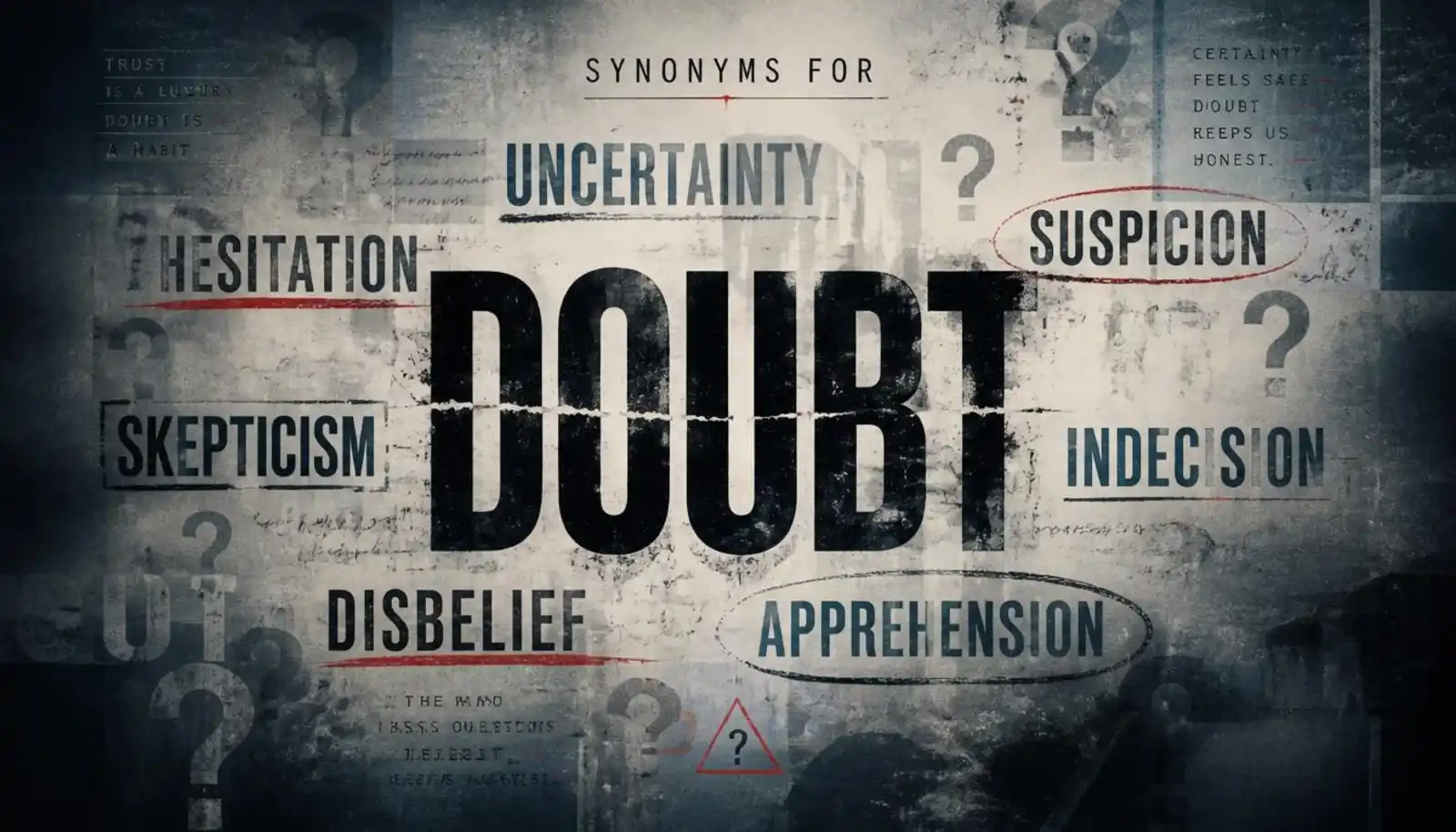
Some useful synonyms for doubt include uncertainty, skepticism, misgiving, suspicion, disbelief, mistrust, and reservation.
- Uncertainty describes a general lack of certainty.
- Skepticism expresses a questioning attitude toward a claim.
- Misgiving describes an uneasy feeling about a decision or situation.
- Suspicion suggests that something may be wrong or dishonest.
- Disbelief describes difficulty accepting something as true.
- Mistrust expresses a lack of trust in someone or something.
- Reservation describes a concern or objection about an idea or decision.
When using doubt as a verb, alternatives include question, suspect, and be skeptical, depending on the context.
Doubt: Definition and Meaning
The word doubt is both a noun and a verb. It describes uncertainty, a lack of belief, or a lack of confidence in something.
As a noun: Doubt is a feeling of uncertainty about whether something is true, correct, or likely to happen.
Example: I have some doubt about his explanation.
As a verb: To doubt means to question something, feel uncertain about it, or find it difficult to believe.
Example: I doubt that the plan will work.
Doubt can also describe a lack of trust or confidence in someone or something.
For example:
- I doubt his honesty. (I am not sure he is honest.)
- She has doubts about the new manager. (She is unsure whether she can trust or rely on the manager.)
The best synonym depends on whether you mean uncertainty, disbelief, suspicion, or lack of trust.
Table of Synonyms for Doubt
| Word | Category | Simple Meaning |
| Uncertainty | Near-exact synonym | Lack of certainty |
| Skepticism | Close synonym | A questioning attitude |
| Misgiving | Close synonym | An uneasy feeling about something |
| Suspicion | Context-dependent alternative | A belief that something may be wrong |
| Disbelief | Close synonym | Difficulty accepting something as true |
| Mistrust | Context-dependent alternative | Lack of trust |
| Distrust | Context-dependent alternative | A feeling that someone is unreliable |
| Incredulity | Close synonym | Difficulty believing something |
| Reservation | Context-dependent alternative | A concern or objection |
| Qualm | Context-dependent alternative | A feeling of worry about doing something |
| Unease | Close synonym | An uncomfortable feeling |
| Lack of confidence | Context-dependent alternative | Little belief in someone’s ability or success |
| Question | Verb alternative | To express doubt about something |
| Suspect | Verb alternative | To think something may be true |
| Hesitate | Verb alternative | To pause because of uncertainty |
| Challenge | Verb alternative | To question or dispute something |
| Be skeptical | Verb phrase | To question whether something is true |
| Call into question | Idiomatic phrase | To make something seem uncertain |
Main Synonyms for Doubt and Their Meanings
Uncertainty
Meaning: Uncertainty is a lack of knowledge or confidence about something.
Category: Near-exact synonym.
Examples:
- There is some uncertainty about the final result.
- Her uncertainty made it difficult to choose a school.
Skepticism
Meaning: Skepticism is an attitude of questioning whether something is true, accurate, or reliable.
Category: Close synonym.
Examples:
- His skepticism about the news was understandable.
- The new product faced skepticism from customers.
Misgiving
Meaning: A misgiving is an uneasy feeling that something may be wrong or may not turn out well.
Category: Close synonym.
Examples:
- I had some misgivings about the deal.
- She shared her misgivings before the meeting.
Suspicion
Meaning: Suspicion is a feeling or belief that something may be wrong, dishonest, or untrue.
Category: Context-dependent alternative.
Examples:
- His strange behavior raised suspicions.
- The police had suspicions about the missing money.
Disbelief
Meaning: Disbelief is the feeling of finding something difficult to accept as true.
Category: Close synonym.
Examples:
- She stared at the results in disbelief.
- His sudden announcement was met with disbelief.
Read More: Synonyms for Category: Meaning, Best Alternatives, and Examples
Mistrust
Meaning: Mistrust is a lack of trust in someone’s honesty, intentions, or actions.
Category: Context-dependent alternative.
Examples:
- Years of broken promises created mistrust.
- The customers developed mistrust toward the company.
Distrust
Meaning: Distrust is a feeling that someone or something cannot be trusted.
Category: Context-dependent alternative.
Examples:
- His actions created distrust among the team.
- I distrust offers that sound too good to be true.
Incredulity
Meaning: Incredulity is the feeling of finding something very difficult to believe.
Category: Close synonym.
Examples:
- He listened to the unbelievable story with incredulity.
- Her expression showed complete incredulity.
Reservation
Meaning: A reservation is a concern or objection that makes someone uncertain about accepting an idea or decision.
Category: Context-dependent alternative.
Examples:
- I have some reservations about this plan.
- The manager expressed reservations about the proposal.
Qualm
Meaning: A qualm is a feeling of worry or uneasiness about doing something, often because it may be wrong.
Category: Context-dependent alternative.
Examples:
- She had no qualms about speaking honestly.
- He had qualms about keeping the extra money.
Read More: Synonyms for Technology: Words, Meanings, and Examples
Unease
Meaning: Unease is an uncomfortable feeling that something may be wrong or uncertain.
Category: Close synonym.
Examples:
- I felt a sense of unease during the conversation.
- The unusual silence created unease in the room.
Lack of Confidence
Meaning: A lack of confidence is a feeling of uncertainty about someone’s abilities, decisions, or chances of success.
Category: Context-dependent alternative.
Examples:
- His lack of confidence affected his performance.
- She overcame her lack of confidence through practice.
Question
Meaning: As a verb, question means to express doubt about whether something is true, correct, or reasonable.
Category: Context-dependent verb alternative.
Examples:
- I question the accuracy of his report.
- She questioned whether the decision was fair.
Suspect
Meaning: As a verb, suspect means to think that something may be true, especially without complete proof.
Category: Context-dependent verb alternative.
Examples:
- I suspect that he knows the answer.
- The teacher suspected that something was wrong.
Hesitate
Meaning: To hesitate means to pause or delay because you feel uncertain or unsure about what to do.
Category: Related verb.
Examples:
- Don’t hesitate to ask for help.
- She hesitated before answering the question.
Read More: Synonyms for Wanting: Words for Desire, Need, and Interest
Challenge
Meaning: As a verb, challenge means to question, dispute, or disagree with something.
Category: Context-dependent verb alternative.
Examples:
- The lawyer challenged the witness’s statement.
- Several students challenged the teacher’s explanation.
Be Skeptical
Meaning: To be skeptical means to question a claim or remain unsure about whether it is true.
Category: Close synonym phrase.
Examples:
- I am skeptical about his promises.
- Many readers are skeptical of online rumors.
Call into Question
Meaning: This phrase means to make something seem uncertain, doubtful, or open to criticism.
Category: Idiomatic phrase.
Examples:
- The new evidence called his story into question.
- Her poor results called the team’s strategy into question.
Related Words and Expressions
Some words are connected to doubt but describe different feelings or situations. They can be useful when you want to express a more specific idea.
Apprehension
Meaning: Apprehension is a feeling of worry or fear about something that may happen.
Examples:
- She felt apprehension before her first interview.
- His apprehension grew as the deadline approached.
Indecision
Meaning: Indecision is the inability to make a choice because you are unsure what to do.
Examples:
- Her indecision delayed the final decision.
- He struggled with indecision when choosing a career.
Wonder
Meaning: Wonder is the act of thinking about something because you are curious or unsure about it.
Examples:
- I wonder whether she received my message.
- He began to wonder if he had made the right choice.
These words are related to doubt, but they are not direct replacements in every sentence.
Read More: Synonyms for Touch: Meaning, Examples, and Alternative Words
Context and Usage: Choosing the Right Synonym
Not every alternative for doubt works in every sentence. Some words describe uncertainty, while others express distrust, disbelief, or difficulty making a decision.
Doubt vs. Uncertainty
Both words describe a lack of certainty, but uncertainty is broader.
- Doubt: I have doubts about his explanation.
- Uncertainty: There is uncertainty about the weather tomorrow.
Use doubt when questioning a particular idea or claim. Use uncertainty when something is not known or decided.
Doubt vs. Skepticism
Skepticism describes a questioning attitude, while doubt can describe a single feeling of uncertainty.
- Doubt: I doubt that he will arrive on time.
- Skepticism: Her skepticism about the advertisement was clear.
Use skepticism when someone questions information or claims rather than simply feeling unsure.
Doubt vs. Suspicion
Suspicion often suggests that you believe something may be wrong or dishonest. Doubt can simply mean that you are not certain.
- Doubt: I have doubts about his explanation.
- Suspicion: I have suspicions about his business dealings.
Use suspicion when you have a reason to think something questionable may have happened.
Doubt vs. Disbelief
Disbelief is stronger than ordinary doubt. It describes difficulty accepting something as true.
- Doubt: I have some doubt about the story.
- Disbelief: She reacted to the surprising news with disbelief.
Use disbelief when something seems hard to believe.
Doubt vs. Hesitation
Doubt is a feeling of uncertainty, while hesitation is a pause or delay before taking action.
- Doubt: He had doubts about accepting the job.
- Hesitation: He hesitated before signing the contract.
Use hesitation when someone delays an action because they are unsure.
Formal and Informal Alternatives
Some alternatives are more suitable for particular writing styles.
- Formal: Skepticism, uncertainty, incredulity, and reservation work well in academic or professional writing.
- Everyday English: Doubt, suspicion, hesitation, and unease sound natural in ordinary conversations.
- Expressive writing: Misgiving and qualm can describe deeper feelings.
Common Usage Mistakes
- Do not use suspicion for every kind of uncertainty. It often suggests possible wrongdoing.
- Do not use hesitation when you mean a simple lack of belief. It usually involves delaying an action.
- Do not treat mistrust and disbelief as identical. Mistrust concerns confidence in someone or something, while disbelief concerns accepting something as true.
- Do not use apprehension as a perfect replacement for doubt. It usually includes worry or fear about the future.
Short Answer: What Are the Best Synonyms for Doubt?
The best synonyms for doubt include uncertainty, skepticism, misgiving, suspicion, disbelief, mistrust, and reservation. Use uncertainty for a general lack of certainty, skepticism when questioning a claim, and suspicion when you think something may be wrong. For the verb, question and suspect are useful alternatives in the right context.
Frequently Asked Questions
What is the closest synonym for doubt?
Uncertainty is one of the closest synonyms for doubt when describing a lack of certainty. Skepticism is another useful choice when questioning whether something is true.
What is another word for doubt in a sentence?
You can use uncertainty, suspicion, misgiving, or skepticism, depending on the meaning. For example, “I have doubts about the plan” can become “I have reservations about the plan.”
What is the difference between doubt and suspicion?
Doubt means feeling unsure about something, while suspicion suggests that something may be wrong or dishonest. Suspicion often involves a stronger belief that something questionable has happened.
What is a formal synonym for doubt?
Skepticism, uncertainty, incredulity, and reservation are useful alternatives in formal writing. The best choice depends on the sentence and the meaning you want to express.
What is the opposite of doubt?
Common antonyms of doubt include certainty, confidence, belief, trust, and conviction. Certainty is especially suitable when doubt means uncertainty, while trust works when doubt means a lack of confidence in someone.
Conclusion
Learning different synonyms for doubt can make your writing clearer and more expressive. Words such as uncertainty, skepticism, misgiving, and disbelief help you describe different feelings and situations. Choosing the right alternative also makes your essays, blog posts, emails, and everyday conversations more natural. Practice using these words in your own sentences, and remember that the best synonym is always the one that matches your intended meaning.

Rafaqat Ali is the founder of RankVorexa, a vocabulary-focused website dedicated to synonyms, word meanings, and better English word choices. He creates simple, useful, and easy-to-understand content to help students, writers, bloggers, and English learners improve their vocabulary and writing skills.