
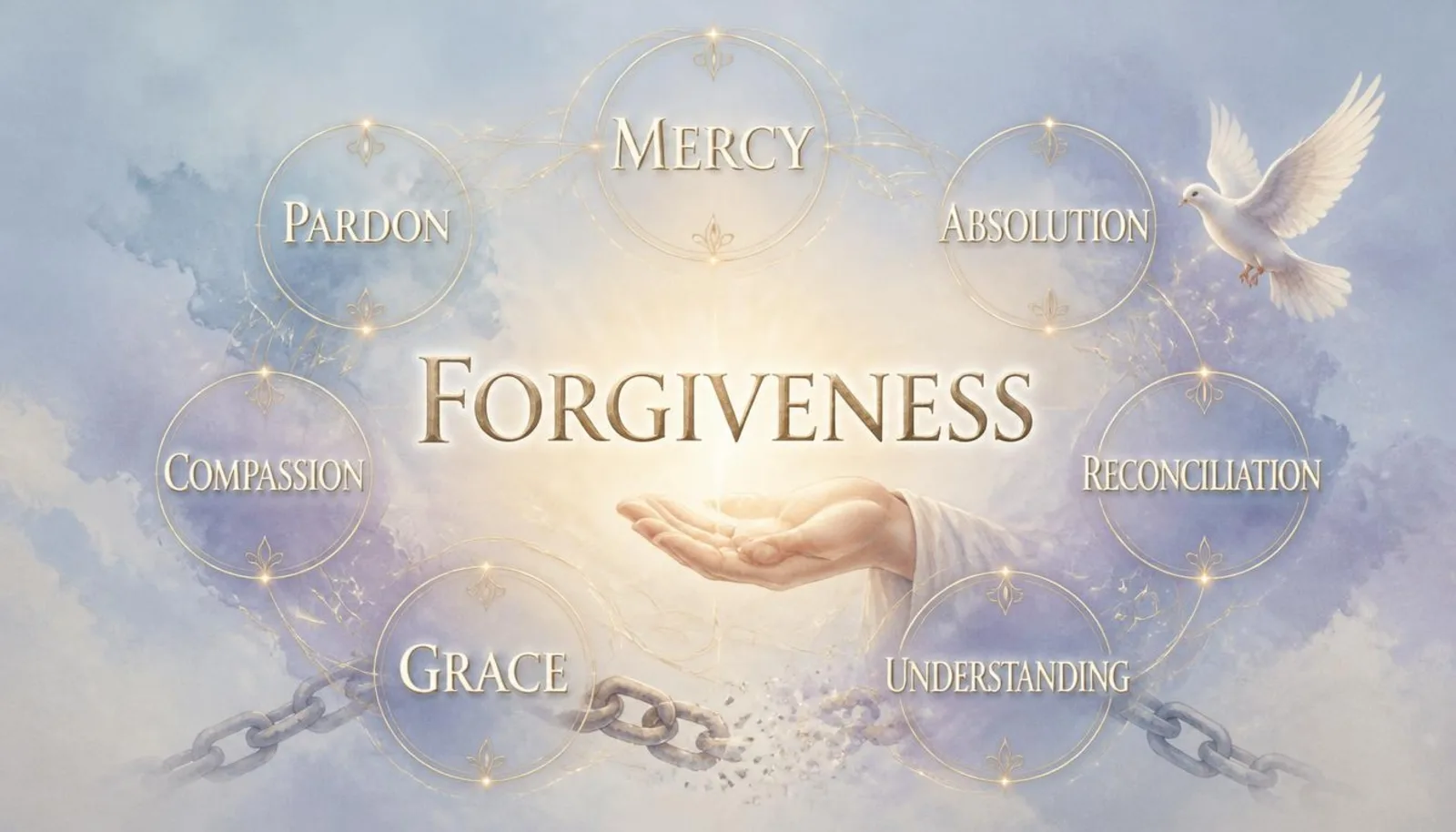
Forgiveness means letting go of anger or resentment toward someone who has hurt you. Learning synonyms for forgiveness, such as pardon, absolution, and mercy, can help you express this idea more clearly. However, each word has a slightly different meaning, so the best choice depends on the context.
Quick Answer
Pardon is one of the closest alternatives to forgiveness when referring to excusing an offense or mistake. Absolution is a more formal or religious term for release from guilt or sin. Other related words include mercy, compassion, leniency, and forbearance. These words describe different aspects of forgiveness rather than serving as exact replacements.
What Does Forgiveness Mean?
Forgiveness is the act of letting go of anger, resentment, or the desire to punish someone for a mistake or wrongdoing. It means choosing not to hold an offense against another person.
Forgiveness does not always mean forgetting what happened, accepting harmful behavior, or rebuilding a relationship. Someone can forgive another person while still setting boundaries or choosing to stay apart.
For example:
- She offered forgiveness after her friend apologized.
- Forgiveness helped him move forward after the disagreement.
Best Synonyms for Forgiveness
The following words and expressions relate to forgiveness. Some are close alternatives, while others describe specific forms of mercy, acceptance, or letting go of resentment.
| Word | Word Type | Meaning or Relationship |
| Pardon | Close alternative | Excusing an offense or wrongdoing |
| Absolution | Context-specific alternative | Formal release from guilt or sin |
| Clemency | Related term | Mercy shown by reducing punishment |
| Mercy | Related term | Kindness toward someone who could be punished |
| Leniency | Related term | A less strict or severe response |
| Forbearance | Related term | Patience and restraint toward someone’s mistakes |
| Remission | Context-specific alternative | Cancellation or reduction of a penalty, debt, or religious guilt |
| Indulgence | Related term | Willingness to overlook someone’s behavior |
| Compassion | Related term | Concern for another person’s suffering |
| Grace | Related term | Kindness or goodwill shown toward someone |
| Tolerance | Related term | Willingness to accept behavior or differences |
| Understanding | Related term | Sympathy or awareness of another person’s situation |
| Reconciliation | Related concept | Restoring a relationship after disagreement or conflict |
| Amnesty | Context-specific alternative | Official forgiveness granted to a group for certain offenses |
| Condonation | Related but distinct term | Overlooking or accepting wrongdoing, sometimes without expressing disapproval |
Pardon
Pardon is one of the closest alternatives to forgiveness. It means excusing an offense or choosing not to hold a mistake against someone. It can also refer to an official decision to forgive a crime or remove a penalty.
Examples:
- The governor granted him a pardon.
- The court pardoned him for the offense.
Absolution
Absolution means formal release from guilt or sin, especially in a religious context. It can also refer to being freed from blame in certain formal situations.
Examples:
- The priest offered absolution after the confession.
- He searched for absolution after admitting his mistake.
Clemency
Clemency means showing mercy by reducing the punishment given to someone. It is commonly used in legal and official situations rather than everyday personal relationships.
Examples:
- The governor granted clemency to the prisoner.
- The judge showed clemency because of his difficult circumstances.
Mercy
Mercy means showing kindness or compassion instead of giving someone the punishment they might deserve. It is related to forgiveness but focuses more on kindness and restraint.
Examples:
- The judge showed mercy when deciding the sentence.
- She asked her parents for mercy after breaking the rules.
Read More: Synonyms for Doubt: Meaning, Best Alternatives, and Examples
Leniency
Leniency means being less strict or severe when responding to someone’s mistake or wrongdoing. It often describes a decision to reduce punishment rather than fully forgive someone.
Examples:
- The teacher showed leniency toward the student.
- The manager treated the first mistake with leniency.
Forbearance
Forbearance means showing patience and self-control when dealing with someone’s mistakes or difficult behavior. It suggests choosing not to react with anger or harshness.
Examples:
- Her forbearance helped prevent another argument.
- He showed forbearance when his coworker made the same mistake again.
Remission
Remission means the cancellation or reduction of something owed, such as a debt, penalty, or punishment. In religious contexts, it can refer to the forgiveness of sins. It is not a general everyday substitute for forgiveness.
Examples:
- The church teaches about the remission of sins.
- The court granted remission of part of his sentence.
Indulgence
Indulgence means allowing someone to enjoy something or overlooking behavior that might normally be restricted. In some contexts, it suggests being too willing to excuse someone’s mistakes.
Examples:
- Her parents showed indulgence when she broke the household rules.
- His parents sometimes showed indulgence toward his minor mistakes.
Read More: Synonyms for Category: Meaning, Best Alternatives, and Examples
Compassion
Compassion means feeling concern for someone who is suffering or facing difficulties. It can encourage forgiveness, but it does not necessarily mean excusing wrongdoing.
Examples:
- She showed compassion toward her friend after the mistake.
- His compassion helped him understand why she had acted that way.
Grace
Grace means showing kindness, patience, or goodwill toward someone, especially when they have made a mistake. It can describe a forgiving attitude, although it is not always a direct synonym for forgiveness.
Examples:
- She responded to his apology with grace.
- He handled the disagreement with patience and grace.
Tolerance
Tolerance means accepting behavior, opinions, or differences that you may not agree with. It is related to forgiveness because both can involve patience and acceptance, but tolerance does not necessarily mean letting go of resentment.
Examples:
- The teacher showed tolerance toward different opinions.
- Their friendship required patience and tolerance.
Understanding
Understanding means recognizing why someone acted in a particular way or appreciating their situation. It can make forgiveness easier, but it does not automatically mean excusing the person’s actions.
Examples:
- Her understanding helped him explain his mistake.
- He showed understanding when his friend missed the meeting.
Read More: Synonyms for Technology: Words, Meanings, and Examples
Reconciliation
Reconciliation means restoring a relationship after an argument, disagreement, or period of separation. Forgiveness can help people reconcile, but the two words describe different things.
Examples:
- Their reconciliation began with an honest conversation.
- Forgiveness helped them work toward reconciliation.
Amnesty
Amnesty means an official decision to forgive or overlook certain offenses, usually for a group of people. It is commonly used in legal and political contexts, not personal relationships.
Examples:
- The government announced an amnesty for certain offenses.
- The new law offered amnesty to eligible individuals.
Condonation
Condonation means overlooking or accepting wrongdoing, sometimes in a way that suggests approval or a failure to object. Unlike forgiveness, it can imply that unacceptable behavior is being tolerated.
Examples:
- His silence was seen as condonation of the behavior.
- The manager’s condonation of repeated mistakes concerned the team.
Read More: Synonyms for Wanting: Words for Desire, Need, and Interest
Forgiveness vs. Other Related Words
Some words are connected to forgiveness but have different meanings. Understanding these differences can help you choose the right expression.
Forgiveness vs. Pardon
Forgiveness means letting go of resentment toward someone who has hurt you. Pardon means excusing an offense or wrongdoing. Pardon can sound more formal or official, while forgiveness is more common in personal relationships.
Forgiveness vs. Mercy
Forgiveness involves letting go of anger or resentment. Mercy means showing kindness or reducing punishment. Someone can show mercy without fully forgiving another person.
Forgiveness vs. Absolution
Forgiveness is a general act of letting go of resentment. Absolution refers to formal release from guilt or sin, especially in religious settings. It is more formal and specific.
Forgiveness vs. Reconciliation
Forgiveness means releasing resentment toward someone. Reconciliation means restoring a relationship. People can forgive each other without becoming close again.
Forgiveness vs. Exoneration
Forgiveness means letting go of resentment after an offense. Exoneration means clearing someone of blame or proving that they are not responsible. A person may be exonerated because they did nothing wrong, rather than forgiven for an offense.
Forgiveness vs. Condonation
Forgiveness means releasing resentment toward someone for their actions. Condonation means overlooking or accepting wrongdoing, sometimes without showing disapproval. Forgiveness does not require approving of harmful behavior.
Common Mistakes When Choosing a Synonym for Forgiveness
Some words may seem similar to forgiveness but are not interchangeable in every sentence.
- Using mercy as an exact replacement: Mercy focuses on kindness or reducing punishment, not necessarily releasing resentment.
- Confusing reconciliation with forgiveness: Reconciliation means repairing a relationship, while forgiveness is an emotional or personal response.
- Using exoneration incorrectly: Exoneration means clearing someone of blame, not forgiving them.
- Treating condonation as positive forgiveness: Condonation can suggest overlooking or accepting harmful behavior.
- Using absolution in everyday situations: Absolution is more suitable for religious or formal contexts.
Short Answer: What Is Another Word for Forgiveness?
Pardon is one of the closest alternatives to forgiveness when referring to excusing an offense. Absolution is more suitable for religious or formal contexts. Other related words include mercy, compassion, leniency, and forbearance, depending on the situation.
Frequently Asked Questions
What is the closest synonym for forgiveness?
Pardon is one of the closest synonyms for forgiveness because both can refer to excusing someone’s offense or mistake. However, forgiveness is more natural in everyday personal situations.
What is another word for forgiveness in a sentence?
Depending on the context, you can use pardon as an alternative to forgiveness. For example: “The teacher pardoned the student for the mistake.” In religious contexts, absolution may also be appropriate.
Are forgiveness and pardon the same?
They have similar meanings, but they are not always interchangeable. Forgiveness usually refers to letting go of resentment, while pardon focuses on excusing an offense or wrongdoing.
Is mercy a synonym for forgiveness?
Mercy is a related word, but it is not an exact synonym. It means showing kindness or reducing punishment instead of treating someone harshly.
What is the difference between forgiveness and reconciliation?
Forgiveness means letting go of resentment toward someone. Reconciliation means restoring a relationship after conflict. Forgiveness may lead to reconciliation, but it does not always do so.
Conclusion
Forgiveness means letting go of resentment and choosing not to hold someone’s mistake or wrongdoing against them. Pardon is a close alternative when referring to excusing an offense, while absolution is mainly used in religious or formal contexts. Mercy, compassion, leniency, and forbearance describe related ideas. Reconciliation refers to restoring a relationship, and condonation means overlooking or accepting wrongdoing. Understanding these differences helps you choose the right word and express your thoughts more clearly in everyday English and writing.

Rafaqat Ali is the founder of RankVorexa, a vocabulary-focused website dedicated to synonyms, word meanings, and better English word choices. He creates simple, useful, and easy-to-understand content to help students, writers, bloggers, and English learners improve their vocabulary and writing skills.