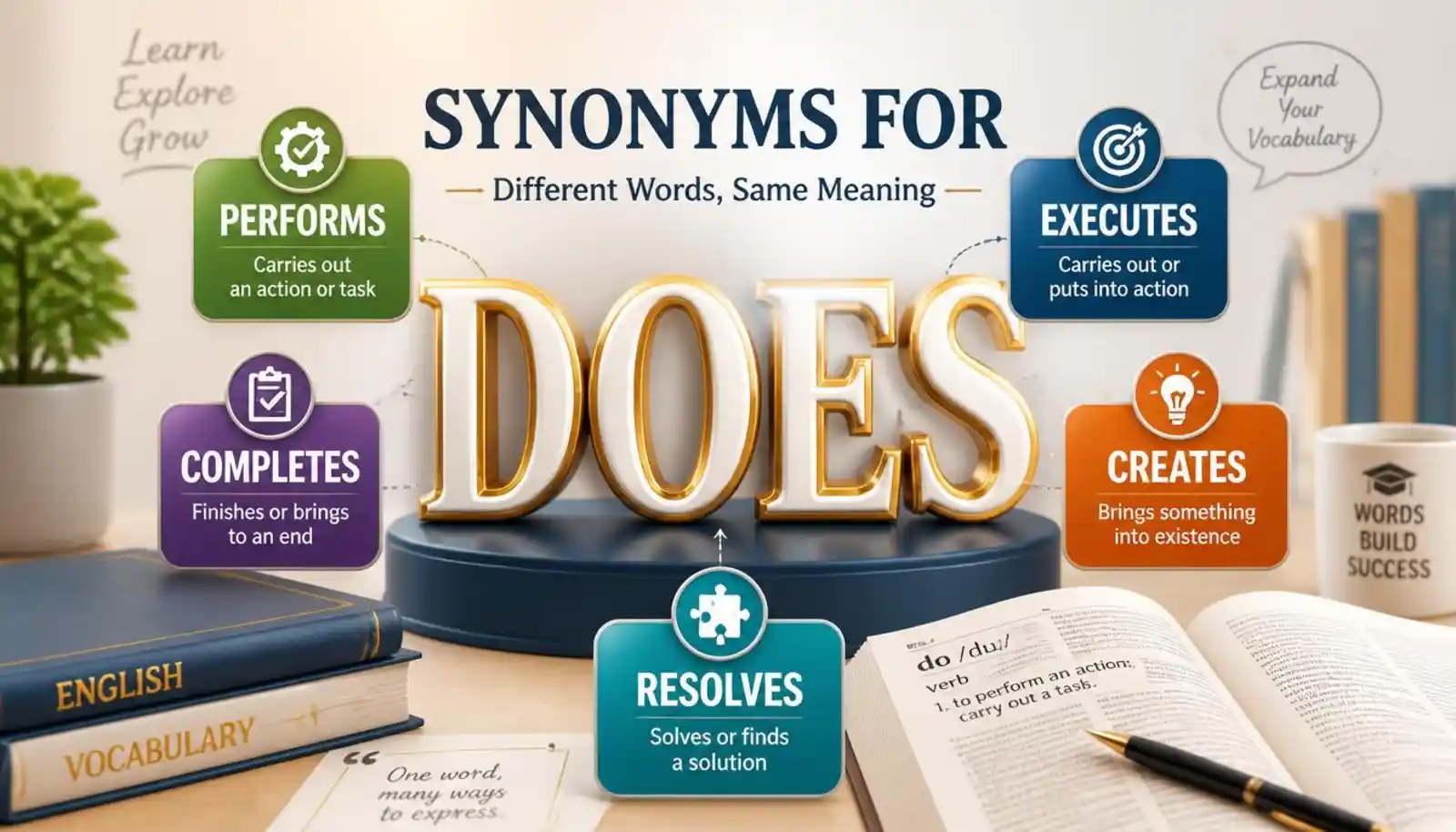
Have you used does too often and wanted a more precise word? Learning synonyms for does can make your English clearer and less repetitive. For example, “She does the task quickly” can become “She completes the task quickly.”
Does is the third-person singular form of do. Its best alternative depends on the context, because it can describe an action, task, responsibility, or result.
Learning synonyms for does can help students, writers, bloggers, and everyday English users write more naturally.
Quick Answer
The best alternative to does depends on the sentence:
- Does a task → performs, completes, accomplishes
- Does a task or action → carries out, executes
- Does a study, event, or activity → conducts
- Does a job or responsibility → handles, manages, fulfills
- Does a plan or program → implements
- Does something in practice → applies, practices, engages in
- Does something with a machine or system → operates, runs
- Does something successfully → accomplishes
- Does something to create a result → creates, produces, makes, generates
- Does something that causes an effect → causes
- Does something for someone → provides, delivers
- Does something about a problem → addresses, tackles, resolves
- Does something in a particular way → acts, behaves
- Does a job or activity → works, functions
Important: When it is used as an auxiliary verb, such as “Does she like coffee?”, it normally cannot be replaced with an ordinary synonym.
What Does “Does” Mean?
Does is the third-person singular present form of do. It can mean performing an action, completing a task, carrying out an activity, producing an effect, or taking action depending on context.
For example:
- She does her homework every evening.
- He does a great job.
- The machine does the work automatically.
In each sentence, does has a slightly different function. That is why choosing a replacement requires attention to the surrounding words.
Performs
Performs means carries out a task, action, duty, or activity.
- She performs her duties carefully.
- The technician performs several safety checks each morning.
Carries Out
Carries out means completing or performing a planned task, instruction, or action.
- The team carries out the safety inspection every month.
- She carries out the manager’s instructions carefully.
Executes
Executes means carrying out a plan, order, instruction, or action.
- The company executes its marketing plan effectively.
- The software executes the command automatically.
Completes
Completes means finishes a task, activity, or piece of work.
- She completes her homework before dinner.
- He completes the report by Friday.
Accomplishes
Accomplishes means successfully completes or achieves a task, goal, or purpose.
- She accomplishes the task ahead of schedule.
- He accomplishes his daily goals with careful planning.
Conducts
Conducts means carrying out an organized activity, study, meeting, test, or investigation.
- The researchers conduct a survey every year.
- The manager conducts weekly team meetings.
Handles
Handles means deals with or takes responsibility for a task, situation, or problem.
- She handles customer complaints professionally.
- He handles the paperwork for the entire department.
Manages
Manages means takes control of, organizes, or deals with something successfully.
- She manages the project efficiently.
- He manages several responsibilities at once.
Undertakes
Undertakes means accepting responsibility for and begins a task or project.
- The organization undertakes several community projects each year.
- She undertakes the difficult assignment without hesitation.
Fulfills
Fulfills means carrying out or satisfies a duty, responsibility, requirement, or promise.
- He fulfills his responsibilities as a team leader.
- She fulfills all the requirements of the position.
Implements
Implement means putting a plan, policy, system, or decision into action.
- The school implements a new attendance policy.
- The company implements the changes next month.
Applies
Applies means uses a rule, method, principle, skill, or knowledge in a particular situation.
- She applies her knowledge to real-world problems.
- He applies the same method to every experiment.
Practices
Practice means repeatedly performing an activity or skill to improve it.
- She practices the piano every evening.
- He practices speaking English with his classmates.
Engages In
Engages in means takes part in a particular activity, practice, or type of behavior.
- She engages in regular exercise.
- The students engage in group discussions during class.
Operates
Operates means controls or uses a machine, device, system, or business.
- She operates the printing machine safely.
- He operates a small repair shop downtown.
Runs
Runs means operates, controls, or manages a machine, system, program, or business.
- She runs a successful online store.
- The computer runs the program automatically.
Works
Works means performs a function or carries out an activity, often with a specific purpose.
- This method works well for beginners.
- The new system works without any major problems.
Functions
Functions operate or perform its intended purpose.
- The device functions properly after the repair.
- The new software functions as expected.
Acts
Acts means behaving or taking action in a particular way.
- She acts calmly during difficult situations.
- He acts quickly when a problem appears.
Behaves
Behaves means acts or responds in a particular manner.
- The child behaves politely around guests.
- The machine behaves differently in cold weather.
Creates
Creates means makes something new or causes something to exist.
- The artist creates beautiful designs.
- The new policy creates more opportunities for students.
Produces
Produces means makes, generates, or brings about a result, product, or effect.
- The factory produces thousands of units each month.
- The treatment produces positive results for many patients.
Makes
Makes means creates, prepares, builds, or causes something, depending on context.
- She makes dinner for her family.
- The decision makes a noticeable difference to the project.
Causes
Causes means making something happen as a result of an action or event.
- Heavy rain causes flooding in low areas.
- Lack of sleep causes tiredness during the day.
Generates
Generates means produces or creates a result, effect, amount, or response.
- The campaign generates thousands of website visits.
- The machine generates enough power for the building.
Provides
Provides means gives or makes something available for someone to use or receive.
- The program provides free training to new employees.
- The website provides useful information for students.
Delivers
Delivers means provides, supplies, or produces something that is expected or promised.
- The service delivers reliable results.
- The company delivers training to new employees.
Addresses
Addresses deal with a problem, issue, need, or concern.
- The new policy addresses several safety concerns.
- The report addresses the main causes of the problem.
Tackles
Tackles actively deal with a difficult problem or challenge.
- The organization tackles food waste in local communities.
- The team tackles the technical problems one by one.
Resolves
Resolves means solves a problem, disagreement, or difficulty.
- The technician resolves the software issue quickly.
- The manager resolves the disagreement between the employees.
How to Choose the Right Alternative to “Does”
The correct alternative depends on what it means in the sentence.
If it refers to finishing a task, completing or accomplishing it may work well. If it refers to carrying out a plan, executes or implements may be more precise. For responsibilities, handles, manages, or fulfills can be useful.
For machines and systems, operates, runs, or functions may be appropriate. When it refers to creating or producing a result, words such as creates, produces, makes, and generates can provide more specific meanings.
Important Note About Auxiliary “Does”
Not every use of does can be replaced with a synonym.
In the question:
Does she like coffee?
Does is an auxiliary verb that helps form the question. You cannot normally replace it with words such as performs, completes, or creates.
The same applies to sentences such as:
He does not understand the question.
Here, it helps form the negative construction. It is not being used to mean “performs” or “completes.”
Frequently Asked Questions
What is the closest synonym for “does”?
There is no single closest synonym for every use of does. Depending on context, performs, carries out, completes, or makes may work.
Can “does” be replaced in every sentence?
No. Does can function as either a main verb or an auxiliary verb, so its replacement depends on the sentence.
What can I use instead of “does” in formal writing?
Use a more precise verb when possible. For example, use conducts for research, implements a plan, completes a task, and addresses a problem.
Are “makes” and “does” synonyms?
They can overlap in some contexts, but they are not interchangeable everywhere. Make usually focuses on creating, preparing, or causing something.
Are “works” and “does” synonyms?
Sometimes they overlap when describing how something functions, but work has its own meanings and cannot replace does in every sentence.
Are all 30 alternatives interchangeable with “does”?
No. These are useful contextual alternatives rather than 30 exact synonyms. The correct choice depends on the meaning of does in the sentence.
Conclusion
Learning synonyms for does can help you choose more precise verbs and avoid repetitive writing. However, the best replacement depends on context. Words such as performs, completes, conducts, implements, operates, creates, produces, addresses, and resolves each express a particular meaning more clearly. Remember that does can also function as an auxiliary verb, where an ordinary synonym usually cannot replace it. Choosing the right verb makes your English more natural, specific, and effective.

Rafaqat Ali is the founder of RankVorexa, a vocabulary-focused website dedicated to synonyms, word meanings, and better English word choices. He creates simple, useful, and easy-to-understand content to help students, writers, bloggers, and English learners improve their vocabulary and writing skills.