
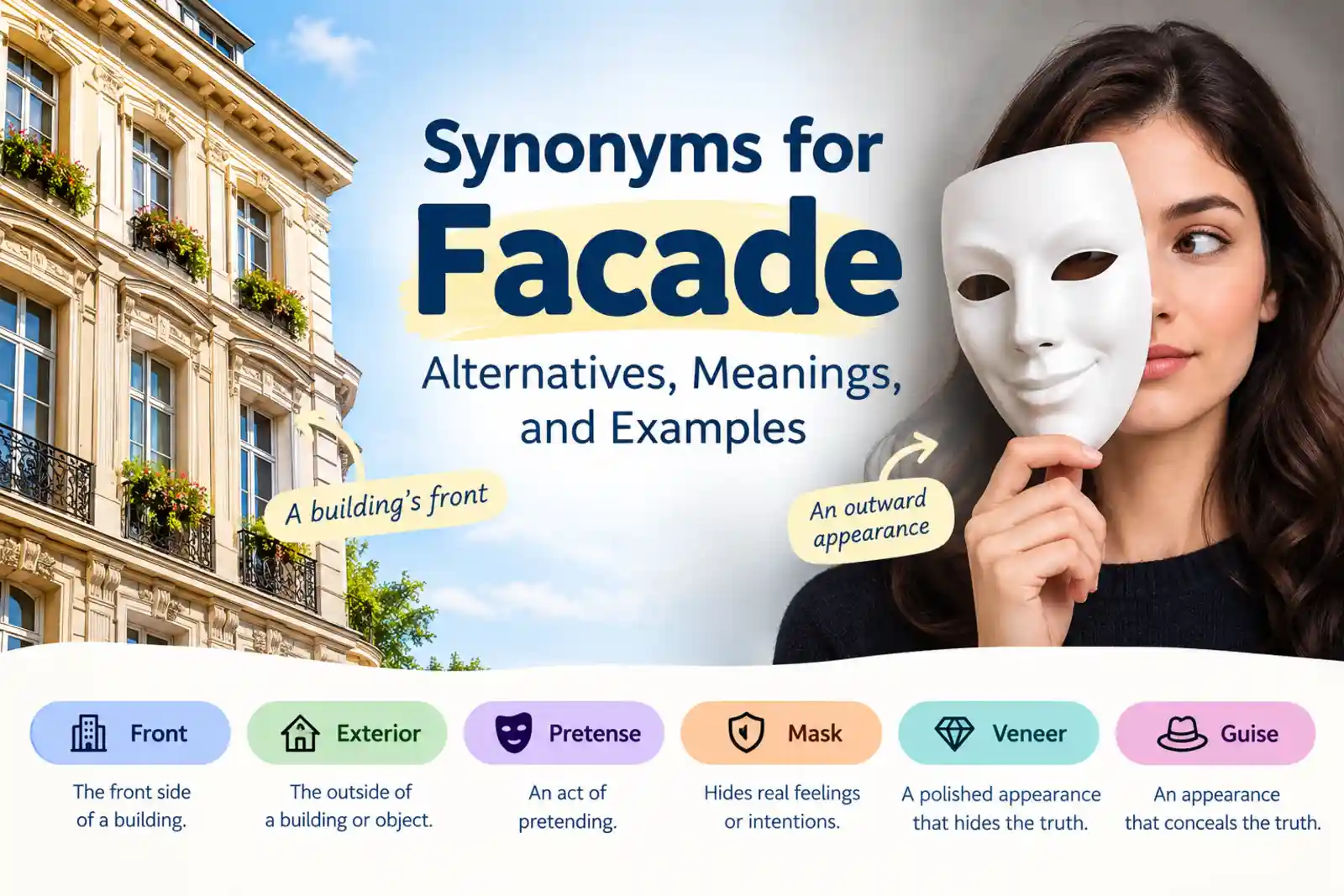
The word facade can describe a building’s front or an outward appearance that hides the truth. Alternatives like front, pretense, mask, and veneer work in different contexts. This guide explains their meanings and shows you how to use them naturally.
Quick Answer
The best synonym for facade depends on its meaning:
- Front: The front side of a building.
- Exterior: The outside of a building or object.
- Pretense: An act of pretending.
- False front: An appearance that hides the truth.
- Mask: Something that conceals real feelings or intentions.
- Veneer: A polished outer appearance that hides a less pleasant reality.
- Guise: An appearance or form that can conceal the true nature of something.
Use front when referring to a building’s front. Choose pretense, mask, veneer, or false front when describing an appearance that hides reality.
What Does Facade Mean?
Facade is a noun with two main meanings.
Building meaning: The front or face of a building, especially the side that people see from the street.
Figurative meaning: An outward appearance that hides someone’s real feelings, intentions, or the true nature of a situation.
For example, a building may have an elegant facade, while a person may maintain a calm facade to hide their worry. The context determines which alternative fits best.
Table of Synonyms for Facade
| Word | Category | Simple Meaning |
| Front | Near-exact synonym (building) | The forward-facing side of a building |
| Exterior | Close synonym (building) | The outside of a building or object |
| Face | Context-dependent alternative | The front or visible side of something |
| Frontage | Context-dependent alternative | The part of a property facing a street |
| Elevation | Related technical term | A drawing or view of one side of a building |
| Pretense | Close synonym (figurative) | An act of pretending |
| False front | Close synonym (figurative) | An outward appearance that hides the truth |
| Mask | Context-dependent alternative | Something that conceals true feelings or intentions |
| Veneer | Close synonym (figurative) | A polished surface that hides what lies beneath |
| Guise | Close synonym (figurative) | An appearance or form that may conceal the truth |
| Semblance | Context-dependent alternative | An appearance or limited impression of something |
| Illusion | Context-dependent alternative | An impression that differs from reality |
| Show | Context-dependent alternative | An outward display, sometimes meant to impress |
| Disguise | Context-dependent alternative | Something that hides identity or true nature |
| Cover | Context-dependent alternative | Something used to conceal an activity or the truth |
These alternatives differ in meaning. Some describe the physical front of a building, while others describe an appearance that may hide reality.
Front
Meaning: The front is the side of a building that faces the street or main entrance.
Category: Near-exact synonym for the building meaning.
Examples:
- The front of the house needs a fresh coat of paint.
- We stood in front of the building to take a photo.
Exterior
Meaning: The exterior is the outside surface or outer part of a building or object.
Category: Close synonym for the building meaning.
Examples:
- The building’s exterior looks clean and modern.
- They painted the exterior of the old school.
Face
Meaning: The face is the front or visible side of a building or object.
Category: Context-dependent alternative.
Examples:
- The south face of the tower gets plenty of sunlight.
- The building’s front face features large stone columns.
Frontage
Meaning: Frontage is the part of a property that faces a street or another area.
Category: Context-dependent alternative.
Examples:
- The shop has a wide frontage on Main Street.
- The house has a brick frontage and a wooden door.
Elevation
Meaning: An elevation is a drawing or view showing one side of a building.
Category: Related technical term.
Examples:
- The architect showed us the front elevation.
- The plans include an elevation of the new library.
Read More: Synonyms for Rooted: Alternatives, Meanings, and Examples
Pretense
Meaning: A pretense is an act of pretending or making something seem true when it is not.
Category: Close synonym for the figurative meaning.
Examples:
- His confidence was only a pretense.
- She dropped the pretense that everything was fine.
False Front
Meaning: A false front is an outward appearance or display that conceals the real situation.
Category: Close synonym for the figurative meaning.
Examples:
- His cheerful attitude was a false front.
- The company’s polished image was a false front that hid its poor service.
Mask
Meaning: A mask is something that hides a person’s real feelings, character, or intentions.
Category: Context-dependent alternative.
Examples:
- His smile was a mask for his sadness.
- She used humor as a mask for her fear.
Veneer
Meaning: A veneer is a thin outer layer or a polished appearance that hides a different reality.
Category: Close synonym in figurative contexts.
Examples:
- A veneer of politeness hid his anger.
- The scandal exposed the veneer of respectability.
Guise
Meaning: A guise is an appearance or form that can conceal the true nature of someone or something.
Category: Close synonym for the figurative meaning.
Examples:
- He offered the criticism under the guise of helpful advice.
- The scam operated under the guise of a genuine charity.
Read More: Synonyms for Tale: 30 Alternatives and Related Words
Semblance
Meaning: A semblance is an appearance or impression of something, which may be incomplete or misleading.
Category: Context-dependent alternative.
Examples:
- She tried to maintain a semblance of calm.
- The team restored a semblance of order after the meeting.
Illusion
Meaning: An illusion is an impression that makes something seem different from what it really is.
Category: Context-dependent alternative.
Examples:
- Their luxury lifestyle was an illusion.
- The bright lights created an illusion of space.
Show
Meaning: A show is an outward display of a feeling or quality, sometimes intended to impress others.
Category: Context-dependent alternative.
Examples:
- His kindness was just a show for the guests.
- She put on a show of confidence during the interview.
Disguise
Meaning: A disguise hides or changes the true identity or nature of someone or something.
Category: Context-dependent alternative.
Examples:
- He disguised his anger as a joke.
- The plain exterior disguised the building’s elegant interior.
Cover
Meaning: A cover is something used to conceal an activity, intention, or truth.
Category: Context-dependent alternative.
Examples:
- He used a work meeting as a cover for his visit.
- Their friendly conversation was a cover for a tense negotiation.
Read More: Synonyms for Until: 30 Words With Meaning and Examples
Context and Usage Comparison
The best alternative to facade depends on whether you are describing a physical building or an outward appearance that hides reality.
When describing a building
Use front for the side facing the street or main entrance. Use exterior for the outside of the building as a whole. Frontage refers to the part of a property facing a street, while elevation is a technical term for a drawing or view of one side.
- Facade: The building’s facade was covered in stone.
- Front: The front of the building was covered in stone.
- Exterior: The building’s exterior was covered in stone.
These words can describe similar features, but they emphasize different aspects.
When describing a false appearance
Use pretense to emphasize pretending, mask to describe hidden feelings, veneer to suggest a polished surface hiding something less appealing, and guise when something appears in a form that conceals its true nature.
- Pretense: His calmness was a pretense.
- Mask: His calm expression was a mask for his fear.
- Veneer: A veneer of friendliness hid her dislike.
- Guise: He offered the insult under the guise of a joke.
A facade often describes the overall outward image. These alternatives highlight particular ways that an appearance can conceal or misrepresent reality.
Common mistakes to avoid
- Do not use exterior to mean a false appearance; it usually refers to the physical outside.
- Do not use pretense to describe the front of a building.
- Do not assume that illusion, mask, and facade are interchangeable in every sentence.
- Remember that a facade can describe an outward image without necessarily proving deliberate deception.
Short Answer
The closest everyday alternative to facade is usually front when discussing a building. For a misleading appearance, false front, pretense, mask, veneer, and guise may fit, depending on the context. Choose the word that expresses your intended meaning most clearly.
Frequently Asked Questions
What is the closest synonym for facade?
For a building, front is usually the closest everyday alternative. For a misleading appearance, false front or pretense may fit better.
What is another word for facade in a sentence?
It depends on the meaning. You could write, “The building’s front looked impressive,” or “His confidence was a pretense.”
What is the difference between facade and pretense?
A facade is an outward appearance that may hide the truth. A pretense is an act of pretending or making something seem true when it is not.
Is facade a positive or negative word?
It can be neutral when referring to a building’s front. In figurative use, it often suggests that an outward appearance hides a different reality.
Can exterior and facade be used interchangeably?
Sometimes, when describing buildings. However, exterior refers to the outside more broadly, while facade often refers to a building’s front or a misleading outward appearance.
Conclusion
Choosing the right alternative for facade helps you express your meaning clearly. Words such as front and exterior describe buildings, while pretense, mask, veneer, and guise can describe appearances that hide the truth. Understanding these differences can improve your essays, blog posts, captions, and everyday conversations. Practice using these words in sentences to build a stronger vocabulary and communicate with confidence.

Rafaqat Ali is the founder of RankVorexa, a vocabulary-focused website dedicated to synonyms, word meanings, and better English word choices. He creates simple, useful, and easy-to-understand content to help students, writers, bloggers, and English learners improve their vocabulary and writing skills.