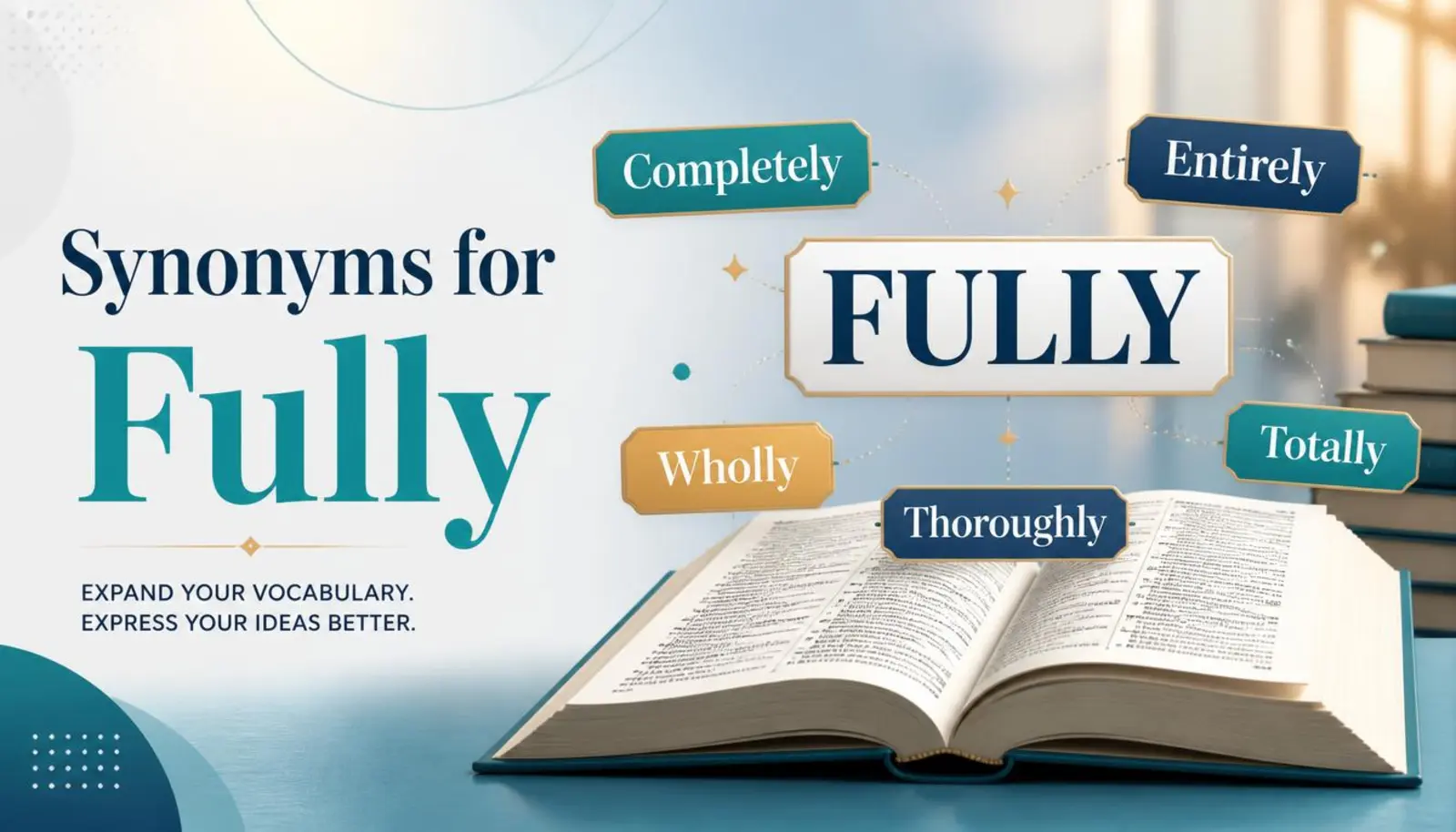
Have you ever used fully too often and wanted a clearer alternative? Learning synonyms fully can make your English more natural and less repetitive. For example, “I fully understand” can become “I completely understand.”
Fully usually means completely, entirely, or to the greatest possible degree. The best alternative depends on the context, as some words express specific types of completeness.
Quick Answer
The closest everyday synonyms for fully are completely, entirely, wholly, and totally. Depending on the context, thoroughly, absolutely, perfectly, comprehensively, exhaustively, and in full can also express related meanings.
Table of Synonyms and Related Alternatives
| Word or Expression | Category |
| Completely | Direct synonym |
| Entirely | Direct synonym |
| Wholly | Direct synonym |
| Totally | Direct synonym |
| Thoroughly | Close, context-dependent alternative |
| Absolutely | Context-dependent alternative |
| Perfectly | Context-dependent alternative |
| Altogether | Context-dependent alternative |
| Utterly | Emphatic, context-dependent alternative |
| Comprehensively | Coverage-related alternative |
| Exhaustively | Detail-focused alternative |
| In full | Phrase expressing completeness |
| In its entirety | Phrase expressing completeness |
| To the full | Phrase expressing maximum use or enjoyment |
| All the way | Informal, context-dependent expression |
| As much as possible | Degree-based expression |
| In every respect | Phrase covering every aspect |
| In all respects | Phrase covering every aspect |
| In every way | Phrase covering all relevant aspects |
| Through and through | Character-specific expression |
| Without reservation | Expression of unqualified support or acceptance |
| Without qualification | Expression without conditions or limitations |
| Without exception | Expression covering every case |
| Without omission | Expression leaving nothing relevant out |
| In full detail | Expression of complete detail |
| In detail | Expression of detailed treatment |
| At length | Expression of extended discussion |
| To the fullest extent | Expression of the maximum possible degree |
| To the fullest | Expression of maximum use or enjoyment |
| In full measure | Expression of complete or greatest degree |
Definition and Meaning of Fully
Fully is an adverb meaning completely, entirely, or to the greatest possible degree.
Examples:
- I fully understand your concern.
- The theater was fully booked.
- Please explain the situation fully.
Completely
Completely means entirely or with nothing remaining incomplete. It is one of the closest and most versatile synonyms for fully.
- I completely understand your concern.
- The room was completely empty.
Entirely
Entirely means completely or as a whole. It often emphasizes that something applies to the whole of a person, thing, or situation.
- The decision was entirely yours.
- The house is made entirely of wood.
Wholly
Wholly means completely or entirely. It is more formal and less common in everyday conversation than completely.
- The company is wholly responsible for the mistake.
- Her decision was wholly justified.
Totally
Totally means completely and is especially common in informal and conversational English.
- I totally understand what you mean.
- The storm totally changed our plans.
Thoroughly
Thoroughly means completely and with careful attention to all relevant parts. It is useful when fully refers to careful examination, preparation, or action.
- Please check the document thoroughly before sending it.
- We thoroughly cleaned the kitchen before the guests arrived.
Absolutely
Absolutely can express complete certainty, strong agreement, or strong emphasis. It is not a general replacement for fully.
- I absolutely agree with your decision.
- She was absolutely certain about the answer.
Read More: Synonyms for Spacious: 30 Words with Meaning and Example
Perfectly
Perfectly can mean exactly, completely, or in an ideal way in certain contexts. It should not be treated as a general synonym for fully.
- The instructions are perfectly clear.
- The two pieces fit together perfectly.
Altogether
Altogether can sometimes mean completely or entirely, especially in emphatic expressions. It is not interchangeable with fully in every sentence.
- The new plan is altogether different from the old one.
- His explanation was altogether convincing.
Utterly
Utterly means completely and is usually used with strong or extreme descriptions. It adds emphasis beyond ordinary fully.
- The idea was utterly impossible.
- She was utterly shocked by the news.
Comprehensively
Comprehensively means covering all or nearly all important aspects of a subject. It works when fully means addressing a topic broadly and thoroughly.
- The guide explains the process comprehensively.
- The report examines the issue comprehensively.
Exhaustively
Exhaustively means covering every important detail, possibility, or relevant point. It emphasizes completeness through extensive investigation or analysis.
- The committee investigated the complaint exhaustively.
- The researchers examined the evidence exhaustively.
In Full
In full means completely, with nothing intended or required left out. It is especially common with payments, information, statements, and reproductions.
- Please pay the balance in full.
- She told us the story in full.
Read More: Synonyms for Babysitter: 30 Words with Meaning and Examples
In Its Entirety
In its entirety means as a complete whole, without leaving out any part.
- We watched the documentary in its entirety.
- The agreement was published in its entirety.
To the Full
To the full means to the greatest possible degree, especially when talking about enjoying life or making full use of an opportunity.
- She wants to enjoy every moment to the full.
- He used his abilities to the full.
All the Way
All the way is an informal expression that can suggest complete support, commitment, or continuation to the final point. It is not a general synonym for fully.
- I support you all the way.
- We drove all the way to the coast.
As Much as Possible
As much as possible means to the greatest degree that circumstances allow. It is useful when fully refers to reaching the maximum practical level.
- Try to relax as much as possible.
- We want to help as much as possible.
In Every Respect
In every respect means in every relevant way or aspect. It can express completeness when all important aspects are being considered.
- The revised design is different in every respect.
- The plan was successful in every respect.
In All Respects
In all respects means in every relevant aspect or consideration. It is more common in formal or analytical writing.
- The two proposals are similar in all respects.
- The revised system is an improvement in all respects.
Read More: Synonyms for Monotheism: 30 words with Meaning and Example
In Every Way
In every way means in all relevant ways or aspects. It emphasizes that a statement applies broadly rather than to one specific feature.
- The new system is better in every way.
- The solution was practical in every way.
Through and Through
Through and through means completely in character or nature. It is mainly used to describe what someone or something is fundamentally like.
- She is a teacher through and through.
- He is a musician through and through.
Without Reservation
Without reservation means without hesitation or limitation, especially when expressing complete support, approval, or acceptance. It is not a general synonym for fully.
- She accepted the proposal without reservation.
- He gave his support without reservation.
Without Qualification
Without qualification means without conditions, exceptions, or limiting statements. It is useful when describing unconditional support, approval, or agreement.
- She offered her support without qualification.
- The organization endorsed the principle without qualification.
Without Exception
Without exception means including every relevant person, case, or item. It expresses complete coverage rather than general completeness.
- Every employee attended the meeting without exception.
- The rule applies to all members without exception.
Without Omission
Without omission means with no relevant part left out. It is mainly used for records, accounts, lists, or descriptions.
- The report records the major events without omission.
- The historian described the important developments without omission.
Read More: Synonyms for Floating: 30 words with Meaning and Example
In Full Detail
In full detail means with all important information or relevant details included. It is useful when fully means explaining or describing something completely.
- The guide explains the procedure in full detail.
- She described the problem in full detail.
In Detail
In detail means with considerable attention to the parts, facts, or features of something. It is related to completeness but does not directly mean fully.
- The teacher explained the process in detail.
- The report describes the accident in detail.
At Length
At length means for a long time or with considerable discussion and detail. It is useful when something is discussed extensively rather than simply “fully.”
- We discussed the problem at length.
- The researchers debated the issue at length.
To the Fullest Extent
To the fullest extent means to the greatest degree or limit that is possible or permitted. It is common in formal, legal, and policy-related language.
- The company used the available resources to the fullest extent.
- The law should protect consumers to the fullest extent permitted.
To the Fullest
To the fullest means as completely or fully as possible, especially when talking about living, enjoying, or developing something.
- She wants to live life to the fullest.
- He hopes to develop his talents to the fullest.
Read More: Synonyms for Intentions: 26 Words and Alternatives
In Full Measure
In full measure means in the complete or greatest amount or degree appropriate to the situation. It is more formal and literary than fully.
- She received the recognition she deserved in full measure.
- The volunteers gave their time in full measure.
FAQs
What is the closest synonym for fully?
Completely is one of the closest and most common synonyms for fully. Entirely, wholly, and totally also work in many contexts.
Is completely the same as fully?
Often, yes. Both can mean that something is complete or has reached its full degree, although they are not interchangeable in every sentence.
What is a formal synonym for fully?
Entirely and wholly can work well in formal writing. Comprehensively and exhaustively are useful when fully means covering a subject or examining something in great detail.
What is an informal synonym for fully?
Totally is common in casual English. Other informal expressions, such as all the way, can overlap with fully in specific contexts but are not general synonyms.
Can fully mean “carefully”?
Not usually. Thoroughly is a better choice when you mean doing something carefully and completely.
What is the difference between fully and completely?
They are often interchangeable. Fully can emphasize reaching a complete level, condition, or state, while completely often emphasizes that nothing remains incomplete.
What is the difference between fully and entirely?
Both can mean completely. Entirely often emphasizes the whole of something, while fully can also describe a degree, state, condition, or level.
Is utterly a synonym for fully?
Utterly can express complete intensity, especially with words such as impossible, shocked, or ridiculous. It is not a general replacement for fully.
Is thoroughly a synonym for fully?
Thoroughly overlaps with fully when an action is completed carefully and comprehensively. However, it does not replace fully in every context.
Can I use these alternatives in academic writing?
Yes, but choose according to meaning. Entirely, wholly, comprehensively, exhaustively, and in detail can work in formal contexts, while totally is generally more conversational.
Conclusion
Learning synonyms fully gives you more precise ways to express completeness, maximum degree, and thoroughness. Words such as completely, entirely, wholly, and totally work in many everyday sentences, while alternatives such as thoroughly, comprehensively, in full, and to the fullest extent fit more specific contexts.
The key is not to treat every expression as a direct synonym. Choosing the word or phrase that matches the exact meaning of your sentence will make your English more natural, precise, and effective.

Rafaqat Ali is the founder of RankVorexa, a vocabulary-focused website dedicated to synonyms, word meanings, and better English word choices. He creates simple, useful, and easy-to-understand content to help students, writers, bloggers, and English learners improve their vocabulary and writing skills.