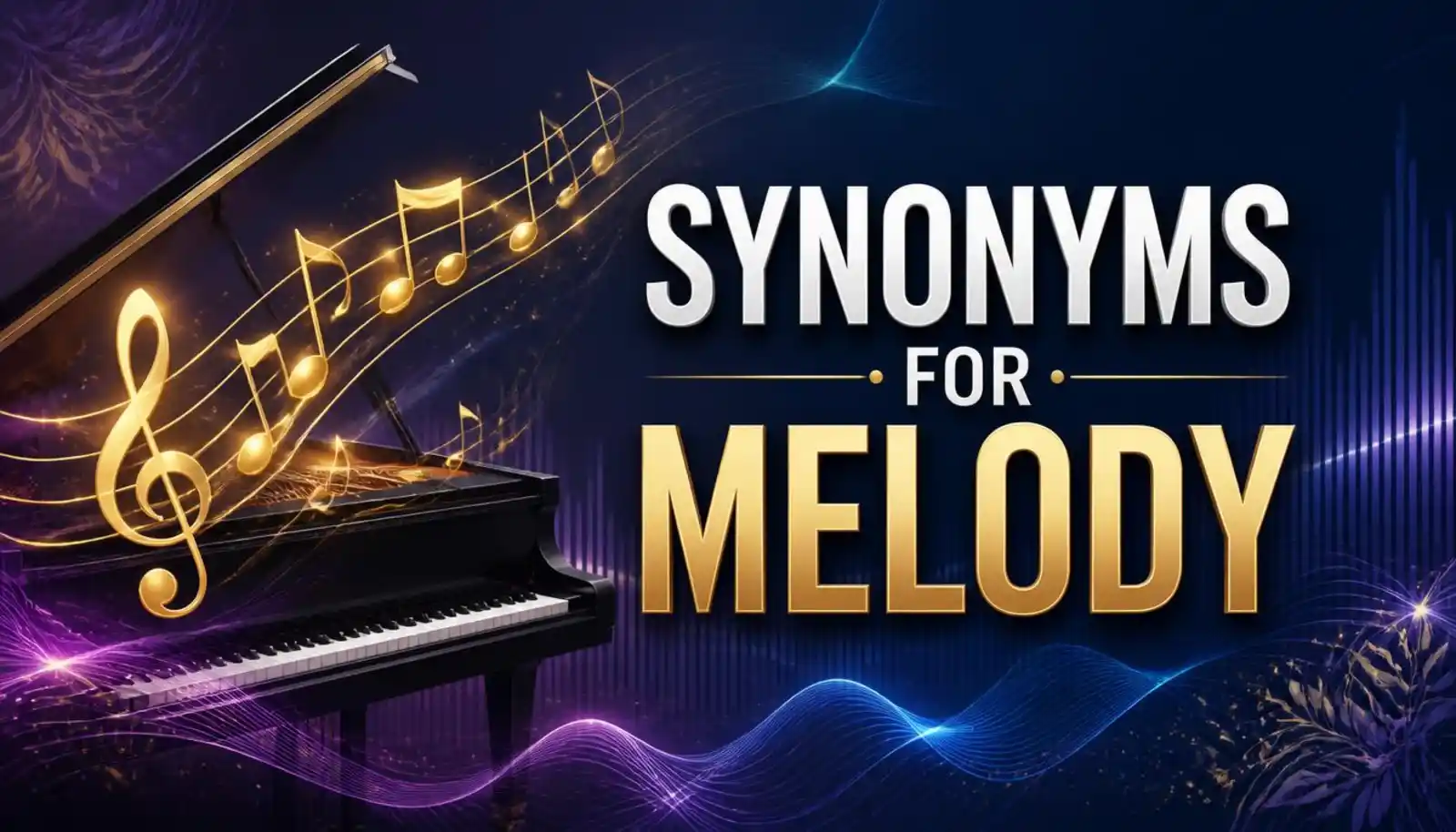
Have you ever hummed the part of a song you remember most? That part is often the melody. Learning synonyms for melody gives you more ways to describe music clearly and naturally. Tune is the most common everyday synonym, while air is a more old-fashioned or literary alternative.
Other terms, such as theme, motif, hook, riff, and refrain, describe related musical ideas rather than exact synonyms.
Quick Answer
The closest everyday synonym for melody is tune. Air can also mean melody, especially in older, traditional, or literary English. Melodic line can describe a melody in music theory, while theme, strain, theme tune, and other terms overlap with melody only in particular contexts.
Words such as motif, phrase, riff, hook, refrain, chorus, countermelody, harmony, and rhythm are related musical terms, not direct synonyms.
Synonyms and Related Musical Terms
| Word | Category |
|---|---|
| Tune | Direct synonym |
| Air | Direct but old-fashioned synonym |
| Melodic line | Context-dependent alternative |
| Strain | Context-dependent term |
| Theme | Context-dependent term |
| Theme tune | Specialized term |
| Motif | Related term |
| Phrase | Related term |
| Figure | Related term |
| Riff | Related term |
| Hook | Related term |
| Refrain | Related term |
| Chorus | Related term |
| Countermelody | Related term |
| Descant | Related term |
| Leitmotif | Related term |
| Subject | Technical term |
| Cantus firmus | Technical term |
| Ostinato | Related term |
| Chant | Related term |
| Plainchant | Specialized term |
| Aria | Related musical form |
| Recitative | Vocal style |
| Ballad | Broader musical work |
| Carol | Broader musical work |
| Hymn | Broader musical work |
| Song | Broader musical work |
| Harmony | Different musical element |
| Rhythm | Different musical element |
Important: Tune is the clearest everyday synonym for melody, while air is a valid but less common synonym. The remaining terms are context-dependent alternatives or related musical vocabulary. They should not automatically replace melody in every sentence.
Definition and Meaning of Melody
Melody is a sequence of musical notes arranged to form a recognizable musical idea.
In simple English, a melody is often the part of music that you can sing, hum, or remember.
For example:
“I love the melody of this song.”
Here, melody refers to the sequence of notes that creates the recognizable musical line.
Tune
Meaning: A tune is a recognizable sequence of musical notes and is the most common everyday synonym for melody.
Examples:
- I love the tune of that song.
- She hummed a cheerful tune in the kitchen.
Air
Meaning: An air can mean a tune or melody, especially in older, traditional, or literary English.
Examples:
- The singer performed an old Scottish tune.
- The traditional air had a gentle, memorable melody.
Melodic Line
Meaning: A melodic line is the sequence of notes that forms a melody within a musical composition.
Examples:
- The violin carried the main melodic line.
- She practiced the melodic line before the concert.
Strain
Meaning: A strain is a section or passage of music with its own distinct musical idea.
Examples:
- The final strain sounded gentle and calm.
- I recognized the opening strain of the traditional piece.
Theme
Meaning: A theme is an important musical idea that may be developed or repeated during a composition.
Examples:
- The film has a memorable musical theme.
- I recognized the theme when the orchestra began.
Theme Tune
Meaning: A theme tune is a melody associated with a television show, program, film, or other production.
Examples:
- I still remember that television theme tune.
- The theme tune played before the show started.
Read More: Synonyms for Trumpet: 30 Related Words, Types & Terms
Motif
Meaning: A motif is a short musical idea that may be repeated or developed within a composition.
Examples:
- The composer repeated the same motif.
- I noticed a short motif in the piano part.
Phrase
Meaning: A phrase is a short musical unit that forms part of a larger musical idea.
Examples:
- Sing the first phrase slowly.
- The final phrase sounded smooth and gentle.
Figure
Meaning: A figure is a short musical pattern used within a piece of music.
Examples:
- The pianist played a quick musical figure.
- That figure appears again near the ending.
Riff
Meaning: A riff is a short musical pattern that is repeated, especially in rock, jazz, and popular music.
Examples:
- The guitarist played a powerful riff.
- I recognized the song from its opening riff.
Hook
Meaning: A hook is a catchy musical, lyrical, or rhythmic idea that is easy to remember.
Examples:
- The song has a catchy hook.
- I remembered the hook after hearing the song once.
Refrain
Meaning: A refrain is a repeated part of a song or musical composition.
Examples:
- Everyone joined in during the refrain.
- The repeated refrain made the song memorable.
Read More: Synonyms for Strengths: 30 Strong Alternatives for Better Writing
Chorus
Meaning: A chorus is a repeated section of a song that often contains memorable musical material.
Examples:
- The chorus is my favorite part of the song.
- Everyone sang the chorus together.
Countermelody
Meaning: A countermelody is a secondary melody that accompanies the main melody.
Examples:
- The flute added a soft countermelody.
- I liked the countermelody behind the singer’s voice.
Descant
Meaning: A descant is a higher musical part performed above a main melody.
Examples:
- The children sang a descant near the end.
- Her descant rose above the main tune.
Leitmotif
Meaning: A leitmotif is a recurring musical idea associated with a particular person, place, object, or idea.
Examples:
- The character has a distinctive leitmotif.
- The leitmotif returns whenever the hero appears.
Subject
Meaning: A subject is a principal musical idea, especially the main theme introduced in a fugue.
Examples:
- The composer introduced the subject at the start.
- The other voices repeated the subject later.
Cantus Firmus
Meaning: Cantus firmus is a fixed melody used as the basis for other musical parts.
Examples:
- The composer built the work around a cantus firmus.
- Students studied the cantus firmus in music class.
Read More: Synonyms for Reincarnation: 30 Words and Related Terms
Ostinato
Meaning: An ostinato is a short musical pattern that is repeated throughout part of a composition.
Examples:
- The piano played a steady ostinato.
- The composer used an ostinato beneath the melody.
Chant
Meaning: A chant is a style of singing that often uses simple, repeated, or limited musical patterns.
Examples:
- The monks sang a quiet chant.
- The crowd began a simple chant.
Plainchant
Meaning: Plainchant is a traditional form of unaccompanied religious singing with simple melodic patterns.
Examples:
- The choir performed plainchant during the service.
- The recording features ancient plainchant.
Aria
Meaning: An aria is a solo vocal piece, especially one performed in an opera, that usually contains developed melodic material.
Examples:
- The singer performed a powerful aria.
- Her aria was the highlight of the opera.
Recitative
Meaning: Recitative is a speech-like style of singing used mainly to advance the story in opera.
Examples:
- The opera began with a short recital.
- The singer used recitative before the main aria.
Ballad
Meaning: A ballad is a song or poem that often tells a story and may contain a prominent melody.
Examples:
- She sang a slow ballad.
- The ballad told a story about a lost traveler.
Read More: Synonyms for Meadow: 30 Alternatives, Related Terms & Phrases
Carol
Meaning: A carol is a song associated especially with Christmas or another religious or seasonal celebration.
Examples:
- We sang a Christmas carol at school.
- That carol has a warm and memorable melody.
Hymn
Meaning: A hymn is a religious song written or arranged for singing.
Examples:
- The choir sang a beautiful hymn.
- Everyone stood quietly during the hymn.
Song
Meaning: A song is a complete musical work that may contain one or more melodies.
Examples:
- That song has a beautiful melody.
- We listened to the song on the way home.
Harmony
Meaning: Harmony is the combination of notes that accompanies or supports a melody.
Examples:
- The harmony made the melody sound richer.
- The singers added warm harmony behind her voice.
Rhythm
Meaning: Rhythm is the pattern of beats, accents, and timing in music.
Examples:
- The rhythm made everyone want to dance.
- I like the simple rhythm of this song.
Theme and Variation
Meaning: Theme and variation is a musical form in which a theme is presented and then changed in different versions.
Examples:
- The composer used theme and variation in the final movement.
- We studied theme and variation in music class.
Read More: Synonyms for Moisture: 30 Words with meaning and Example
Frequently Asked Questions About Melody
What is the closest synonym for melody?
Tune is the closest and most common everyday synonym for melody. For example, “I like the tune” can often replace “I like the melody.”
Is “air” a synonym for melody?
Yes. Air can mean a tune or melody, but this use is more old-fashioned, literary, or traditional than everyday modern English.
Is “song” a synonym for melody?
No. A song is a complete musical work, while a melody is a sequence of musical notes within a piece. A song can contain a melody.
Is “theme” a synonym for melody?
Not generally. A theme is a main musical idea, and that idea may be melodic. However, the theme has a broader meaning than melody.
Is “melodic line” another word for melody?
In many music-theory contexts, melodic lines can describe the sequence of notes that makes up a melody. However, it is better understood as a descriptive musical term than as a general everyday synonym.
Is “strain” a synonym for melody?
Not exactly. Strain usually refers to a section or passage of music with a distinct musical idea. In some contexts, that passage may function as a melody, but the words are not interchangeable in every sentence.
Is “harmony” a synonym for melody?
No. Harmony involves notes that sound together to support or complement the melody. Melody and harmony are different musical elements.
Is “rhythm” a synonym for melody?
No. Rhythm is the pattern of beats and timing in music. Melody and rhythm often work together, but they describe different aspects of music.
Is “motif” another word for melody?
Not exactly. A motif is usually a short musical idea that may form part of a melody or appear repeatedly within a composition.
What is another word for a catchy melody?
Tune is the simplest choice when you mean the melody itself. Hook is useful when you mean a catchy musical, lyrical, or rhythmic idea that stays in the listener’s memory.
What is the difference between melody and tune?
In everyday English, melody and tune are often interchangeable. Melody is common in musical and formal discussions, while tune is especially natural in everyday speech.
Are there 30 exact synonyms for melody?
No. English does not have 30 common, interchangeable synonyms for melody. Tune is the clearest modern synonym, while air is a valid but less common synonym. The other terms in this guide describe related musical ideas, structures, forms, or elements.
Conclusion
Learning synonyms for melody can help you describe music more precisely and naturally. Tune is the clearest everyday alternative, while air is a valid but more traditional or literary synonym. Other terms, such as melodic line, theme, motif, hook, riff, refrain, harmony, and rhythm, have related meanings but should not automatically replace melody.
Understanding these distinctions helps you choose the right word for essays, music discussions, reviews, creative writing, and everyday English.

Rafaqat Ali is the founder of RankVorexa, a vocabulary-focused website dedicated to synonyms, word meanings, and better English word choices. He creates simple, useful, and easy-to-understand content to help students, writers, bloggers, and English learners improve their vocabulary and writing skills.