
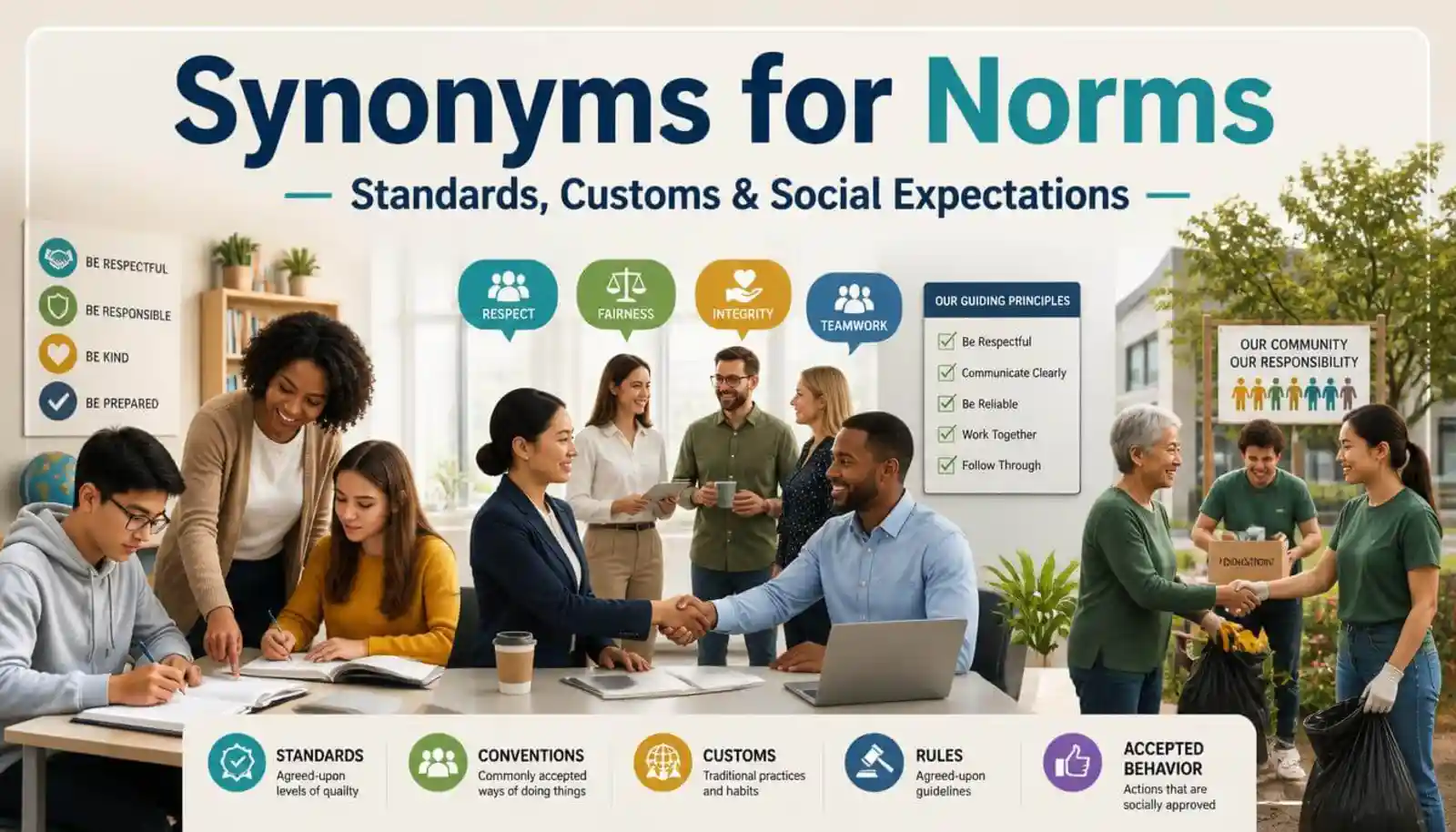
Have you ever wondered why certain behaviors are considered normal in a group? A school may expect students to be punctual, while a workplace may expect polite communication. These shared expectations are called norms.
In simple English, norms are shared standards or expectations that guide behavior. Learning synonyms for norms helps you choose clearer words such as standards, conventions, customs, practices, rules, and expectations.
Quick Answer
The closest alternatives to norms include standards, conventions, customs, practices, expectations, and rules. In social contexts, social rules, social expectations, accepted behavior, and social conventions can also work well.
- Standards — accepted levels of behavior, quality, or performance
- Conventions — commonly accepted ways of doing something
- Customs — traditional ways of behaving
- Practices — usual ways of doing something
- Expectations — behaviors people believe are appropriate or normal
- Rules — stated or understood instructions about behavior
- Social rules — informal rules that guide social behavior
- Social expectations — ideas about how people should behave
- Accepted behavior — behavior considered normal or appropriate by a group
- Cultural practices — common ways of behaving within a culture
Table of Synonyms and Alternatives
| Term | Accuracy | Best Context |
| Standards | Strong synonym | Accepted levels of behavior, quality, or performance |
| Conventions | Strong synonym | Commonly accepted ways of doing things |
| Customs | Context-specific synonym | Traditional behavior within a group or culture |
| Practices | Contextual alternative | Usual or established ways of doing things |
| Expectations | Strong synonym | Expected behavior within a group |
| Rules | Close alternative | Stated or understood behavioral requirements |
| Social rules | Close alternative | Informal rules governing social behavior |
| Social expectations | Close alternative | Expected behavior in society |
| Accepted behavior | Descriptive alternative | Behavior considered normal by a group |
| Cultural practices | Contextual alternative | Behavior associated with a culture |
| Guidelines | Contextual alternative | Recommended ways to act |
| Principles | Contextual alternative | Beliefs that guide behavior |
| Etiquette | Contextual alternative | Accepted rules of polite behavior |
| Decorum | Contextual alternative | Proper behavior in formal situations |
| Codes | Contextual alternative | Formal rules guiding a group or profession |
| Regulations | Formal alternative | Official rules created by authorities |
| Policies | Formal alternative | Organizational rules or positions |
| Protocols | Formal alternative | Formal procedures for particular situations |
| Professional standards | Contextual alternative | Expected workplace behavior and quality |
| Social conventions | Contextual alternative | Accepted ways of behaving socially |
| Social standards | Contextual alternative | Shared expectations for social behavior |
| Group expectations | Contextual alternative | Expected behavior within a particular group |
| Shared expectations | Contextual alternative | Common beliefs about appropriate behavior |
| Accepted practices | Contextual alternative | Practices commonly approved by a group |
| Established practices | Contextual alternative | Long-used or recognized ways of doing things |
| Traditions | Related term | Practices passed between generations |
| Habits | Related term | Repeated actions or behaviors |
| Behavior | Related term | The way a person or group acts |
| Conduct | Related term | The way someone behaves |
| Values | Related term | Beliefs about what is important or desirable |
Definition and Meaning of Norms
Norms are shared standards, expectations, or patterns of behavior that guide how people act in a group or society.
Norms can be formal or informal. A workplace may have formal norms about meetings and communication. A community may have informal norms about greeting people, waiting in line, or speaking politely.
For example:
“Removing your shoes before entering a home is a common norm in some cultures.”
Norms can appear in many areas of life, including family life, education, workplaces, communities, and culture.
Standards
Meaning: Standards are accepted levels of behavior, quality, or performance.
Examples:
- The school has high standards for student behavior.
- The company maintains strict safety standards.
Conventions
Meaning: Conventions are commonly accepted ways of doing something.
Examples:
- Email greetings follow certain professional conventions.
- Writers often follow conventions when creating formal reports.
Customs
Meaning: Customs are traditional ways of behaving within a group or culture.
Examples:
- Sharing food with guests is a common custom.
- Local customs can differ from one country to another.
Practices
Meaning: Practices are usual or established ways of doing something.
Examples:
- The company uses fair hiring practices.
- Good farming practices can protect the soil.
Expectations
Meaning: Expectations are ideas about how people should behave or what should happen.
Examples:
- The job has clear expectations for new workers.
- Social expectations can change over time.
Rules
Meaning: Rules are instructions about what people should or should not do.
Examples:
- The classroom rules ask students to raise their hands.
- We must follow the rules of the game.
Read More: Synonyms for Shortly: 30 Words with Meaning and Examples
Social Rules
Meaning: Social rules are informal rules that guide how people behave around others.
Examples:
- Taking turns in a conversation is a basic social rule.
- Children learn many social rules at school.
Social Expectations
Meaning: Social expectations are ideas about how people are expected to behave in society.
Examples:
- Social expectations can influence the way people dress.
- Young people may challenge old social expectations.
Accepted Behavior
Meaning: Accepted behavior is behavior that a group considers normal or appropriate.
Examples:
- Greeting visitors politely is accepted behavior in many homes.
- The group discussed what counts as accepted behavior.
Cultural Practices
Meaning: Cultural practices are common ways of behaving within a particular culture.
Examples:
- Food-sharing is an important cultural practice in some communities.
- Travelers should respect local cultural practices.
Guidelines
Meaning: Guidelines are general suggestions about how to behave or do something.
Examples:
- The teacher gave us guidelines for the project.
- Follow the safety guidelines before using the machine.
Principles
Meaning: Principles are basic beliefs that guide how people act.
Examples:
- Honesty is one of her main principles.
- The organization follows strong environmental principles.
Read More: Synonyms for Landmark: 30 Words with Meaning and Examples
Etiquette
Meaning: Etiquette means accepted rules of polite behavior.
Examples:
- Basic table etiquette is useful at formal dinners.
- Good email etiquette makes messages easier to understand.
Decorum
Meaning: Decorum means proper and polite behavior in a particular situation.
Examples:
- Everyone maintained decorum during the meeting.
- The ceremony required a sense of decorum.
Codes
Meaning: Codes are sets of rules that guide behavior in a group or profession.
Examples:
- Doctors follow a professional code.
- The company created a code for employee conduct.
Regulations
Meaning: Regulations are official rules made by an authority.
Examples:
- The factory must follow safety regulations.
- New regulations changed how businesses operate.
Policies
Meaning: Policies are official rules or plans used by an organization.
Examples:
- The school has strict attendance policies.
- The company updated its privacy policies.
Protocols
Meaning: Protocols are formal procedures for handling particular situations.
Examples:
- The hospital has strict safety protocols.
- Staff must follow the emergency protocol.
Read More: Synonyms for Monumental: 30 Words with Meaning and Example
Professional Standards
Meaning: Professional standards are accepted levels of behavior and quality at work.
Examples:
- Nurses must follow professional standards.
- The company trains workers to meet industry standards.
Social Conventions
Meaning: Social conventions are commonly accepted ways of behaving around other people.
Examples:
- Saying thank you is a common social convention.
- Social conventions can differ between cultures.
Social Standards
Meaning: Social standards are shared ideas about appropriate behavior in a society or group.
Examples:
- Social standards can change across generations.
- The campaign challenged outdated social standards.
Group Expectations
Meaning: Group expectations are shared ideas about how members of a group should behave.
Examples:
- New employees quickly learn the group’s expectations.
- Group expectations can influence individual behavior.
Shared Expectations
Meaning: Shared expectations are common beliefs about what people should do or how they should behave.
Examples:
- Respect is one of the team’s shared expectations.
- Shared expectations can help a community work together.
Accepted Practices
Meaning: Accepted practices are ways of doing things that a group generally considers appropriate.
Examples:
- The company follows accepted practices for workplace safety.
- These accepted practices are common in the industry.
Read More: Synonyms for Spacious: 30 Words with Meaning and Example
Established Practices
Meaning: Established practices are ways of doing things that have become recognized or customary over time.
Examples:
- The organization follows established practices for handling complaints.
- Established practices can make workplace procedures more consistent.
Traditions
Meaning: Traditions are customs and practices passed from one generation to another.
Examples:
- The family has a tradition of eating together on Sundays.
- Many holiday traditions have deep cultural roots.
Habits
Meaning: Habits are actions that people or groups do regularly.
Examples:
- Checking your phone can become a daily habit.
- Healthy habits can improve your daily routine.
Behavior
Meaning: Behavior is the way a person or group acts.
Examples:
- The child showed polite behavior at dinner.
- Social behavior can change in different settings.
Conduct
Meaning: Conduct is the way someone behaves, especially in a particular setting.
Examples:
- The teacher praised his respectful conduct.
- Professional conduct is important in the workplace.
Values
Meaning: Values are beliefs about what is important, desirable, or worthwhile.
Examples:
- Respect is one of the family’s core values.
- Different cultures may have different values.
Read More: Synonyms for Vase: 30 words with Meaning and Example
Short Answer
The best alternatives for norms depend on the context. Standards, conventions, customs, practices, expectations, and rules are among the closest choices. For social situations, social rules, social expectations, accepted behavior, and social conventions can be especially useful.
Some terms are related rather than interchangeable. Traditions describe practices passed through time, while values describe beliefs about what is important. Behavior and conduct describe how people act, while habits describe repeated actions.
Choosing the right term helps you express the exact idea instead of using norms in every situation.
Frequently Asked Questions
What is the closest synonym for norms?
Standards is one of the closest general alternatives to norms. Depending on the context, conventions, customs, practices, or expectations may be more precise.
What are synonyms for social norms?
Useful alternatives include social rules, social expectations, social conventions, accepted behavior, and social standards.
Are norms and rules the same?
Not always. Rules are usually stated clearly and may be formally enforced. Norms can be informal and unwritten, such as waiting your turn when speaking.
What is the difference between norms and customs?
Norms are shared expectations about behavior. Customs are usually traditional ways of behaving within a culture or community.
What is the difference between norms and standards?
Standards often describe an accepted level of quality, performance, or behavior. Norms more often describe common or expected behavior within a group.
Can expectations mean norms?
Yes, in some social contexts. Expectations describe what people believe someone should do, while norms are broader shared standards or patterns of behavior.
Are values synonyms for norms?
No. Values are beliefs about what is important or desirable, while norms are shared expectations about behavior. Values can influence the norms of a group.
Are traditions synonyms for norms?
Not exactly. A tradition is a practice or custom passed through time. A tradition can become part of a group’s norms, but the two words are not interchangeable.
Conclusion
Learning alternatives for norms can make your writing more precise and natural. Words such as standards, conventions, customs, practices, expectations, and rules can describe different aspects of shared behavior. Other terms, such as traditions, habits, behavior, conduct, and values, are related but should not be treated as exact synonyms. Students, bloggers, and content writers can use these distinctions to choose the most accurate word for each context and make their English clearer and stronger.

Rafaqat Ali is the founder of RankVorexa, a vocabulary-focused website dedicated to synonyms, word meanings, and better English word choices. He creates simple, useful, and easy-to-understand content to help students, writers, bloggers, and English learners improve their vocabulary and writing skills.