Have you ever used plus too often in your writing? Choosing the right alternative can make your sentences clearer and more natural. For example, “The phone is affordable, and it also has a great camera” sounds smoother than using plus repeatedly.
The best alternative depends on the context. Some expressions add information, while others describe extra items, mathematical addition, or advantages. This guide explores 30 alternatives and related expressions with clear meanings and natural examples to help students, bloggers, content writers, and everyday English users choose the right words.
Quick Answer: What Are the Best Alternatives to Plus?
The best alternative depends on the meaning of plus.
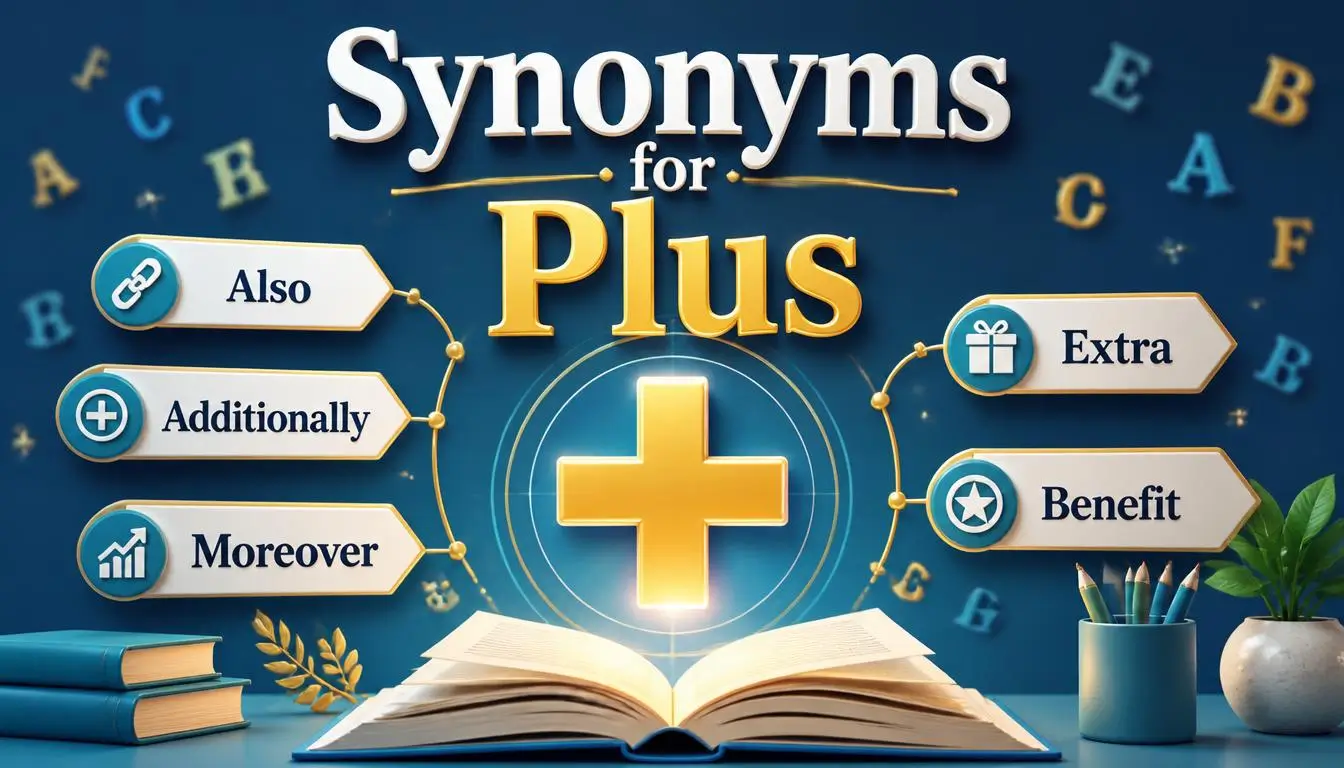
- To add information: also, additionally, furthermore, moreover
- To mean “also” at the end of a sentence: too, as well
- To connect items or ideas: and, along with, as well as
- To describe something extra: extra, additional, supplementary
- To describe an advantage: benefit, advantage, perk
- For mathematical addition: added to
For example, “The hotel is affordable, plus it is close to the beach” can become “The hotel is affordable, and it is also close to the beach.”
These expressions are not all interchangeable. Choose one that matches the sentence’s meaning and grammatical structure.
What Does Plus Mean?
Plus has several meanings in English, and its grammatical role depends on the sentence.
- Adding information: It introduces an additional point. Example: “The room is spacious, plus it has a balcony.”
- Mathematical addition: It indicates that one number is added to another. Example: “Four plus six equals ten.”
- Something extra: It can describe an additional item or feature. Example: “The package includes a free delivery service as a plus.”
- An advantage: As a noun, it can mean a positive feature. Example: “Flexible working hours are a plus.”
Plus can function as a conjunction, preposition, noun, or adjective.
Examples:
- Conjunction: The laptop is affordable, plus it runs smoothly.
- Preposition: The total cost is $20 plus tax.
- Noun: Free parking is a plus.
- Adjective: The store offers plus-size clothing.
Table of Alternatives to Plus
The categories below show whether an entry is a close alternative, a context-specific expression, or a related term. Related terms are not direct synonyms in every sentence.
| Word or phrase | Category | Meaning or use |
| Also | Close synonym in addition contexts | Adds another fact or action |
| Too | Close synonym in addition contexts | Means “also,” usually at the end of a clause |
| Additionally | Addition connector | Introduces another fact or point |
| Furthermore | Addition connector | Adds a supporting point |
| Moreover | Addition connector | Adds a point that strengthens the previous idea |
| In addition | Addition expression | Introduces another item or point |
| As well | Close synonym in addition contexts | Means “also” or “too” |
| And | Context-specific alternative | Connects words, phrases, or clauses |
| Along with | Inclusion expression | Indicates that something accompanies something else |
| Together with | Inclusion expression | Shows that people or things are included together |
| As well as | Inclusion expression | Adds another person, thing, or activity |
| Besides | Context-specific alternative | Means “in addition to” or introduces another point |
| Added to | Mathematical or additive expression | Indicates that one amount is combined with another |
| Combined with | Related expression | Describes things joined or considered together |
| Extra | Additionality alternative | Means beyond what is usual or expected |
| Additional | Additionality alternative | Means added to what already exists |
| Further | Context-specific alternative | Means additional in phrases such as “further information” |
| Another | Additional-item word | Refers to one more or a different item |
| Supplementary | Related alternative | Describes material that provides extra support |
| More | Quantity alternative | Indicates a greater amount, number, or degree |
| Bonus | Related term | Something extra, often a reward |
| Benefit | Related term | A helpful result or favorable effect |
| Advantage | Related term | A feature that gives someone a favorable position |
| Perk | Related term | An extra benefit or privilege |
| Asset | Related term | A valuable quality, person, or resource |
| Gain | Related term | An increase or something obtained |
| Upside | Related term | The positive aspect of a situation |
| Positive | Related term | A favorable aspect or result |
| Pro | Related term | An argument or feature in favor of something |
| Positive feature | Descriptive expression | A quality that makes something desirable |
30 Alternatives to Plus and How to Use Them
Also
Also adds another fact or action to a statement. It is a natural choice when plus introduces additional information.
- The restaurant serves Italian food and also offers vegetarian meals.
- I finished my homework and also helped my brother study.
Too
“Too means “also” or “in addition.” It commonly appears at the end of a clause and often sounds natural in conversation.
- I would like to visit the museum too.
- Maya is joining the school trip too.
Additionally
Additionally introduces another fact, requirement, or point. It is useful in reports, instructions, and formal writing.
- The apartment has two bedrooms. Additionally, it includes a private balcony.
- Applicants must submit a résumé. Additionally, they should provide two references.
Furthermore
Furthermore adds a supporting point to an idea that has already been introduced. It is most common in formal or carefully structured writing.
- The software is easy to use. Furthermore, it works on older computers.
- The proposal could reduce costs. Furthermore, it would save the team valuable time.
Moreover
Moreover introduces another point that strengthens or develops the previous statement. It often sounds more formal than also.
- The course is affordable. Moreover, it includes individual feedback.
- The route is shorter. Moreover, it avoids the busiest roads.
In Addition
In addition introduces another fact, item, or point. It is useful when presenting several features or requirements.
- In addition, visitors can use the free parking area.
- The workshop covers grammar. In addition, it teaches practical editing skills.
Read More: Synonyms for Debt: 30 Words with Meaning and Examples
As Well
As well means “also” or “too” and commonly appears at the end of a clause.
- Please send me the updated document as well.
- Her brother applied for the scholarship as well.
And
And connects words, phrases, or clauses. It can express addition, but it does not replace plus in every construction.
- We bought apples and oranges at the market.
- The room is bright and comfortable.
Along With
Along with indicates that something accompanies or is included with another thing. It is useful for listing related items or people.
- The teacher handed out a worksheet along with the reading assignment.
- She packed a jacket along with her other travel essentials.
Together With
Together with shows that people or things are included or present together. It emphasizes association rather than simply adding information to an argument.
- The manager arrived together with two members of the team.
- The price includes breakfast together with access to the fitness center.
As Well As
As well as adds another person, thing, or activity to a statement. It connects related items without always making them equally prominent.
- The job requires patience as well as strong communication skills.
- She enjoys gardening as well as cooking.
Besides
Besides can mean “in addition to” when introducing another item or person. It can also introduce a further reason or point.
- Besides Spanish, he speaks French and Italian.
- Besides being affordable, the laptop has a long battery life.
Read More: Synonyms for Cave: 30 Words with Meaning and Examples
Added To
Added to describes one amount being included in another or an extra charge being applied. In mathematics, plus is usually the more direct wording for an equation.
- When three is added to five, the result is eight.
- A service charge was added to the final bill.
Combined With
Combined with describes two or more things brought together or considered jointly. It is useful for explaining how factors work together.
- Regular exercise, combined with a balanced diet, can support overall fitness.
- Her experience, combined with careful planning, helped the project succeed.
Extra
Extra describes something beyond what is usual, expected, or required. It commonly refers to additional items, amounts, or services.
- We packed an extra pair of shoes for the trip.
- Could we have an extra chair for the guest?
Additional
Additional means added to what already exists or is available. It is common in professional, academic, and everyday writing.
- The teacher provided additional practice exercises.
- We need additional information before making a decision.
Further
Further can mean “additional” in phrases such as further details, further information, and further discussion.
- Please contact the office if you need further information.
- The doctor recommended further tests before confirming the diagnosis.
Another
Another refers to one more item or a different one. It is suitable when the intended meaning is an additional person, thing, or unit.
- Could I have another glass of water?
- We need another day to complete the assignment.
Read More: Synonyms for Sweetie: 30 Words With Meaning and Examples
Supplementary
Supplementary describes something that provides extra information, support, or material. It is often used in educational, professional, and technical contexts.
- Students received supplementary reading materials for the exam.
- The course includes supplementary lessons for learners who need extra practice.
More
More indicates a greater amount, number, or degree. It works when the intended meaning involves an increase in quantity rather than simply adding another point.
- We need more time to finish the report.
- Please add more examples to the explanation.
Bonus
A bonus is something extra, often a reward or an unexpected benefit. It relates to the idea of an added positive feature, but it is not a general replacement for plus.
- The hotel offered free airport transfers as a bonus.
- Employees received a year-end bonus for their performance.
Benefit
A benefit is a helpful result or favorable effect. Use it when plus refers to something that makes a situation better.
- One benefit of walking regularly is improved cardiovascular fitness.
- Flexible working hours are a major benefit of the job.
Advantage
An advantage is a feature or condition that gives someone or something a favorable position.
- Her previous experience gave her an advantage during the interview.
- One advantage of this phone is its long battery life.
Perk
A perk is an extra benefit or privilege, often associated with a job, service, or membership. It is informal and usually positive.
- Free lunches are a popular perk at the company.
- One perk of the membership is access to exclusive classes.
Read More: Synonyms for Serendipity: 30 Words and Related Phrases
Asset
An asset is a valuable quality, skill, person, or resource. It describes something that contributes value rather than simply another item in a list.
- Her problem-solving ability is a valuable asset to the team.
- Clear communication is an important asset for a project manager.
Gain
A gain is an increase or something obtained. It often describes progress, improvement, or an increase in value.
- The business recorded a gain in revenue last quarter.
- Regular practice can lead to gains in reading comprehension.
Upside
The upside is the positive aspect of a situation, especially one that also has disadvantages.
- The upside of working remotely is that there is no daily commute.
- The flight was delayed, but the upside was that we had time to eat.
Positive
As a noun, positive can refer to a favorable aspect or result. It is useful when discussing the good points of a situation.
- One positive of the new schedule is the longer lunch break.
- We discussed the positives and negatives of studying online.
Pro
A pro is an argument or feature in favor of a decision, plan, or choice. It is commonly used when comparing pros and cons.
- One pro of the new plan is its lower cost.
- We listed the pros and cons before choosing a supplier.
Positive Feature
A positive feature is a quality that makes something useful, attractive, or desirable. It is a descriptive expression rather than a direct synonym in every context.
- A long battery life is a positive feature of this phone.
- One positive feature of the course is its flexible schedule.
Read More: Synonyms for Noisy: 30 Words, Meanings, and Examples
Frequently Asked Questions
What is the most common synonym for plus?
Also is a common alternative when plus introduces extra information. Too and as well are also common, especially in everyday English. The best choice depends on sentence structure.
What is a formal alternative to plus?
Additionally, furthermore, moreover, and in addition can introduce extra information in formal writing. Use them when adding a point, not when describing mathematical addition or a positive feature.
What is another word for plus in mathematics?
Added to can describe the operation in words, but plus is the standard and most direct term in a mathematical expression. For example, “Four plus six equals ten.”
What does plus mean when it describes an advantage?
When used as a noun, a plus means a positive feature or benefit. Depending on the sentence, alternatives include advantage, benefit, or positive feature.
Are plus and additional interchangeable?
No, not in every context. Additional is an adjective, as in “additional information,” while plus can connect clauses, indicate addition, or function as a noun. The words overlap only in certain contexts.
Can I use plus in formal writing?
Yes. Plus is standard English, but the best choice depends on the purpose. In a formal argument, additionally or in addition may be suitable. In mathematics, use plus when writing expressions such as “four plus six.”
Conclusion
Choosing an alternative to plus starts with identifying its meaning. Use also, too, or in addition to add information; choose extra or additional for something more; and use advantage or benefit when describing a positive feature. For mathematical expressions, plus is often the clearest choice, while added to can explain the operation in words. Understanding these distinctions helps you write more naturally, avoid awkward substitutions, and communicate your ideas with greater precision.

Rafaqat Ali is the founder of RankVorexa, a vocabulary-focused website dedicated to synonyms, word meanings, and better English word choices. He creates simple, useful, and easy-to-understand content to help students, writers, bloggers, and English learners improve their vocabulary and writing skills.