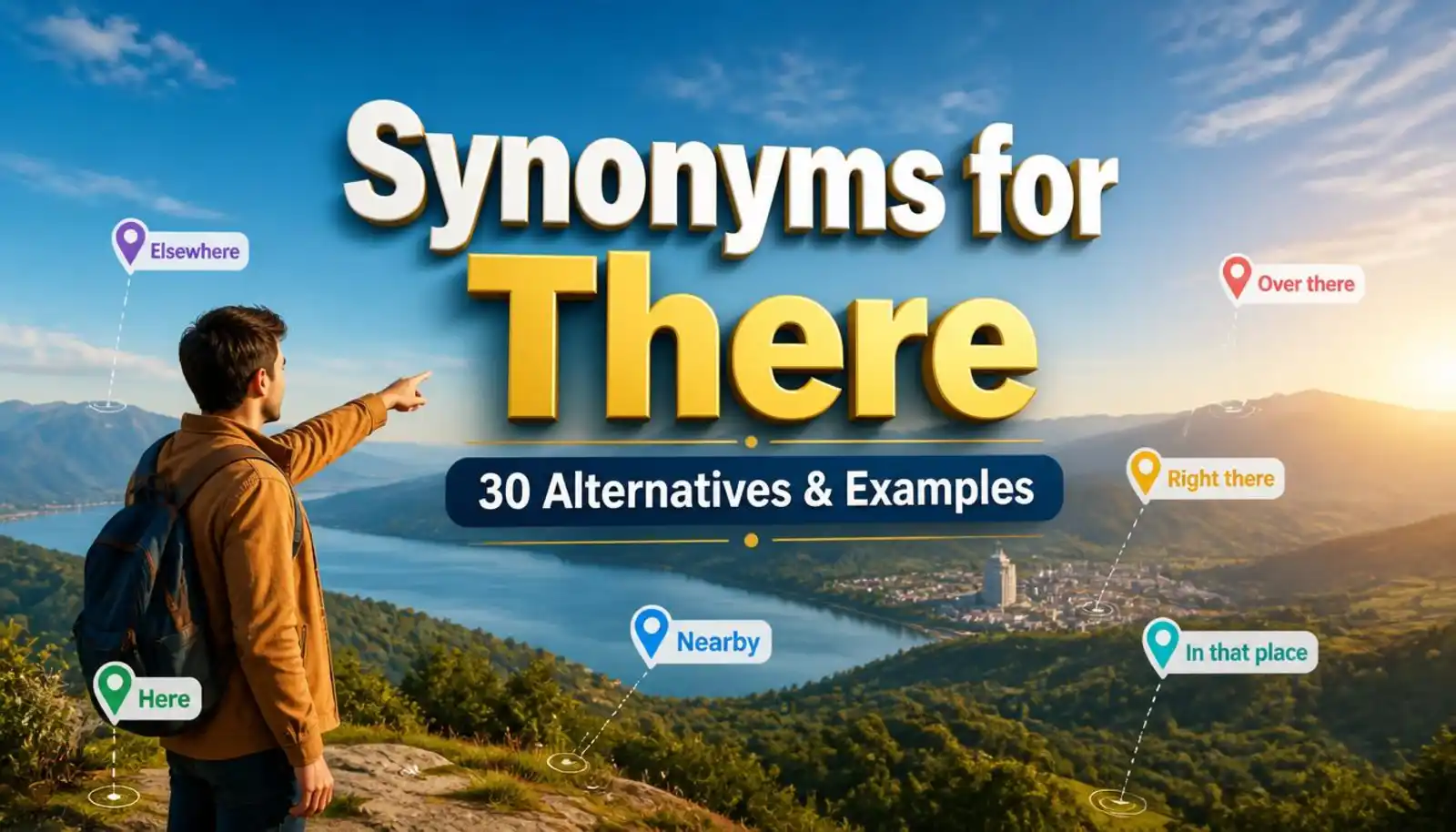
Have you used “there” too often and wanted a better alternative? The right choice depends on its meaning and context.
They can point to a place, as in “Your bag is there,” or introduce existence, as in “There is a book on the desk.” Understanding these uses helps students, bloggers, and everyday English users choose clearer, more precise expressions.
Quick Answer
When there means “in or at that place,” the closest alternatives include in that place, over there, right there, at that place, at that spot, and in that location. Other expressions, such as yonder, nearby, elsewhere, in that area, and in the vicinity, are related location words that work only in certain contexts. The best choice depends on whether you mean a specific place, a general area, distance, direction, or another location.
Table of Alternatives to “There”
| Word or Expression | Typical Use |
|---|---|
| In that place | Refers to a specific place |
| Over there | Points to a place away from the speaker |
| Right there | Points to a specific, clearly identified place |
| Just there | Points to a particular nearby or indicated place |
| At that place | Refers to a particular location |
| At that spot | Points to a specific spot |
| In that spot | Refers to a particular position |
| In that location | Refers to a specified location |
| At that location | Refers to a specific location |
| At the location | Refers to a known or specified place |
| At the site | Refers to a known site or work location |
| At that site | Refers to a particular site |
| In that area | Refers to a general area |
| In the area | Refers to the general area being discussed |
| In the vicinity | Refers to an area near a particular place |
| Nearby | Means in a place close by |
| Close by | Means at a short distance |
| Elsewhere | Means in another place |
| Yonder | Points to a distant place |
| Away | Shows distance from a reference point |
| Around | Refers to a general nearby area |
| In that setting | Refers to a place or environment |
| In that direction | Points toward a particular direction |
| Back there | Points to a place mentioned or seen earlier |
| Up there | Points to a higher or distant place |
| Down there | Points to a lower or distant place |
| Out there | Points to a place outside or at a distance |
| In the same place | Refers to the previously mentioned place |
| At the same spot | Refers to the same specific position |
| At hand | Means very near or readily available |
Note: These 30 expressions are not all exact synonyms. It is highly context-dependent, so this list separates close alternatives from related location words and expressions. This helps you choose a natural replacement without changing the original meaning.
Definition and Meaning of “There”
There is mainly an adverb that points to a place. In its locative use, it can mean in, at, or to that place.
For example:
- “Put the keys there.”
- “She is waiting there.”
- “The bus is parked there.”
In these sentences, they identify a location.
There is another important grammatical use:
- “There is a problem.”
- “There are two chairs in the room.”
In these sentences, there is an existential word that introduces the existence of something. It does not mean “in that place.”
For this reason, most location-based alternatives cannot replace “There is a problem.”
The alternatives below mainly apply to the locative use of there.
In That Place
Meaning: This means in the specific place that was mentioned or pointed out.
Examples:
- “Leave the package in that place.”
- “We waited in that place until noon.”
Usage note: This is one of the closest literal alternatives to locative there, although it usually sounds more deliberate and less natural in casual speech.
Over There
Meaning: This points to a place away from the speaker, often at some noticeable distance.
Examples:
- “Your shoes are over there.”
- “Look over there by the window.”
Usage note: Over there is very natural in everyday English and often works when there alone feels too vague.
Right There
Meaning: This points to a specific place that is clearly identified or visible.
Examples:
- “Your keys are right there on the table.”
- “The bus stop is right there.”
Usage note: Right there adds emphasis and usually makes the location sound immediate or obvious.
Just There
Meaning: This points to a particular place that has been indicated or is easy to identify.
Examples:
- “The restaurant is just there across the street.”
- “I left the box just there.”
Usage note: Just there is context-dependent and can suggest a particular nearby position.
At That Place
Meaning: This means at the particular place being discussed.
Examples:
- “We met at that place last summer.”
- “She worked at that place for years.”
Usage note: This is grammatical but can sound more formal or less natural than there in everyday conversation.
At That Spot
Meaning: This points to one particular spot or position.
Examples:
- “Please stand at that spot.”
- “The tree used to grow at that spot.”
Usage note: Use this when the exact position matters.
Read More: Synonyms for Website: 18 Words You Can Use Instead
In That Spot
Meaning: This means in one particular place or position.
Examples:
- “Someone left a chair in that spot.”
- “We decided to build the shed in that spot.”
Usage note: In that spot is especially useful when something occupies a particular physical position.
In That Location
Meaning: This means in the specific location being discussed.
Examples:
- “The old store stood in that location.”
- “We found a small building in that location.”
Usage note: This expression is more formal and precise than everyday there.
At That Location
Meaning: This means at the specific location being discussed.
Examples:
- “The event will take place at that location.”
- “We found the missing car at that location.”
Usage note: It is common in formal, professional, and logistical contexts.
At the Location
Meaning: This refers to a known or specified place.
Examples:
- “The workers arrived at the location early.”
- “We will meet at the location at noon.”
Usage note: This phrase is more specific and formal than there.
At the Site
Meaning: This means at a known place where an activity, project, construction job, or event is taking place.
Examples:
- “The workers arrived at the site early.”
- “Engineers inspected the site yesterday.”
Usage note: Site is more specific than there because it usually refers to a designated place.
At That Site
Meaning: This refers to a particular site already identified in the conversation.
Examples:
- “A new school will be built at that site.”
- “Archaeologists found artifacts at that site.”
Usage note: This expression is useful when referring to a particular piece of land or designated location.
Read More: Synonyms for Existential: 20 Words to Describe Existence and Life
In That Area
Meaning: This refers to a general part of a place.
Examples:
- “Several restaurants are in that area.”
- “My cousin lives in that area.”
Usage note: Unlike there, in that area usually describes a broader location rather than one exact point.
In the Area
Meaning: This means in the general area being discussed.
Examples:
- “Are there any hotels in the area?”
- “We saw several shops in the area.”
Usage note: This is useful when the exact location is not important.
In the Vicinity
Meaning: This refers to an area near a particular place.
Examples:
- “Several hotels are located in the vicinity.”
- “Police found the vehicle somewhere in the vicinity.”
Usage note: In the vicinity is more formal than nearby and does not identify one exact spot.
Nearby
Meaning: This means in a place that is close to the relevant reference point.
Examples:
- “There is a pharmacy nearby.”
- “I live nearby, so I can walk there.”
Usage note: Nearby focuses on closeness, so it is not interchangeable with there in every sentence.
Close By
Meaning: This means at a short distance from a particular place.
Examples:
- “There is a grocery store close by.”
- “A bus stop is close by.”
Usage note: Close by is a natural everyday expression for a nearby location.
Elsewhere
Meaning: This means in another place.
Examples:
- “The store was closed, so we went elsewhere.”
- “If you cannot find it here, look elsewhere.”
Usage note: Elsewhere does not mean the same place as there. It normally means another or different place.
Read More: Synonyms for Existential: 20 Words to Describe Existence and Life
Yonder
Meaning: This means over there, usually referring to a noticeable distance.
Examples:
- “The hills are visible yonder.”
- “A small house stands yonder.”
Usage note: Yonder is uncommon in modern everyday American English and may sound literary, old-fashioned, or regional.
Away
Meaning: This shows that someone or something is at a distance from a reference point.
Examples:
- “The station is two miles away.”
- “The beach is not far away.”
Usage note: Away emphasizes distance rather than simply pointing to a place.
Around
Meaning: This refers to a general area or a place nearby.
Examples:
- “Is your brother around?”
- “There are several shops around.”
Usage note: Around is broad and informal. It can sometimes relate to there, but it is not a direct substitute.
In That Setting
Meaning: This means in a particular place, environment, or situation.
Examples:
- “Students learn well in that setting.”
- “The story takes place in that setting.”
Usage note: Setting can describe a physical environment, social environment, or situation, so its meaning is broader than there.
In That Direction
Meaning: This points toward the direction of a particular place.
Examples:
- “The station is in that direction.”
- “Walk in that direction for five minutes.”
Usage note: This describes direction rather than identifying an exact location, so it is a related expression rather than a direct synonym.
Read More: Synonyms for Density: 24 Words, Alternatives & Related Terms
Back There
Meaning: This points to a place that was mentioned, seen, or visited earlier.
Examples:
- “I left my coat back there.”
- “We parked the car back there.”
Usage note: Back there often suggests a previously mentioned or more distant location.
Up There
Meaning: This points to a place that is higher than the speaker or appears higher from the speaker’s position.
Examples:
- “Your bag is up there on the shelf.”
- “The birds are flying up there.”
Usage note: Up there adds a sense of vertical position that simply there does not necessarily express.
Down There
Meaning: This points to a place that is lower than the speaker or appears lower from the speaker’s position.
Examples:
- “The children are playing down there.”
- “I saw your keys down there.”
Usage note: Down there adds a sense of lower position.
Out There
Meaning: This points to a place outside or at some distance from the speaker.
Examples:
- “Someone is waiting out there.”
- “There is a small village out there.”
Usage note: Out there can suggest an outside area, a distant place, or a location away from the speaker.
In the Same Place
Meaning: This refers to the place that was already mentioned.
Examples:
- “We stayed in the same place all night.”
- “The boxes are still in the same place.”
Usage note: This expression emphasizes that the location has not changed.
At the Same Spot
Meaning: This refers to the exact spot that was mentioned before.
Examples:
- “Meet me at the same spot tomorrow.”
- “The car was parked at the same spot.”
Usage note: Use this when you want to emphasize the exact physical position.
Read More: Synonyms for Urbanization: 29 Words for City Growth
At Hand
Meaning: This means very near or easy to reach.
Examples:
- “Keep your phone at hand.”
- “Help was close at hand.”
Usage note: At hand is an idiomatic expression. It can relate to something being nearby, but it is not a direct synonym for there.
Short Answer and Questions
What is the closest synonym for “there”?
When there refers to a specific place, that place is one of the closest alternatives. Over there and right there are often more natural in everyday speech.
What can I say instead of “there”?
Depending on the context, you can use it over there, right there, at that spot, in that location, at that place, or in that area.
Is “here” a synonym for “there”?
No. Here normally refers to the speaker’s location, while there normally points to a different location.
Is “elsewhere” a synonym for “there”?
Not exactly. Elsewhere means “in another place,” so it is a related location word rather than a direct synonym.
Is “nearby” a synonym for “there”?
Not exactly. Nearby means “in a place close by,” while “there simply points to a particular location.
Is “yonder” still used?
Yes, but it is uncommon in everyday modern English. It can sound literary, old-fashioned, or regional.
Can “there” mean something other than a place?
Yes. In “There is a problem,” it introduces the existence of something. It does not simply mean “in that place.”
Are all 30 expressions exact synonyms for “there”?
No. Some are close contextual alternatives, while others express distance, direction, a general area, or another type of location. The correct choice depends on the sentence.
Conclusion
Learning alternatives there can make your writing clearer and less repetitive. Choose expressions like in that place, over there, right there, or at that spot based on the context. Other options may express distance, direction, or a broader area, so use them only when they fit the meaning.

Rafaqat Ali is the founder of RankVorexa, a vocabulary-focused website dedicated to synonyms, word meanings, and better English word choices. He creates simple, useful, and easy-to-understand content to help students, writers, bloggers, and English learners improve their vocabulary and writing skills.