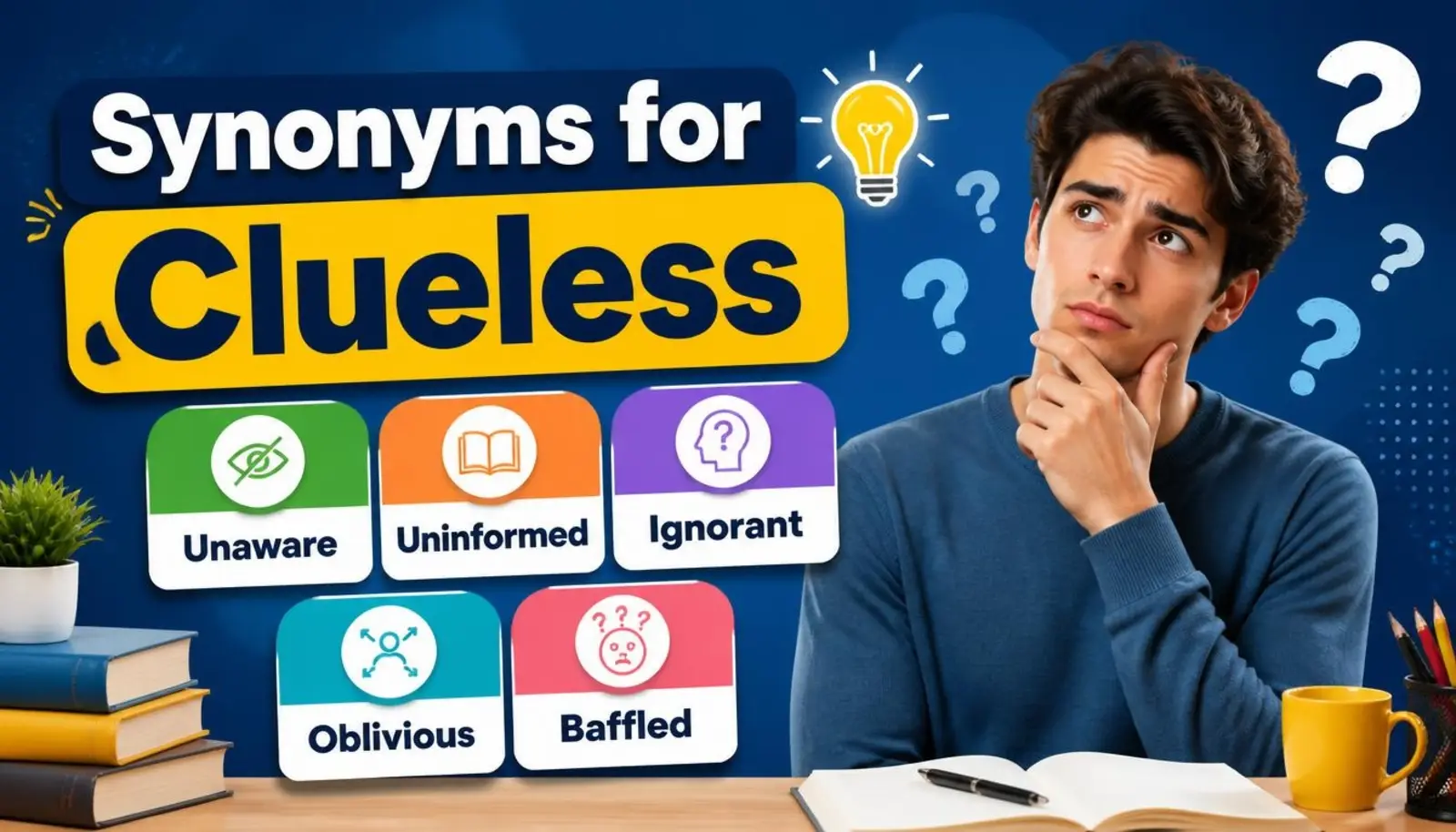
The word clueless describes someone who lacks knowledge, awareness, or understanding. Alternatives such as ignorant, unaware, uninformed, and oblivious express different aspects of this meaning. Learning these words helps you communicate clearly in everyday conversations and writing.
Quick Answer
Some useful synonyms and alternatives for clueless include:
Lack of knowledge:
- Ignorant: Having little or no knowledge about something.
- Uninformed: Lacking important facts or information.
- Ill-informed: Having incomplete or incorrect information.
- Unversed: Having limited knowledge of a subject.
Lack of awareness:
- Unaware: Not knowing that something exists or is happening.
- Oblivious: Not noticing or realizing what is happening.
Difficulty understanding:
- Confused: Having trouble understanding something.
- Baffled: Completely puzzled by something.
- Perplexed: Feeling confused or uncertain.
- Bewildered: Extremely confused by a situation.
Lack of experience:
- Naive: Lacking experience or good judgment.
- Inexperienced: Having little practical experience.
For everyday conversations, unaware, uninformed, and confused are useful alternatives. Choose the word that best describes whether someone lacks knowledge, misses important information, or struggles to understand something.
Definition and Meaning of Clueless
The word clueless is an informal adjective that describes someone who has little or no knowledge, information, or understanding about something.
It can also describe someone who does not understand what is happening or what they should do.
Examples:
- I’m completely clueless about fixing computers.
- He seemed clueless during the meeting.
- She was clueless about the surprise party.
The word often suggests a lack of knowledge or awareness. Depending on the situation, it can also sound critical or insulting.
Table of Synonyms for Clueless
| Word | Category | Simple Meaning |
| Ignorant | Close synonym | Lacking knowledge |
| Unaware | Close synonym | Not knowing something |
| Uninformed | Close synonym | Lacking important information |
| Oblivious | Context-dependent alternative | Not noticing something |
| Ill-informed | Close synonym | Having incomplete or incorrect information |
| Unversed | Context-dependent alternative | Lacking knowledge of a subject |
| Unfamiliar | Context-dependent alternative | Not knowing something well |
| Uninitiated | Context-dependent alternative | Lacking introductory knowledge |
| Unschooled | Related term | Lacking education or training |
| Naive | Context-dependent alternative | Lacking experience or judgment |
| Inexperienced | Context-dependent alternative | Lacking practical experience |
| Confused | Context-dependent alternative | Having difficulty understanding |
| Baffled | Context-dependent alternative | Completely puzzled |
| Perplexed | Context-dependent alternative | Confused or uncertain |
| Bewildered | Context-dependent alternative | Extremely confused |
| Puzzled | Context-dependent alternative | Unsure about something |
| Mystified | Context-dependent alternative | Unable to understand something |
| Stumped | Informal expression | Unable to solve a problem |
| At a loss | Idiom or phrase | Unsure what to do or say |
| At sea | Idiom or phrase | Completely confused |
| In the dark | Idiom or phrase | Lacking important information |
| Without a clue | Informal expression | Having no idea about something |
Main Synonyms and Related Terms for Clueless
Ignorant
Meaning: Having little or no knowledge about a particular subject or situation.
Category: Close synonym.
Examples:
- I was ignorant of the new company rules.
- He is not ignorant; he just needs more information.
Unaware
Meaning: Not knowing that something exists or is happening.
Category: Close synonym.
Examples:
- She was unaware of the schedule change.
- I was unaware that the store had closed.
Uninformed
Meaning: Lacking the facts or information needed to understand something.
Category: Close synonym.
Examples:
- Many people are uninformed about the new policy.
- He made an uninformed decision without checking the facts.
Oblivious
Meaning: Not noticing or realizing what is happening around you.
Category: Context-dependent alternative.
Examples:
- She was oblivious to the noise outside.
- He seemed oblivious to everyone’s concerns.
Ill-Informed
Meaning: Having incomplete, incorrect, or insufficient information about something.
Category: Close synonym.
Examples:
- His opinion was based on ill-informed assumptions.
- An ill-informed buyer may overlook important details.
Read More: Synonyms for Check: Words, Meanings, and Examples
Unversed
Meaning: Not having much knowledge or experience in a particular subject. This word is less common and has a somewhat formal tone.
Category: Context-dependent alternative.
Examples:
- She is unversed in financial matters.
- I am unversed in the rules of tennis.
Unfamiliar
Meaning: Not knowing or understanding something because you have not experienced or learned about it.
Category: Context-dependent alternative.
Examples:
- I am unfamiliar with this computer program.
- The new students were unfamiliar with the school rules.
Uninitiated
Meaning: Not having the knowledge or experience needed to understand a particular subject or activity.
Category: Context-dependent alternative.
Examples:
- The instructions may confuse the uninitiated.
- The game can seem difficult to the uninitiated.
Unschooled
Meaning: Having little formal education or training in a particular subject.
Category: Related term.
Examples:
- He was unschooled in modern technology.
- She felt unschooled in the basics of business.
Naive
Meaning: Lacking experience or judgment and therefore not understanding how a situation works.
Category: Context-dependent alternative.
Examples:
- I was naive about how business deals worked.
- Her naive expectations led to disappointment.
Read More: Synonyms for Needy: Meanings, Examples, and Usage
Inexperienced
Meaning: Lacking the practical knowledge or skills gained through experience.
Category: Context-dependent alternative.
Examples:
- The inexperienced worker needed extra guidance.
- I was inexperienced with this type of software.
Confused
Meaning: Having difficulty understanding something or knowing what to do.
Category: Context-dependent alternative.
Examples:
- I was confused by the complicated instructions.
- She looked confused during the lesson.
Baffled
Meaning: Completely unable to understand or explain something.
Category: Context-dependent alternative.
Examples:
- The strange message left me baffled.
- He was baffled by the difficult question.
Perplexed
Meaning: Feeling confused or uncertain because something is difficult to understand.
Category: Context-dependent alternative.
Examples:
- She looked perplexed by the unexpected result.
- I was perplexed by his unusual response.
Bewildered
Meaning: Extremely confused because a situation is difficult to understand.
Category: Context-dependent alternative.
Examples:
- The sudden changes left everyone bewildered.
- He looked bewildered when the instructions changed.
Read More: Synonyms for Influencer: 30 Words, Meanings, and Examples
Puzzled
Meaning: Unsure or confused because something is unclear or surprising.
Category: Context-dependent alternative.
Examples:
- I was puzzled by her strange question.
- The teacher looked puzzled by the answer.
Mystified
Meaning: Completely unable to understand something mysterious or confusing.
Category: Context-dependent alternative.
Examples:
- We were mystified by the strange noise.
- She remained mystified by his sudden decision.
Stumped
Meaning: Unable to answer a question or solve a problem.
Category: Informal expression.
Examples:
- The difficult puzzle left me stumped.
- I was stumped by the final exam question.
At a Loss
Meaning: Unsure what to do, say, or think in a particular situation.
Category: Idiom or phrase.
Examples:
- I was at a loss for words.
- She was at a loss about how to respond.
At Sea
Meaning: Feeling completely confused or uncertain about something.
Category: Idiom or phrase.
Examples:
- I was completely at sea during the lecture.
- He felt at sea when using the new software.
In the Dark
Meaning: Having little or no information about something.
Category: Idiom or phrase.
Examples:
- We were kept in the dark about the changes.
- I was in the dark about their plans.
Read More: Synonyms for Keen: Words, Meanings, and Examples
Without a Clue
Meaning: Having no idea or knowledge about something.
Category: Informal expression.
Examples:
- I didn’t have a clue how to fix it.
- He had no clue what the teacher meant.
Clueless vs. Similar Words: Context and Usage Comparison
Not every alternative for clueless has the same meaning. Some describe a lack of knowledge, while others describe confusion or a lack of experience. Choosing the right word makes your writing more accurate.
Clueless vs. Ignorant
Clueless is an informal word for having little knowledge or understanding. Ignorant also describes a lack of knowledge, but it can sound more critical.
- Clueless: I’m clueless about computer programming.
- Ignorant: I’m ignorant of the basic rules of programming.
Use clueless in casual conversations and ignorant when you want to emphasize a lack of knowledge.
Clueless vs. Unaware
Clueless can describe someone who does not understand a situation. Unaware specifically means not knowing that something exists or is happening.
- Clueless: He was clueless about what to do next.
- Unaware: He was unaware that the meeting had started.
Use unaware when someone simply does not know about something.
Clueless vs. Uninformed
Clueless is a broad, informal word for having little knowledge or understanding. Uninformed specifically describes someone who lacks important facts or information.
- Clueless: I was clueless about the new company policy.
- Uninformed: I was uninformed about the changes to the company policy.
Use uninformed when someone needs more facts or information to understand a subject.
Clueless vs. Oblivious
Oblivious describes someone who fails to notice something happening around them. Clueless is broader and can describe a lack of knowledge or understanding.
- Clueless: She was clueless about the new rules.
- Oblivious: She was oblivious to the warning signs.
Confused vs. Clueless
Clueless suggests having little knowledge or no idea about something. Confused describes someone who has difficulty making sense of information or a situation.
- Clueless: I am clueless about how this machine works.
- Confused: I am confused by the machine’s instructions.
Clueless vs. Naive
Naive describes someone who lacks experience or judgment. Clueless focuses more on a lack of knowledge or understanding.
- Clueless: He was clueless about the company’s rules.
- Naive: He was naive about how business negotiations worked.
Choosing the Right Alternative
| Situation | Best Alternative |
| Lacking knowledge | Ignorant |
| Not knowing something happened | Unaware |
| Not noticing what is happening | Oblivious |
| Lacking information | Uninformed |
| Having difficulty understanding | Confused |
| Completely puzzled | Baffled |
| Lacking practical experience | Inexperienced |
| Having no idea what to do | At a loss |
| Knowing very little about a subject | Unversed |
Common usage mistake: Do not use unschooled as a direct replacement for clueless in every sentence. Someone can have a high level of education and still be clueless about a particular subject. Similarly, naive describes limited experience or judgment, not simply a lack of information.
Short Answer: What Is Another Word for Clueless?
Some of the best alternatives for clueless are ignorant, unaware, uninformed, oblivious, and confused. If someone cannot understand a situation, baffled, perplexed, or bewildered may be more suitable.
The best choice depends on the meaning you want to express. Use unaware for a lack of awareness, ignorant for limited knowledge, and confused for difficulty understanding something.
Frequently Asked Questions
What is the closest synonym for clueless?
Uninformed and ignorant are two close synonyms for clueless. Both describe someone who lacks knowledge or information about something.
What is a polite word for clueless?
Unaware, uninformed, and unfamiliar are often more polite alternatives. They describe a lack of knowledge without sounding as harsh or judgmental as ignorant.
What is a professional way to say clueless?
In professional writing, use words such as uninformed, unfamiliar, or unaware. For example, instead of saying someone is clueless about a project, say they are unfamiliar with its requirements.
What is the difference between clueless and confused?
Clueless usually describes someone who lacks knowledge or understanding about something. Confused describes someone who has difficulty making sense of information or a situation.
Can clueless and ignorant be used interchangeably?
Sometimes. Both words can describe a lack of knowledge, but ignorant can sound more critical. Clueless is generally more informal and conversational.
Conclusion
Learning different words for clueless helps you express a lack of knowledge, awareness, or understanding more accurately. Alternatives such as unaware, uninformed, ignorant, and oblivious work in different situations, while confused and baffled describe difficulty understanding something. Practice using these words in emails, essays, blog posts, captions, and everyday conversations. Choosing the right alternative will make your vocabulary stronger and your communication clearer.

Rafaqat Ali is the founder of RankVorexa, a vocabulary-focused website dedicated to synonyms, word meanings, and better English word choices. He creates simple, useful, and easy-to-understand content to help students, writers, bloggers, and English learners improve their vocabulary and writing skills.