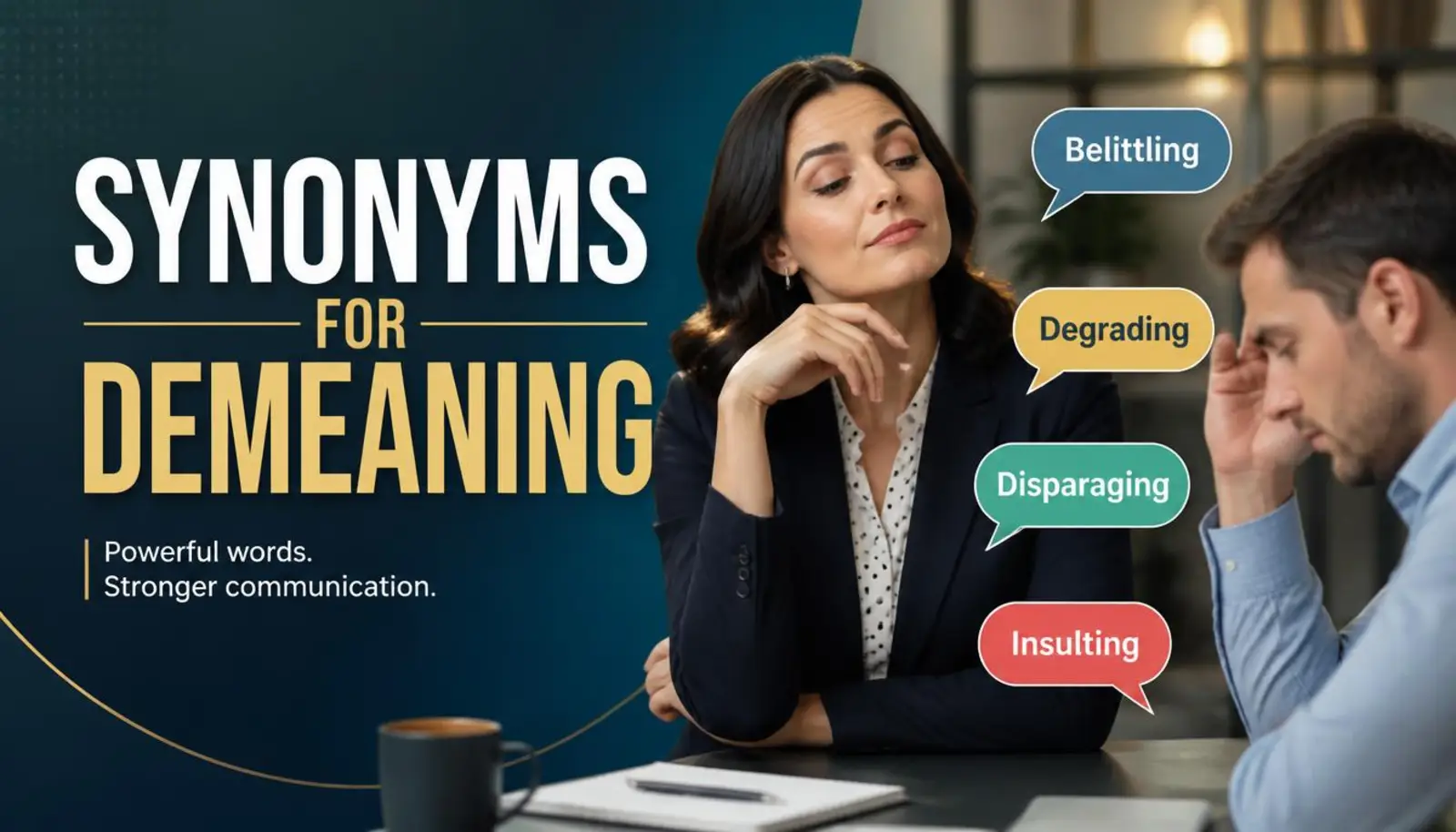
Have you ever heard a comment that made someone feel small or unimportant? Demeaning describes words or behavior that lower someone’s dignity, worth, or importance.
Common alternatives include degrading, belittling, disparaging, derogatory, humiliating, and insulting. Other words describe specific forms of demeaning behavior, such as condescending, patronizing, mocking, and scornful.
Quick Answer
The closest synonyms for demeaning include degrading, belittling, disparaging, derogatory, denigrating, humiliating, insulting, and devaluing.
Words such as condescending, patronizing, contemptuous, scornful, disdainful, derisive, and slighting describe particular forms of demeaning behavior.
Other terms, including mocking, ridiculing, sneering, taunting, shaming, dismissive, dehumanizing, offensive, and abusive, are related but are not exact synonyms in every context.
Table of Synonyms
| Word | Category |
| Degrading | Very close synonym |
| Belittling | Very close synonym |
| Disparaging | Very close synonym |
| Derogatory | Very close synonym |
| Denigrating | Very close synonym |
| Humiliating | Close synonym |
| Insulting | Close synonym |
| Devaluing | Close synonym |
| Slighting | Close synonym |
| Disrespectful | Close alternative |
| Condescending | Contextual alternative |
| Patronizing | Contextual alternative |
| Contemptuous | Contextual alternative |
| Scornful | Contextual alternative |
| Disdainful | Contextual alternative |
| Derisive | Contextual alternative |
| Dismissive | Related alternative |
| Mocking | Contextual alternative |
| Ridiculing | Contextual alternative |
| Sneering | Contextual alternative |
| Taunting | Contextual alternative |
| Shaming | Contextual alternative |
| Dehumanizing | Strong related term |
| Offensive | Related term |
| Abusive | Strong related term |
| Pejorative | Related term |
| Denigratory | Related term |
| Deprecatory | Contextual alternative |
| Vituperative | Strong related term |
| Insolent | Related term |
What Does Demeaning Mean?
Demeaning means making someone feel less important, respected, worthy, or capable.
It can describe words, actions, attitudes, jokes, or treatment that lower another person’s dignity.
For example:
- The manager made a demeaning comment about his employee’s abilities.
- She found the joke demeaning and disrespectful.
Demeaning vs. Insulting
Demeaning focuses on lowering someone’s dignity, value, or sense of worth. Insulting is broader and can include any disrespectful or offensive remark.
Demeaning vs. Belittling
Belittling means making someone or something seem less important, capable, or valuable. It is one of the closest alternatives to demeaning.
Demeaning vs. Humiliating
Humiliating focuses more strongly on causing shame or embarrassment. Something can be demeaning without causing obvious humiliation.
Degrading
Degrading means lowering someone’s dignity, worth, or status.
- The worker complained about the degrading treatment.
- His degrading remarks made everyone uncomfortable.
Belittling
Belittling means making someone seem less important, capable, or valuable.
- She was tired of his belittling comments.
- The coach stopped making belittling remarks about the players.
Disparaging
Disparaging means speaking about someone or something as though it has little value or merit.
- He made disparaging comments about her work.
- The article contained several disparaging remarks about the company.
Derogatory
Derogatory means expressing an insulting or disrespectful opinion about someone or something.
- The employee objected to the derogatory comment.
- The teacher asked students to avoid derogatory language.
Denigrating
Denigrating means unfairly describing someone or something as less valuable or worthy.
- She criticized his denigrating remarks.
- The speech included denigrating comments about other workers.
Humiliating
Humiliating means causing someone to feel ashamed, embarrassed, or stripped of dignity.
- Being laughed at in front of the class was humiliating.
- He described the experience as deeply humiliating.
Read More: Synonyms for Funds: 30 Useful Words and Financial Alternatives
Insulting
Insulting means showing disrespect or saying something offensive about another person.
- His insulting comment upset his colleague.
- She found the question insulting.
Devaluing
Devaluing means treating someone or something as less valuable or important.
- His comments devalued her years of hard work.
- The policy was criticized for devaluing the work of caregivers.
Slighting
Slighting means treating someone as unimportant or failing to give them proper respect or attention.
- She felt slighted by his dismissive response.
- His slighting remarks offended the new employee.
Disrespectful
Disrespectful means showing a lack of respect toward someone or something.
- His disrespectful tone upset the customer.
- The student apologized for his disrespectful behavior.
Condescending
Condescending describes behavior that suggests someone thinks they are more intelligent, important, or capable than another person.
- Her condescending tone annoyed the entire team.
- He gave me a condescending explanation.
Patronizing
Patronizing means treating someone as though they are less intelligent, capable, or mature.
- I disliked his patronizing attitude.
- Her patronizing comments made the new employee uncomfortable.
Read More: Synonyms for Melody: 30 Words with Meaning and Example
Contemptuous
Contemptuous means showing that you consider someone or something beneath respect.
- He gave the waiter a contemptuous look.
- Her contemptuous response ended the conversation.
Scornful
Scornful means showing strong disrespect, ridicule, or lack of approval.
- He gave a scornful laugh.
- Her scornful remarks hurt his feelings.
Disdainful
Disdainful means showing that you believe someone or something is unworthy of respect.
- She gave him a disdainful glance.
- His disdainful attitude made cooperation difficult.
Derisive
Derisive means expressing ridicule or mockery toward someone or something.
- The audience reacted to his derisive comments.
- She used a derisive tone when discussing his idea.
Dismissive
Dismissive means treating someone, their feelings, or their ideas as unimportant.
- His dismissive response made her feel ignored.
- The manager was dismissive of their concerns.
Usage note: Dismissive is related to demeaning, but it does not always imply an intention to lower someone’s dignity.
Mocking
Mocking means making fun of someone in a way that can be insulting or disrespectful.
- His mocking tone made the conversation uncomfortable.
- She ignored the mocking comments from her classmates.
Read More: Synonyms for Facility: 30 Words With Meaning and Examples
Ridiculing
Ridiculing means making someone or something seem foolish through mockery.
- They were ridiculing his accent.
- The comedian was criticized for ridiculing the guest.
Sneering
Sneering means expressing disrespect or contempt through a mocking attitude or expression.
- He responded with a sneering smile.
- Her sneering comments made the situation worse.
Taunting
Taunting means deliberately provoking someone with insulting or mocking remarks.
- The players were warned against taunting their opponents.
- He kept taunting his brother during the game.
Shaming
Shaming means making someone feel ashamed or embarrassed because of their actions, choices, or identity.
- The campaign focused on helping people without shaming them.
- She criticized the practice of shaming employees for mistakes.
Dehumanizing
Dehumanizing means treating people as though they are less than fully human.
- The prisoners described the conditions as dehumanizing.
- The activist spoke against dehumanizing language.
Usage note: Dehumanizing is much stronger than demeaning because it involves denying or reducing a person’s humanity.
Read More: Synonyms for Reincarnation: 30 Words and Related Terms
Offensive
Offensive means causing anger, hurt, or upset because something is disrespectful, insulting, or inappropriate.
- The remark was offensive to many people.
- He apologized for his offensive joke.
Usage note: Offensive is broader than demeaning. Something can be offensive without specifically lowering someone’s sense of worth.
Abusive
Abusive means using cruel, harmful, or insulting behavior or language toward someone.
- The employee reported abusive treatment.
- Abusive language can seriously damage a relationship.
Usage note: Abusive is stronger than demeaning and can refer to repeated harmful behavior, not just insulting language.
Pejorative
Pejorative means expressing a negative, disapproving, or disparaging meaning.
- The term has a strongly pejorative meaning.
- She avoided using pejorative language in the report.
Usage note: Pejorative is especially common in discussions of language, labels, and word meanings.
Denigratory
Denigratory means expressing criticism that lowers the value, reputation, or importance of someone or something.
- The article contained denigratory comments about the organization.
- He objected to the speaker’s denigratory language.
Usage note: Denigratory is valid but less common in everyday speech than disparaging or derogatory.
Deprecatory
Deprecatory describes language that expresses disapproval or belittling criticism.
- His deprecatory comments were unnecessary.
- She made a deprecatory remark about the proposal.
Usage note: Deprecatory is relatively formal. Do not confuse it with deprecating, which is also common in phrases such as self-deprecating humor.
Vituperative
Vituperative describes language that is bitter, abusive, and strongly insulting.
- The debate became increasingly vituperative.
- His vituperative response surprised everyone.
Usage note: Vituperative is a strong and formal word. It describes harsh verbal attacks rather than ordinary demeaning behavior.
Read More: Synonyms for Strengths: 30 Strong Alternatives for Better Writing
Insolent
Insolent means rude and disrespectful, especially toward someone who has authority.
- The supervisor objected to his insolent reply.
- The student was disciplined for his insolent behavior.
Usage note: Insolent is related to demeaning but is more specifically about openly rude or disrespectful behavior.
Common Questions About Demeaning Synonyms
What is the closest synonym for demeaning?
Belittling, degrading, disparaging, denigrating, and devaluing are among the closest alternatives, depending on the sentence.
Is belittling the same as demeaning?
They are very close. Both describe language or behavior that makes someone seem less important, capable, or valuable.
Is degrading stronger than demeaning?
Often, yes. Degrading can suggest a more serious lowering of dignity or status, especially when describing treatment or conditions.
Is insulting a synonym for demeaning?
Insulting can be a synonym in some contexts, but it is broader. An insult does not always specifically make someone seem less valuable or important.
What is a formal synonym for demeaning?
Derogatory, denigrating, denigratory, and pejorative can work in more formal or analytical contexts.
What is a word for making someone feel small?
Belittling is one of the most natural words for making someone feel less important, capable, or valuable.
What is the difference between condescending and demeaning?
Condescending describes an attitude of superiority toward another person. Demeaning focuses more directly on lowering someone’s dignity, value, or importance.
Can demeaning describe behavior?
Yes. Demeaning can describe comments, attitudes, treatment, jokes, gestures, or other behavior that lowers someone’s dignity or sense of worth.
Conclusion
The best synonym for demeaning depends on exactly what you want to express. Belittling, degrading, disparaging, denigrating, derogatory, and devaluing are among the closest choices. Words such as condescending, patronizing, mocking, dismissive, and scornful describe more specific forms of disrespectful behavior. Stronger terms such as dehumanizing and abusive should be used carefully because they carry more serious meanings. Choosing the right word makes your writing clearer, more precise, and more natural.

Rafaqat Ali is the founder of RankVorexa, a vocabulary-focused website dedicated to synonyms, word meanings, and better English word choices. He creates simple, useful, and easy-to-understand content to help students, writers, bloggers, and English learners improve their vocabulary and writing skills.