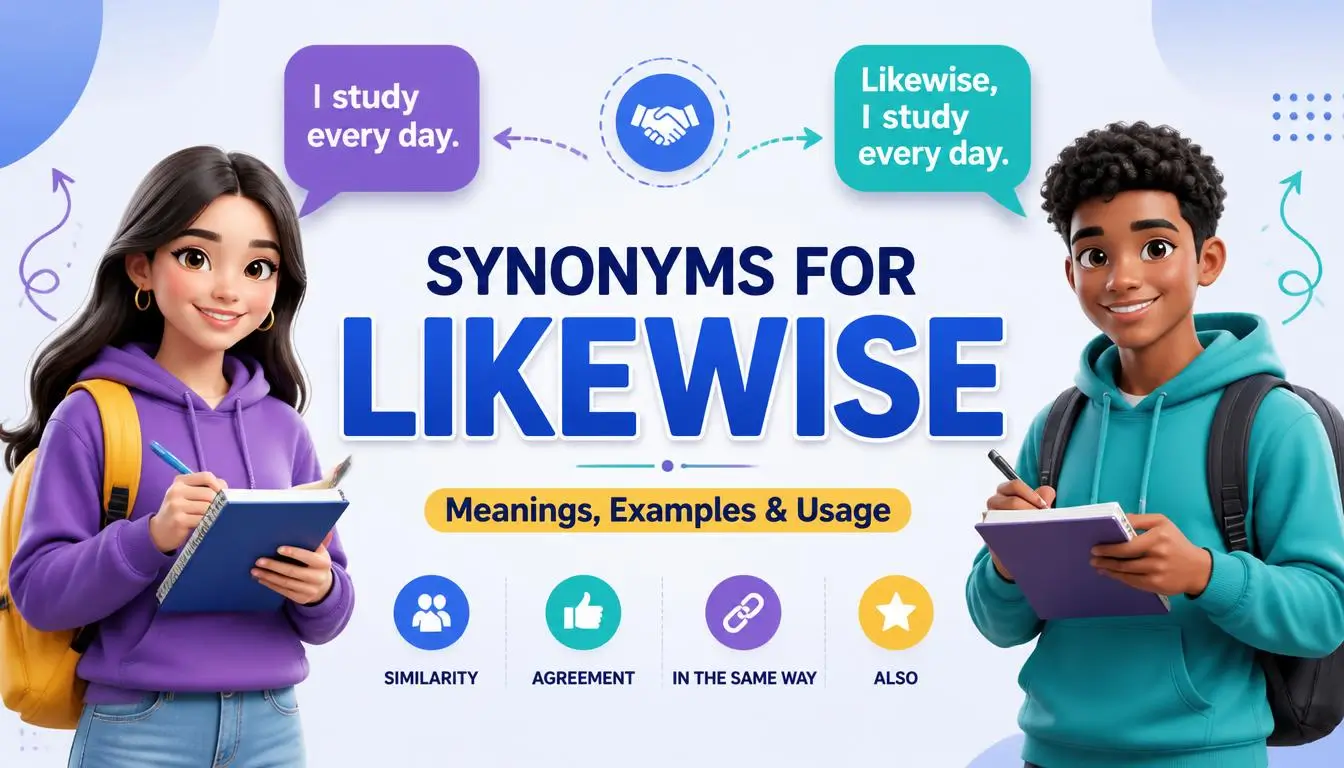
The word likewise can mean “similarly” or “also,” depending on the context. Alternatives like too and in the same way help you express shared actions or add related information.
Understanding these differences helps you choose the right words for clear, natural English.
Quick Answer
The best alternative to likewise depends on the meaning you want to express.
- Similarly: To show that two situations or actions are alike.
- In the same way: To describe a similar method or action.
- Also: To add another fact or action.
- Too: To add information, often in everyday conversation.
- As well: Another natural way to say “also.”
- Equally: To show the same degree or extent.
- Furthermore: To add a point that supports an earlier idea.
- By the same token: To introduce a related point based on similar reasoning.
When someone says, “It was a pleasure meeting you,” you can reply, “Likewise.” In this context, it means that meeting the other person was a pleasure for you, too.
Definition and Meaning of Likewise
Likewise is an adverb that commonly means in a similar way or also. It can describe a similar action, introduce a related point, or express a shared feeling.
It has three common uses:
- Similarity: “She helped her neighbor, and he did likewise.” Here, did likewise means that he helped his neighbor, too.
- A related point: “The first school offers small classes. Likewise, the second school gives students individual attention.” Here, likewise connects two similar features.
- A shared feeling or response: “It was a pleasure meeting you.” “Likewise.” Here, the speaker means that the pleasure was mutual.
These uses overlap, but they are not identical. Before choosing an alternative, consider whether you want to compare actions, add information, or respond to another person.
Table of Synonyms and Alternatives for Likewise
| Word or phrase | Category | Simple meaning |
| Similarly | Near-exact synonym | In a similar way |
| In the same way | Near-exact synonym | Using a similar method |
| In a similar manner | Close synonym | In a way that is alike |
| Also | Context-dependent alternative | In addition |
| Too | Context-dependent alternative | Also; in addition |
| As well | Context-dependent alternative | Also; in addition |
| Equally | Context-dependent alternative | To the same degree |
| In addition | Additive expression | Adding another point |
| Additionally | Additive expression | Adding more information |
| Furthermore | Additive transition | Adding a supporting point |
| Moreover | Additive transition | Adding a related or supporting point |
| By the same token | Related phrase | Based on similar reasoning |
| In like manner | Formal alternative | In the same way |
| Same here | Informal related expression | I feel or think the same way |
Note: These expressions are not interchangeable in every sentence. Similarly and in the same way emphasize likeness. Also, too, and as well add information. Furthermore and moreover introduce additional points, while the same here is mainly a conversational response.
Detailed Synonyms and Examples
Similarly
Meaning: In a way that is like something else.
Category: Near-exact synonym when comparing actions, situations, or ideas.
Examples:
- Mia enjoys reading. Similarly, her brother loves books.
- The first team performed well, and the second team performed similarly.
In the Same Way
Meaning: Using a method or approach that is like another one.
Category: Near-exact synonym when describing similar actions or methods.
Examples:
- I helped my sister, and I will help my brother in the same way.
- Treat new customers in the same way you treat regular ones.
In a Similar Manner
Meaning: Doing something in a way that resembles another action.
Category: Close synonym; somewhat formal.
Examples:
- Both teachers explained the lesson in a similar manner.
- The two artists used color in a similar manner.
Also
Meaning: In addition to something already mentioned.
Category: Context-dependent alternative; primarily used to add information.
Examples:
- Maya enjoys reading. Her brother also enjoys reading.
- We also need some fresh fruit.
Read More: Synonyms for Mock: Meanings, Examples, and Usage
Too
Meaning: In addition; commonly used in everyday speech and writing.
Category: Context-dependent alternative.
Examples:
- Maya enjoys reading, too.
- My cousin likes playing soccer, too.
As Well
Meaning: In addition to someone or something else.
Category: Context-dependent alternative.
Examples:
- Maya enjoys reading as well.
- Daniel speaks Spanish and French as well.
Equally
Meaning: To the same degree or extent.
Category: Context-dependent alternative; useful when comparing levels or importance.
Examples:
- Both candidates are equally qualified for the job.
- I care equally about honesty and kindness.
Read More: Synonyms for Greatness: Meanings, Alternatives, and Examples
In Addition
Meaning: Used to introduce another fact, idea, or item.
Category: Additive expression.
Examples:
- The hotel offers free breakfast. In addition, it has a swimming pool.
- In addition to math, Leo studies science every day.
Additionally
Meaning: Used to add another piece of information.
Category: Additive expression; common in formal and professional writing.
Examples:
- The course teaches grammar. Additionally, it helps students build vocabulary.
- Additionally, all visitors must sign in at the front desk.
Furthermore
Meaning: Used to introduce another point that supports or develops an earlier idea.
Category: Additive transition; often formal.
Examples:
- The plan is affordable. Furthermore, it is easy to follow.
- Furthermore, the new library will give students more space to study.
Moreover
Meaning: Used to add information that strengthens or supports a previous statement.
Category: Additive transition; often formal.
Examples:
- The phone is affordable. Moreover, its battery lasts all day.
- Moreover, the school offers free tutoring after class.
Read More: Synonyms for Facade: Alternatives, Meanings, and Examples
By the Same Token
Meaning: Used to introduce a related point based on similar reasoning or a shared principle.
Category: Related phrase; context-dependent.
Examples:
- Parents should listen to their children. By the same token, children should listen to their parents.
- If customers deserve respect, by the same token, employees deserve respect, too.
This phrase is especially useful when you want to apply the same principle to another person or situation. It is not a universal replacement for likewise.
In Like Manner
Meaning: In the same or a similar way.
Category: Formal alternative.
Examples:
- All applications must be reviewed in a similar manner.
- The second team completed the task in a similar manner.
This phrase is formal and less common in everyday American English than in the same way. Use the simpler phrase in most everyday writing.
Same Here
Meaning: An informal way to say that you share someone’s feeling, opinion, or experience.
Category: Informal related expression; mainly used in conversation.
Examples:
- “I’m ready for the weekend.” “Same here!”
- “I love this song.” “Same here!”
Same here works when you want to show that you feel or think the same way as another person. It cannot replace likewise in most formal sentences or descriptions of similar actions.
Read More: Synonyms for Fulfilling: 10 Alternatives, Meanings, and Examples
Context and Usage Comparison
The best alternative depends on whether you want to compare actions, add information, describe equal degrees, or respond to someone.
Likewise vs. Similarly
Both words can connect similar actions or situations. Similarly focuses on likeness, while likewise can also mean “also” or express a matching response.
- Likewise: Emma supported the plan, and Noah did likewise.
- Similarly: Emma supported the plan. Similarly, Noah agreed with the proposal.
The first example uses likewise to refer back to Emma’s action. The second introduces a similar response.
Likewise vs. Also
Use also to add information. Use likewise when referring back to a similar action or introducing a related point.
- Also: Maya enjoys reading. Her brother also enjoys reading.
- Likewise: Maya enjoys reading, and her brother does likewise.
Both examples tell us that the brother enjoys reading. The first adds information with also, while the second uses likewise to refer back to the same action.
Likewise vs. Too vs. As Well
All three can express addition, but too and as well often appear at the end of a sentence. Likewise commonly refers back to an action or connects similar points.
- Too: Maya enjoys reading, too.
- As well: Maya enjoys reading as well.
- Likewise: Maya enjoys reading, and her brother does likewise.
The first two sentences add information about Maya. The third highlights a similar action by her brother.
Likewise vs. Equally
Equally emphasizes the same degree or level. Likewise usually expresses similarity or addition.
- Equally: Both options are equally useful.
- Likewise: I chose the first option, and my friend did likewise.
Use equally when the degree or extent matters. Use likewise when you mean that someone does something similar or that another point is comparable.
Likewise vs. Furthermore vs. Moreover
These expressions can connect ideas, but they have different purposes.
- Likewise: Shows similarity or introduces a related point.
- Furthermore: Adds a point that supports or develops an argument.
- Moreover: Adds information that strengthens a previous statement.
For example, “The plan is affordable. Furthermore, it saves time” adds another reason to support the plan. “The first team succeeded, and the second team did likewise” highlights a similar result.
Furthermore and moreover can work as transitions, but they are not direct replacements for likewise in every context.
Likewise as a Conversation Response
When someone says, “It was a pleasure meeting you,” you can reply, “Likewise.” This means that meeting the other person was a pleasure for you, too.
Other responses fit different situations:
- “Have a great weekend!” — “You too!”
- “I’m excited about the trip.” — “Same here!”
- “It was a pleasure working with you.” — “Likewise!”
These responses are related, but they are not interchangeable in every situation. Choose the one that matches the other person’s words and your intended meaning.
Frequently Asked Questions
What is the closest synonym for likewise?
Similarly is one of the closest alternatives when describing similar actions or situations. In the same way it is also useful when explaining how something is done.
What word can replace likewise in a sentence?
You can often use it similarly, also, too, or in the same way. The best replacement depends on whether you are comparing situations, adding information, or describing a similar action.
What is the difference between likewise and similarly?
Both words express similarity. Likewise can also mean “also” or serve as a conversational response, while similarly mainly emphasizes likeness between things.
Is it formal or informal?
Likewise works in both formal writing and everyday conversation. It can connect related ideas or serve as a short response when someone expresses a feeling or offers a greeting.
Can likewise and also always be used interchangeably?
No. Also usually adds information, while likewise often emphasizes a similar action or situation. For example, “She enjoys music, and her brother does likewise” means that her brother enjoys music, too.
Conclusion
Choosing the right alternative to likewise helps you express ideas clearly and avoid repetition. Similarly and in the same way emphasize likeness, while also, too, and as well add information. Equally highlights the same degree, and furthermore and moreover introduces supporting points. Check the meaning and context before replacing one expression with another, and your writing will sound more natural, precise, and confident.

Rafaqat Ali is the founder of RankVorexa, a vocabulary-focused website dedicated to synonyms, word meanings, and better English word choices. He creates simple, useful, and easy-to-understand content to help students, writers, bloggers, and English learners improve their vocabulary and writing skills.